The Abbasid revolution overthrew the Umayyad Caliphate in 747–750, and it began in Iran. Its leader in the field was Abu Muslim, a man of obscure, probably Iranian origin, who raised the black banners of the movement near Merv in Khorasan in June 747 and led the army that swept west and brought the Abbasid family to power in Iraq.
| Uprising | Black banners raised near Merv, 9 June 747 (25 Ramadan AH 129) |
|---|---|
| Leader in Khorasan | Abu Muslim al-Khorasani (died 755) |
| Military commander | Qahtaba ibn Shabib |
| First Abbasid caliph | Abu al-Abbas al-Saffah, proclaimed at Kufa in late 749 |
| Decisive battle | The Great Zab, January 750; the last Umayyad caliph, Marwan II, killed in Egypt that summer |
| Persian name | ابومسلم خراسانی (Abu Moslem-e Khorâsâni) |
The secret mission for the Prophet’s family
By the 740s many Muslims believed that the caliphate belonged by right to the family of the Prophet rather than to the Umayyads. One group, later called the Hashimiyya, worked in secret for a leader from that family whose name would be revealed only after victory. Its slogan, al-rida min Al Muhammad, “the one who is acceptable from the family of Muhammad”, was deliberately vague and attracted supporters of the descendants of Ali as well as others. The movement’s real leaders were the descendants of the Prophet’s uncle al-Abbas, who lived quietly at Humayma in what is now Jordan.
The organisers chose Khorasan as the place to rise. The province was far from Damascus, full of Arab settlers who resented Syrian domination and of Iranian converts angered by unequal taxes, as described on Iran under the Umayyads and the mawali and the Shu’ubiyya. Agents had been at work there for years.
Who was Abu Muslim
Little is certain about Abu Muslim’s early life. The sources give him different names and origins: some make him a freedman or client of Iranian background from the region of Isfahan or Kufa, while later Persian legend gave him a noble Iranian ancestry. The name Abu Muslim al-Khorasani was itself adopted for the mission. What is clear is that around 745 the Abbasid leader Ibrahim, called the Imam, sent him to Khorasan as his personal representative, and that he proved a brilliant organiser.

The black banners
- June 747 Abu Muslim raises the black banners at a village near Merv
- Early 748 Merv falls; the Umayyad governor Nasr ibn Sayyar flees west and dies later that year
- 748–749 Qahtaba ibn Shabib defeats Umayyad armies in Khorasan, at Gorgan and at Nahavand
- Summer 749 Qahtaba drowns crossing the Euphrates; his son al-Hasan takes Kufa
- Late 749 Abu al-Abbas al-Saffah proclaimed caliph in the mosque of Kufa
- January 750 Marwan II defeated on the Great Zab river in northern Iraq
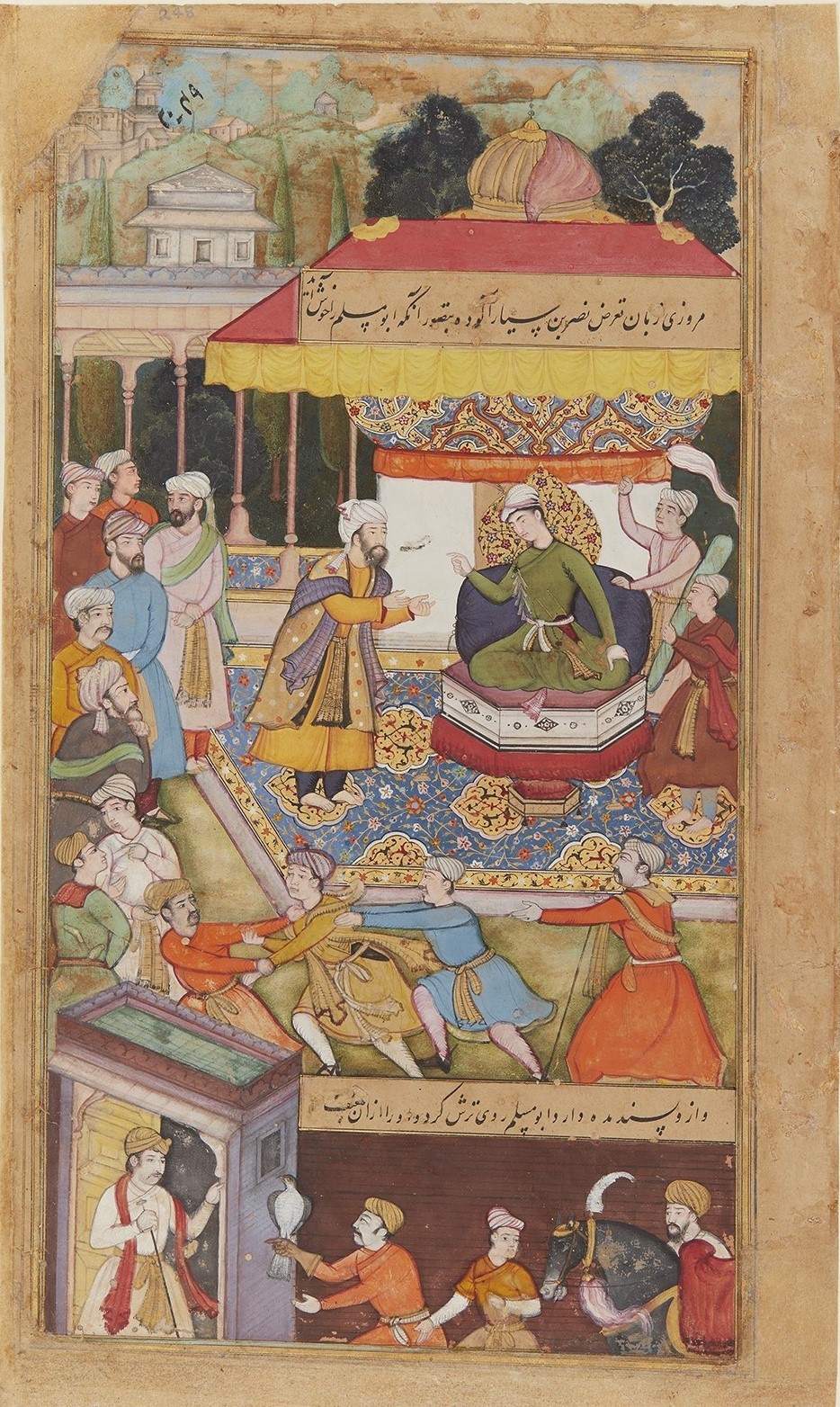
On 9 June 747, at a village in the Merv oasis, Abu Muslim’s followers raised black banners and wore black clothing, the colour that became the badge of the Abbasids. Supporters came in from the villages of the oasis. The Umayyad governor, Nasr ibn Sayyar, was trapped between the rebels and a feud between the Arab tribal factions, which Abu Muslim cleverly exploited. Merv fell early in 748. The army then marched west under Qahtaba ibn Shabib, an Arab commander, winning a string of battles across the Iranian plateau, including one at Nahavand, where the Arabs had defeated the Sasanians a century earlier.
When the army reached Iraq the leadership of the movement revealed its candidate. Ibrahim had been arrested and had died in Umayyad custody, so his brother Abu al-Abbas was proclaimed caliph at Kufa. The last Umayyad army was beaten on the Great Zab in January 750, and members of the Umayyad family were hunted down. One survivor, Abd al-Rahman, escaped to Spain.
A Persian revolution or a Muslim one
For a long time the revolution was seen as an Iranian revolt against Arab rule. Nineteenth-century scholars such as Gerlof van Vloten stressed the role of Iranian converts, and Iranian nationalist writing has often presented Abu Muslim as a hero who avenged the Sasanians. Arabic tradition also called his army “the people of Khorasan”, a phrase that could suggest a Persian army.
Modern research has complicated this picture. Studies of the names of the early revolutionaries, by historians such as Moshe Sharon and Saleh Said Agha, show that many of the leaders and a large part of the army were Arabs settled in Khorasan, and that Iranian converts were important but not the whole story. Elton Daniel and others see the revolution as a coalition of Khorasani Arabs and Iranians, with grievances about tax, status and distance from Syria, united by the religious appeal of the Prophet’s family. The new dynasty was still Arab, but it moved the centre of the caliphate east to Iraq and drew heavily on Persian officials and traditions.
Abu Muslim in power
Abu Muslim governed Khorasan for the new dynasty with great authority. He suppressed rivals and dissidents, among them the Zoroastrian reformer Behafarid, whose teaching the Zoroastrian priests themselves had denounced, as told on Zoroastrians after the Arab conquest. In 751 an army sent from his province defeated a Chinese Tang force at the river Talas in Central Asia. He also kept in contact with the Iranian princes of the Caspian, described on Tabaristan and the Dabuyids.
His power and popularity made the Abbasids uneasy. In 755 the caliph al-Mansur summoned him to his camp in Iraq and had him killed. His death set off a wave of revolts in Iran in his name, from Sunbadh in 755 to al-Muqanna in the 770s, told on the death of Abu Muslim and the Iranian revolts.
The legend of Abu Muslim
Abu Muslim lived on in popular memory far more vividly than in the chronicles. Some sects believed he had not died and would return. In later centuries the Persian Abu Moslem-nameh, a long popular romance, turned him into a champion of the Prophet’s family who fights the Umayyads in a series of adventures. Professional storytellers were still reciting these tales in the Safavid period. Historians treat them as evidence for his fame, not for his life.
Persian words from this page
| ابومسلم | Abu Moslem | Abu Muslim |
| عباسیان | Abbâsiyân | the Abbasids |
| سیاه جامگان | siyâh-jâmegân | “the black-clad”, Abu Muslim’s followers |
| پرچم | parcham | banner, flag |
| مرو | Marv | Merv |
| قیام | qiyâm | uprising |
Sources and further reading
- al-Tabari, The History of al-Tabari, vol. 27, The Abbasid Revolution, translated by John Alden Williams (SUNY Press).
- Elton L. Daniel, The Political and Social History of Khurasan under Abbasid Rule, 747–820 (1979).
- Moshe Sharon, Black Banners from the East (1983).
- Saleh Said Agha, The Revolution which Toppled the Umayyads: Neither Arab nor Abbasid (2003).
- Hugh Kennedy, The Early Abbasid Caliphate (1981).
- G. H. Yusofi, “Abu Moslem Korasani”, Encyclopaedia Iranica.
Want to learn Persian? Get the free Starter Pack
Get the 14-page printable Starter Pack (all 32 letters, a 7-day reading plan, 100 core words and 20 survival phrases) and a short 5-email course. Free.
More in The Arab Conquest and Early Islamic Iran (633–820 CE)
- Salman the Persian
- Why the Sasanian Empire Fell
- The Battle of the Bridge (634)
- The Battle of al-Qadisiyyah
- Rostam Farrokhzad
- The Fall of Ctesiphon
- The Battle of Jalula
- The Battle of Nahavand: “Victory of Victories”
- The Conquest of Fars, Khorasan and the East
- Peroz III and the Sasanian Exiles in China
- Iranian Resistance: Tabaristan and the Dabuyids
- Zoroastrians after the Arab Conquest
- Iran under the Umayyads
- The Mawali and the Shu’ubiyya Movement
- Abu Muslim and the Abbasid Revolution
- The Death of Abu Muslim and the Iranian Revolts
- The Barmakids: Persian Viziers of Baghdad
- Al-Ma’mun in Merv and the Civil War
- Tahir ibn Husayn
- Imam Reza and the Origins of Mashhad
- Babak Khorramdin’s Revolt
- Persian Influence on the Abbasid Caliphate
- The Birth of New Persian