The Sasanian Empire fell to the armies of the early Islamic caliphate between 633 and 651. Historians explain the collapse as several blows landing at once: a ruinous war with Byzantium that ended in 628, plague and floods in Mesopotamia, four years of civil war over the throne, and the sudden unity of Arabia under Islam. None of these is enough on its own, and how much weight each deserves is still argued.
| Period of conquest | 633–651 CE |
|---|---|
| Key battles | The Bridge (634), al-Qadisiyyah (c. 636), Ctesiphon (637), Jalula (637), Nahavand (642) |
| Last Sasanian king | Yazdegerd III, killed near Merv in 651 |
| Caliphs | Abu Bakr (632–634), Umar (634–644), Uthman (644–656) |
| Main written sources | Arabic chronicles of the 9th and 10th centuries, above all al-Tabari and al-Baladhuri |
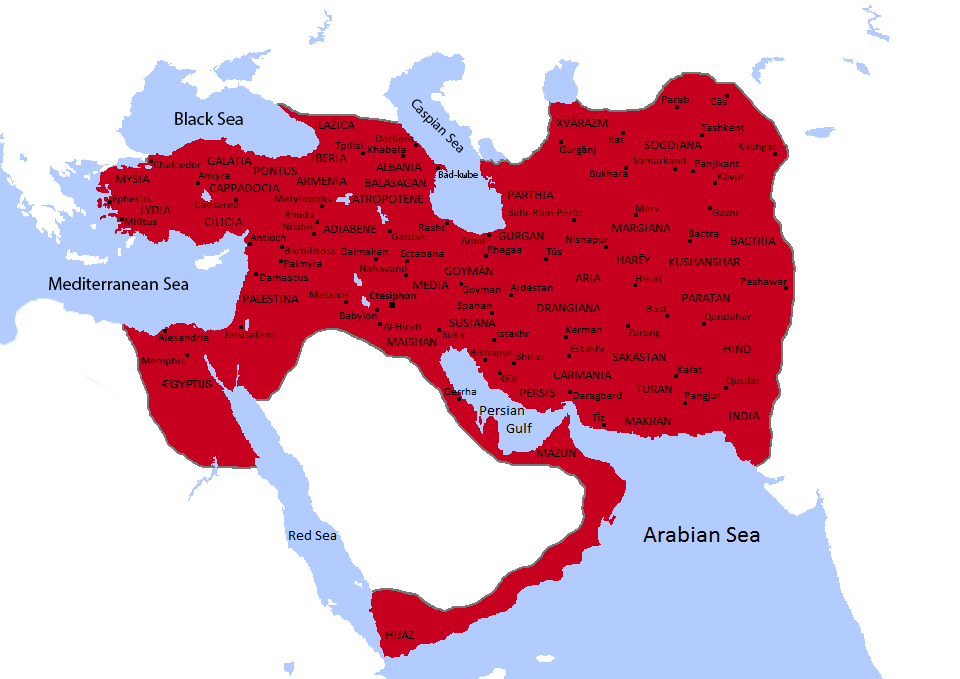

A victory that emptied the treasury
Twenty years before the Arab armies arrived, the Sasanians looked stronger than at any time in their history. In the great war of 602–628 the armies of Khosrow II took Byzantine Syria, Jerusalem and Egypt, and in 626 a Persian army camped opposite Constantinople. The story is told on the last great war between Byzantium and Persia.
Then everything was reversed. The emperor Heraclius marched through the Caucasus into the Iranian heartland, burned the fire temple of Adur Gushnasp and in December 627 defeated a Persian army near Nineveh. Early in 628 a court coup removed Khosrow II and he was put to death. The peace that followed returned the frontier roughly to where it had been in 602. A quarter of a century of fighting had brought no lasting gain, while the cost in silver, men and the loyalty of the great families had been enormous.
Plague, floods and a broken dynasty
The new king, Kavad II, killed his brothers and half-brothers to secure the throne and then died within months, in 628, during an outbreak of plague that struck Mesopotamia. Later writers remembered it as the plague of Shiroe, after Kavad’s personal name. The river country of lower Iraq, the richest tax province of the empire, was hit hard.
Al-Baladhuri and other Arabic writers also describe great floods in the last years of Khosrow II that broke the dikes of the Tigris and Euphrates. The breaches were never fully repaired, and the farmland they drowned became the wide marshes the Arabs called al-Batiha. The exact dating of the floods is uncertain, but the account fits a picture of a province damaged just before it was invaded.
Between 628 and 632 the throne changed hands about ten times, depending on how short-lived claimants are counted. Generals, child kings and two daughters of Khosrow II, Boran and Azarmidokht, followed one another while noble factions fought for control. The period is covered on the civil war and the queens Boran and Azarmidokht. When the young Yazdegerd III was crowned at Istakhr in 632, real power lay with men such as Rostam Farrokhzad, and the factions had not been reconciled.
The frontier that Khosrow II dismantled
For centuries the Sasanians had guarded their desert frontier through the Lakhmids, an Arab dynasty ruling from al-Hira near the Euphrates. Around 602 Khosrow II removed the last Lakhmid king, al-Nu’man III, and put the frontier under his own officials. Soon afterwards, at a place called Dhi Qar, Arab tribesmen of the Bakr confederation defeated a Persian force. The date is given anywhere between about 604 and 611. The battle was small, but it showed that the frontier tribes no longer feared Persian arms, and one of those tribes, the Shayban, would produce al-Muthanna ibn Haritha, the first Arab leader to raid Sasanian Iraq in force.
Arabia united under Islam
The other half of the explanation lies in Arabia. By the death of the Prophet Muhammad in 632 much of the peninsula had accepted the authority of Medina. Under the first caliph, Abu Bakr, the wars known as the Ridda brought the remaining tribes under control, and in 633 Muslim armies under Khalid ibn al-Walid moved into the Sasanian lands along the lower Euphrates. Al-Hira surrendered on terms the same year.
Islam gave the Arab tribes a common leadership, a shared purpose and a reason not to fight one another. Historians such as Fred Donner stress that the conquests were the work of a new state able to direct its manpower, not simply a migration of tribes. The hope of booty and land mattered as well, and the Arabic sources do not hide it. It is also worth remembering that Byzantium, which had just won its war, lost Syria and Egypt to the same armies in the same years. Persian weakness explains a great deal, but not everything.
Nobles, provinces and the Parthian question
The Sasanian state rested on cooperation between the king and great noble houses, several of which, such as the Mihran and the Karen, claimed Parthian descent and held vast estates. In 2008 Parvaneh Pourshariati argued that the conquest succeeded largely because this partnership had broken down after 628: Parthian and Persian factions fought each other, and many nobles preferred to make their own terms with the Arabs. She also proposed a revised chronology for the early battles, which not all specialists accept. Whatever the dating, the pattern of local lords and towns surrendering by treaty is clear in the sources, and it shaped how Iran was ruled afterwards.
How the fall has been told
Almost everything we know comes from Arabic histories written two or three centuries later. Al-Tabari, who died in 923, gathered earlier reports, many of them from the 8th-century collector Sayf ibn Umar, whose battle stories are vivid but often schematic and heroic. Al-Baladhuri’s Futuh al-Buldan (Conquests of the Lands) is drier and more concerned with treaties and taxes. Both treat the victories as signs of divine favour, a theme that remains central in Muslim religious memory of the conquest.
Persian memory took a different shape. Zoroastrian apocalyptic texts in Middle Persian lament the end of the good religion’s kingdom, and in Ferdowsi’s Shahnameh the general Rostam reads in the stars that the dynasty is doomed. In the 20th century the question became political. Abdolhossein Zarrinkoob’s Two Centuries of Silence (1957) presented the conquest as a national catastrophe, while the cleric Morteza Motahhari’s The Mutual Services of Islam and Iran argued that Iranians embraced Islam and enriched it. Most historians now avoid both framings and look instead at how a weakened state, a divided nobility and an energetic new power met at one moment in time.
The conquest itself is told battle by battle: the Battle of the Bridge, al-Qadisiyyah and Nahavand.
Persian words from this page
| ساسانیان | Sâsâniyân | the Sasanians |
| طاعون | tâ’un | plague |
| خلیفه | khalife | caliph |
| یزدگرد | Yazdegerd | Yazdegerd |
| رستم فرخزاد | Rostam Farrokhzâd | Rostam Farrokhzad |
| دو قرن سکوت | Do qarn sokut | Two Centuries of Silence |
Sources and further reading
- al-Tabari, The History of al-Tabari, vol. 11 (The Challenge to the Empires) and vol. 12 (The Battle of al-Qadisiyyah and the Conquest of Syria and Palestine), SUNY Press.
- al-Baladhuri, Futuh al-Buldan, translated by P. K. Hitti and F. C. Murgotten as The Origins of the Islamic State.
- Parvaneh Pourshariati, Decline and Fall of the Sasanian Empire: The Sasanian-Parthian Confederacy and the Arab Conquest of Iran (2008).
- Fred M. Donner, The Early Islamic Conquests (1981).
- Hugh Kennedy, The Great Arab Conquests (2007).
- Michael Morony, “Arab ii. Arab conquest of Iran”, Encyclopaedia Iranica.
Want to learn Persian? Get the free Starter Pack
Get the 14-page printable Starter Pack (all 32 letters, a 7-day reading plan, 100 core words and 20 survival phrases) and a short 5-email course. Free.
More in The Arab Conquest and Early Islamic Iran (633–820 CE)
- Salman the Persian
- Why the Sasanian Empire Fell
- The Battle of the Bridge (634)
- The Battle of al-Qadisiyyah
- Rostam Farrokhzad
- The Fall of Ctesiphon
- The Battle of Jalula
- The Battle of Nahavand: “Victory of Victories”
- The Conquest of Fars, Khorasan and the East
- Peroz III and the Sasanian Exiles in China
- Iranian Resistance: Tabaristan and the Dabuyids
- Zoroastrians after the Arab Conquest
- Iran under the Umayyads
- The Mawali and the Shu’ubiyya Movement
- Abu Muslim and the Abbasid Revolution
- The Death of Abu Muslim and the Iranian Revolts
- The Barmakids: Persian Viziers of Baghdad
- Al-Ma’mun in Merv and the Civil War
- Tahir ibn Husayn
- Imam Reza and the Origins of Mashhad
- Babak Khorramdin’s Revolt
- Persian Influence on the Abbasid Caliphate
- The Birth of New Persian