The Battle of the Bridge was fought on the Euphrates near the later city of Kufa in late 634, when a Sasanian army under Bahman Jadhuyih destroyed a Muslim Arab force that had crossed the river on a bridge of boats. It was the heaviest defeat the Arabs suffered in the conquest of Iraq, and the last great field victory of the Sasanian Empire.
| Date | Sha’ban AH 13, usually converted as October or November 634 |
|---|---|
| Place | West bank of the Euphrates near al-Hira, in what is now southern Iraq |
| Sasanian commander | Bahman Jadhuyih, with Jalinus |
| Arab commanders | Abu Ubayd ibn Mas’ud al-Thaqafi (killed); al-Muthanna ibn Haritha (wounded) |
| Result | Sasanian victory; the Arab army driven back across the river |
| Arabic name | Yawm al-Jisr, “the Day of the Bridge” |
Iraq after Khalid left
In 633 Khalid ibn al-Walid had taken al-Hira and the towns along the edge of the desert, as described on why the Sasanian Empire fell. In 634 the caliph Abu Bakr ordered him to Syria with the best of his men. That left al-Muthanna ibn Haritha of the Shayban tribe holding the Iraqi frontier with a small force, just as the Sasanian court, now steadier under the regent-general Rostam Farrokhzad, began to organise a reply.
Al-Muthanna went to Medina to ask for reinforcements. The new caliph, Umar, struggled at first to find volunteers for Iraq, which had a reputation as a hard front. The man who finally answered was Abu Ubayd ibn Mas’ud of the Thaqif tribe of Ta’if, who was given the command over al-Muthanna’s head.
The campaign before the battle
According to al-Tabari, Abu Ubayd won two early engagements against Persian commanders, Jaban at a place called al-Namariq and Narsi near Kaskar, the district on the Tigris south of Ctesiphon. Rostam then sent a larger army under Bahman Jadhuyih, a senior noble known in the Arabic sources as Dhu’l-Hajib, “the one with the eyebrows”, who brought war elephants with him. The two armies met on opposite banks of the Euphrates.

Crossing the river
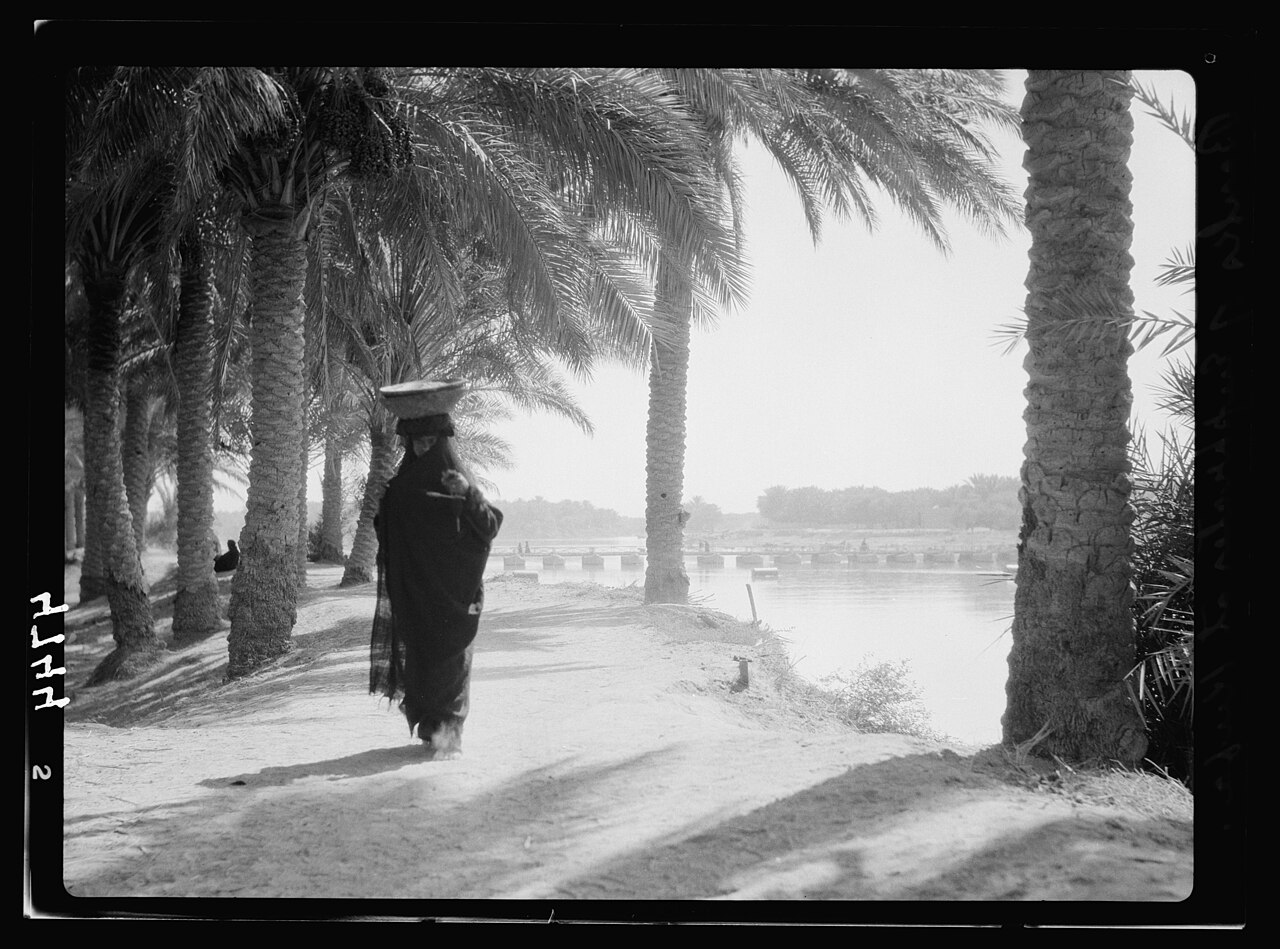
The Arabic accounts say that Bahman offered a choice: either the Persians would cross to the Arab side, or the Arabs could cross to his. Abu Ubayd’s officers urged him to stay where he was, with open desert behind him. He chose to cross, and the Arabs passed over a bridge of boats into a narrow space with the river at their backs.
The elephants decided the day. The Arab horses had never faced them and would not charge. Abu Ubayd attacked a white elephant on foot, struck at it and was pulled down and trampled. Tabari lists a series of men, several of them his kinsmen, who took up the banner after him and were killed in turn. As the line broke, the narrow bridge became a trap. One account says a man of Thaqif cut the boats loose so that no one could flee; others simply describe the crush. Hundreds drowned.
Al-Muthanna, wounded, held a rearguard while the bridge was repaired and led the survivors back across. The traditional figure is around 4,000 Arab dead, killed or drowned, from an army perhaps two or three times that size. Like all numbers in these sources it is a rough tradition rather than a count, and nothing reliable survives for Persian losses.
Why the Persians did not follow up
Bahman did not pursue the beaten army into the desert. Tabari reports that news reached him of unrest at Ctesiphon, where factions were moving against Rostam, and that he turned back. Whether or not that explanation is exact, it fits everything else known about the court in these years: the rivalries described on the page on the Sasanian civil wars had not gone away when Yazdegerd III was crowned.
The chance was lost quickly. Probably within a year, al-Muthanna defeated a Persian army under Mihran at al-Buwayb, near the future site of Kufa, and Arab raids along the Euphrates resumed. Al-Muthanna himself died of his wounds not long afterwards.
What the Bridge changed
For the Muslim leadership in Medina the defeat was a warning. Umar stopped treating Iraq as a frontier for small tribal forces and began assembling a much larger army under Sa’d ibn Abi Waqqas, drawing men from across Arabia. That army fought the decisive battle of al-Qadisiyyah, where Bahman Jadhuyih was among the Persian commanders killed.
The Bridge also shows why historians are careful with the idea that the Sasanian collapse was inevitable. A Persian field army, well led and using elephants with skill, could still beat the Arabs in 634. What the empire lacked was the political unity to turn a victory into a recovered frontier.
How the battle is remembered
The story survives almost entirely in Arabic tradition, in Tabari and al-Baladhuri, where it serves partly as a moral tale about a brave commander who ignored advice. Persian tradition gives it little attention: Ferdowsi’s Shahnameh moves straight to Rostam and al-Qadisiyyah. In modern Iran the battle is sometimes cited as proof that the Sasanians were not beaten easily, while Muslim histories present it as a test the community survived. Both readings rest on the same thin and late sources.
Persian words from this page
| پل | pol | bridge |
| فیل | fil | elephant |
| فرات | Forât | Euphrates |
| نبرد | nabard | battle |
| سپاه | sepâh | army |
| تیسفون | Tisfun | Ctesiphon |
Sources and further reading
- al-Tabari, The History of al-Tabari, vol. 11, The Challenge to the Empires, translated by Khalid Yahya Blankinship (SUNY Press).
- al-Baladhuri, Futuh al-Buldan, translated as The Origins of the Islamic State.
- Fred M. Donner, The Early Islamic Conquests (1981).
- Hugh Kennedy, The Great Arab Conquests (2007).
- Parvaneh Pourshariati, Decline and Fall of the Sasanian Empire (2008).
Want to learn Persian? Get the free Starter Pack
Get the 14-page printable Starter Pack (all 32 letters, a 7-day reading plan, 100 core words and 20 survival phrases) and a short 5-email course. Free.
More in The Arab Conquest and Early Islamic Iran (633–820 CE)
- Salman the Persian
- Why the Sasanian Empire Fell
- The Battle of the Bridge (634)
- The Battle of al-Qadisiyyah
- Rostam Farrokhzad
- The Fall of Ctesiphon
- The Battle of Jalula
- The Battle of Nahavand: “Victory of Victories”
- The Conquest of Fars, Khorasan and the East
- Peroz III and the Sasanian Exiles in China
- Iranian Resistance: Tabaristan and the Dabuyids
- Zoroastrians after the Arab Conquest
- Iran under the Umayyads
- The Mawali and the Shu’ubiyya Movement
- Abu Muslim and the Abbasid Revolution
- The Death of Abu Muslim and the Iranian Revolts
- The Barmakids: Persian Viziers of Baghdad
- Al-Ma’mun in Merv and the Civil War
- Tahir ibn Husayn
- Imam Reza and the Origins of Mashhad
- Babak Khorramdin’s Revolt
- Persian Influence on the Abbasid Caliphate
- The Birth of New Persian