Ctesiphon, the Sasanian capital on the Tigris below modern Baghdad, fell to the Arab army of Sa’d ibn Abi Waqqas in 637, a few months after the Persian defeat at al-Qadisiyyah. Yazdegerd III abandoned the city with his court and much of the treasury, and the conquerors took over the royal palaces and an enormous booty, including the famous jewelled carpet known as the Spring of Khosrow.
| Date | 637 CE (AH 16 in the Arabic chronicles); the siege of the west-bank city began late in 636 |
|---|---|
| Place | The twin cities on the Tigris, about 35 km south-east of modern Baghdad |
| Arabic name | al-Mada’in, “the cities” |
| Persian name | تیسفون (Tisfun); in classical Persian مدائن (Madâ’en) |
| Defender | Yazdegerd III, who withdrew to Hulwan |
| Attacker | Sa’d ibn Abi Waqqas |
A capital of several cities
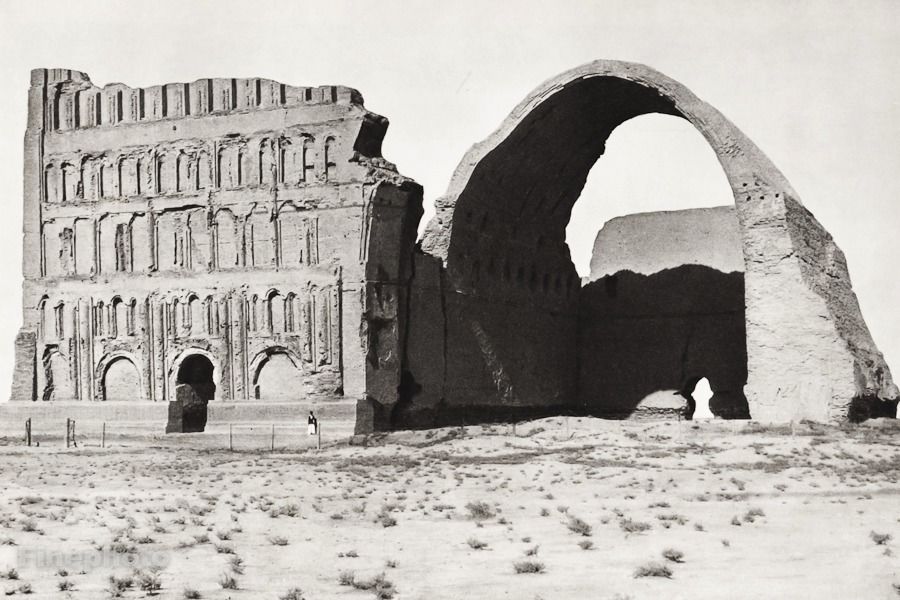
What the Arabs called al-Mada’in was a cluster of royal towns on both banks of the Tigris. On the west bank stood Veh-Ardashir, founded by Ardashir I and known to the Arabs as Bahurasir. On the east bank lay old Ctesiphon, with its palaces and the great vaulted hall of Taq Kasra, the Arch of Khosrow. Together they were the political and administrative heart of the empire and one of the largest urban centres of the Near East.
The siege of Veh-Ardashir
After al-Qadisiyyah Sa’d moved north up the Euphrates and across to the Tigris. The west-bank city was walled, and the Arabs had to besiege it. The chronicles describe months of blockade, with prices rising inside, skirmishes outside the gates and siege engines built for the Arabs, by one account with the help of Persians who had come over to them. Eventually the defenders crossed the river in the night, taking the boats with them, and the Arabs entered an empty city.
Crossing the Tigris
The Tigris was in flood, and the Persians had removed the boats. The best-known story in Tabari tells how the Arab horsemen rode into the river and swam their horses across, shouting prayers, while the Persians on the far bank watched in disbelief. The story became one of the famous scenes of the conquest, and like many such scenes it has the shape of a miracle tale. A crossing at a ford, under pressure and at real risk, is likely enough; the details belong to tradition.
The Persian court did not wait. Yazdegerd had already sent his family and treasure ahead, and he left for Hulwan in the Zagros foothills. The remaining defenders fell back north-east, where they would make a stand at Jalula.

Sa’d in the palace of Khosrow
Sa’d entered the east-bank city and, according to the sources, prayed in the great hall of Khosrow, which was used for a time as the congregational mosque. The Arabic chroniclers describe the conquerors walking through rooms full of things they had no names for. One story tells of soldiers who found camphor and, taking it for salt, put it in their bread.
The booty
The sources speak of the king’s crown and robes, swords and armour said to have belonged to earlier rulers, gold and silver vessels and vast stores of coin. Each item is told with relish, and the totals given are impossible to check. One fifth of the booty was due to the caliph in Medina under Islamic law, and the rest was divided among the soldiers.
The carpet of Khosrow
The most famous object was a huge carpet from the audience hall. Tabari describes it as sixty cubits square, worked in gold, silver and gems to show a garden in spring, with paths, streams and flowering trees, so that the king could enjoy spring even in winter. It is remembered in Persian as Bahar-e Khosrow, the Spring of Khosrow. Sa’d sent it to the caliph Umar, who, the story says, had it cut into pieces and shared among the leading Muslims rather than keep a royal treasure. Whether it was a carpet in the modern sense or a tapestry, nothing of it survives, and the description comes only from the chroniclers.
A capital left behind
The Arabs did not make Ctesiphon their capital. Within a year or two Sa’d moved his army to a new camp at Kufa on the edge of the desert, closer to Arabia. Al-Mada’in became a provincial town. Salman the Persian, a companion of the Prophet, is remembered as one of its governors and is buried at the place now called Salman Pak; his story is told on Salman the Persian.
In 762 the Abbasid caliph al-Mansur founded Baghdad a little upstream. A well-known anecdote says he wanted to pull down the Arch of Khosrow for its bricks and was advised against it, and that the work was abandoned because the demolition cost more than the bricks were worth. Whatever its truth, the arch survived, damaged, into modern times.
Ctesiphon in poetry and memory
The ruined palace became a symbol of lost glory. In the 9th century the Arab poet al-Buhturi wrote a celebrated ode on the ruins, and in the 12th century the Persian poet Khaqani wrote his qasida on the Iwan of Mada’in, which many Iranian schoolchildren still read. The Arabic chronicles treat the fall of the city as a victory foretold; Persian literature dwells on what was lost. Historians read both as sources for attitudes in later centuries, and look to archaeology for the city itself.
Persian words from this page
| تیسفون | Tisfun | Ctesiphon |
| ایوان مدائن | Eyvân-e Madâ’en | the Iwan of Mada’in |
| طاق کسری | Tâq-e Kasrâ | the Arch of Khosrow |
| بهار خسرو | Bahâr-e Khosrow | the Spring of Khosrow (the carpet) |
| فرش | farsh | carpet |
| دجله | Dejle | the Tigris |
Sources and further reading
- al-Tabari, The History of al-Tabari, vol. 13, The Conquest of Iraq, Southwestern Persia, and Egypt, translated by G. H. A. Juynboll (SUNY Press).
- al-Baladhuri, Futuh al-Buldan, translated as The Origins of the Islamic State.
- Khaqani Shirvani, qasida on the Iwan of Mada’in (Ayvan-e Mada’en).
- Hugh Kennedy, The Great Arab Conquests (2007).
- “Ctesiphon”, Encyclopaedia Iranica.
Want to learn Persian? Get the free Starter Pack
Get the 14-page printable Starter Pack (all 32 letters, a 7-day reading plan, 100 core words and 20 survival phrases) and a short 5-email course. Free.
More in The Arab Conquest and Early Islamic Iran (633–820 CE)
- Salman the Persian
- Why the Sasanian Empire Fell
- The Battle of the Bridge (634)
- The Battle of al-Qadisiyyah
- Rostam Farrokhzad
- The Fall of Ctesiphon
- The Battle of Jalula
- The Battle of Nahavand: “Victory of Victories”
- The Conquest of Fars, Khorasan and the East
- Peroz III and the Sasanian Exiles in China
- Iranian Resistance: Tabaristan and the Dabuyids
- Zoroastrians after the Arab Conquest
- Iran under the Umayyads
- The Mawali and the Shu’ubiyya Movement
- Abu Muslim and the Abbasid Revolution
- The Death of Abu Muslim and the Iranian Revolts
- The Barmakids: Persian Viziers of Baghdad
- Al-Ma’mun in Merv and the Civil War
- Tahir ibn Husayn
- Imam Reza and the Origins of Mashhad
- Babak Khorramdin’s Revolt
- Persian Influence on the Abbasid Caliphate
- The Birth of New Persian