Ali ibn Musa al-Rida, known in Iran as Imam Reza, was a descendant of the Prophet Muhammad and, for Twelver Shi’i Muslims, the eighth imam. In 817 the Abbasid caliph al-Ma’mun named him heir to the caliphate at Merv; a year later, in 818, he died at Tus in Khorasan. His tomb, beside that of Harun al-Rashid, grew into the city of Mashhad, today the largest pilgrimage centre in Iran.
| Name | Ali ibn Musa al-Rida; in Persian امام رضا (Emâm Rezâ) |
|---|---|
| Born | Medina, 765 or 768 (reports differ) |
| Father | Musa al-Kazim, the seventh Twelver imam |
| Named heir to al-Ma’mun | Merv, March 817 |
| Died | 818 (Safar 203 AH in most reports), at Sanabad near Tus |
| Buried | Sanabad, in the tomb of Harun al-Rashid, now the shrine at Mashhad |
This page separates two kinds of account. One is what historians, using chronicles such as al-Tabari’s, can establish about his life. The other is the traditional account preserved by Shi’i and Sunni Muslims, which matters to millions of believers and is presented here as their tradition, attributed to its sources.
What the historical record shows
A Medinan scholar of the Prophet’s family
Ali ibn Musa was born in Medina into the family of the Prophet’s descendants through Ali and Fatima, the line known as the Alids. His father, Musa al-Kazim, died in 799 while held in Abbasid custody in Baghdad. Ali lived in Medina as a respected scholar and transmitter of hadith, the reports of the Prophet’s sayings, for most of his life. The chronicles say little about these years.
The summons to Merv
He enters political history in 816–817, when al-Ma’mun, then ruling the caliphate from Merv after the civil war described on al-Ma’mun in Merv, summoned him from Medina. His route took him across Iran, through Nishapur, to Merv. In March 817 al-Ma’mun announced that Ali would be his successor, gave him the honorific al-Rida, “the one approved”, and ordered that the black of the Abbasids be replaced by green. Coins were struck naming him as heir.
The decision caused an uproar. In Baghdad, members of the Abbasid family refused to accept it and in July 817 proclaimed al-Ma’mun’s uncle, Ibrahim ibn al-Mahdi, caliph. Al-Ma’mun’s motives are still debated. Some historians, among them Wilferd Madelung, have taken seriously the idea that he wanted the most worthy member of the Prophet’s family as successor and hoped to end the long hostility between Abbasids and Alids. Others see a calculated move to win over Alid supporters after a series of Alid revolts, possibly encouraged by his Persian vizier al-Fadl ibn Sahl.

Death at Tus, 818
Late in 817 al-Ma’mun began the journey west to reclaim Baghdad, and Ali al-Rida travelled with the court. Early in 818 al-Fadl ibn Sahl was killed at Sarakhs. Some months later, at the village of Sanabad near Tus, Ali al-Rida fell ill and died suddenly. Al-Tabari reports that he died after eating a large quantity of grapes. Al-Ma’mun had him buried in the tomb of his own father, Harun al-Rashid, who had died nearby in 809.
Whether he died naturally or was poisoned cannot be settled from the sources. Some early writers, and many modern historians, note how conveniently both deaths came for al-Ma’mun, who could then make peace with the Abbasids of Baghdad. Others point out that the evidence for poisoning comes from later and partisan accounts. What is certain is that after his death al-Ma’mun named no Alid successor and restored black when he entered Baghdad in 819.
The traditional accounts
In Twelver Shi’i tradition
For Twelver Shi’is, Ali al-Rida was the eighth of the twelve imams, the rightful spiritual and political leaders of the Muslim community after the Prophet. Shi’i works, above all Ibn Babawayh’s tenth-century collection Uyun akhbar al-Rida, preserve many reports of his life. They tell that he accepted the position of heir only under pressure and on condition that he take no part in government; that at al-Ma’mun’s court he debated leading scholars of Judaism, Christianity, Zoroastrianism and other faiths; and that at Nishapur he recited a hadith, transmitted through his forefathers back to the Prophet, which became known as the Silsilat al-Dhahab, the “chain of gold”, because of its line of narrators. Shi’i tradition holds that al-Ma’mun poisoned him, and remembers him as a martyr and as gharib al-ghuraba, “the stranger of strangers”, for dying far from his home in Medina.
The same tradition holds that his sister, Fatima al-Ma’suma, set out to join him and died at Qom, where her shrine stands.
In Sunni tradition
Sunni Muslims do not regard him as an imam in the Shi’i sense, but respect him as a member of the Prophet’s family and a transmitter of hadith. Sunni scholars cited his reports, and the tenth-century hadith scholar Ibn Hibban wrote that he visited the tomb at Tus many times and prayed there. Sunni pilgrims have long visited the shrine as well.
From Sanabad to Mashhad
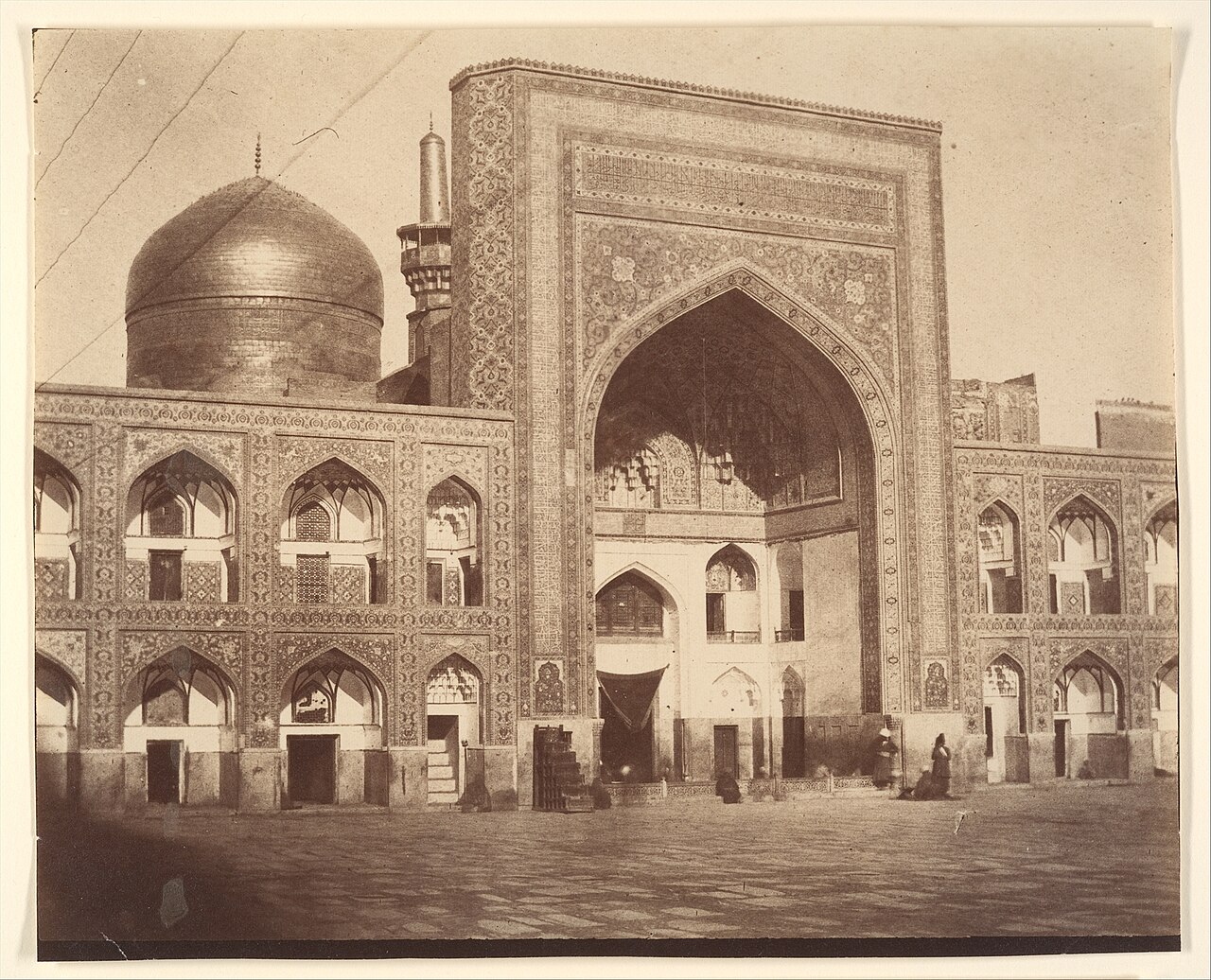
The tomb gave the place its new name: مشهد, Mashhad, the “place of martyrdom” or of witness. For centuries it was a small shrine town next to Tus, the larger city where Ferdowsi was born. The tomb was damaged and rebuilt more than once; the Ghaznavid ruler Mahmud is credited with restoring it in the early eleventh century, and in 1418 the Timurid queen Gawharshad built the great mosque beside it that still bears her name. As Tus declined after the Mongol invasions, Mashhad grew. The Safavids, who made Twelver Shi’ism Iran’s official religion in 1501, turned the shrine into the country’s chief pilgrimage site; Shah Abbas I walked to it from Isfahan in 1601.
The city and the shrine as they are today are covered on Mashhad and the Imam Reza Shrine, and a visitor’s view is on the blog post Mashhad, Iran’s holy city. The longer story of Iranian Shi’ism, which became the state religion only seven centuries after his death, is part of the Safavid Empire.
Persian words from this page
| امام رضا | Emâm Rezâ | Imam Reza |
| امام هشتم | Emâm-e hashtom | the eighth imam |
| مشهد | Mashhad | Mashhad, place of martyrdom |
| طوس | Tus | Tus |
| ولیعهد | vali’ahd | heir to the throne |
| زیارت | ziyârat | pilgrimage |
| حرم | haram | shrine sanctuary |
Sources and further reading
- al-Tabari, The History of al-Tabari, vol. 32, The Reunification of the ‘Abbasid Caliphate, translated by C. E. Bosworth (SUNY Press, 1987).
- Ibn Babawayh (al-Shaykh al-Saduq), Uyun akhbar al-Rida.
- Wilferd Madelung, “‘Ali al-Reza”, Encyclopaedia Iranica.
- Michael Cooperson, Classical Arabic Biography: The Heirs of the Prophets in the Age of al-Ma’mun (Cambridge, 2000), chapter on Ali al-Rida.
- “Mashhad”, Encyclopaedia Iranica.
Want to learn Persian? Get the free Starter Pack
Get the 14-page printable Starter Pack (all 32 letters, a 7-day reading plan, 100 core words and 20 survival phrases) and a short 5-email course. Free.
More in The Arab Conquest and Early Islamic Iran (633–820 CE)
- Salman the Persian
- Why the Sasanian Empire Fell
- The Battle of the Bridge (634)
- The Battle of al-Qadisiyyah
- Rostam Farrokhzad
- The Fall of Ctesiphon
- The Battle of Jalula
- The Battle of Nahavand: “Victory of Victories”
- The Conquest of Fars, Khorasan and the East
- Peroz III and the Sasanian Exiles in China
- Iranian Resistance: Tabaristan and the Dabuyids
- Zoroastrians after the Arab Conquest
- Iran under the Umayyads
- The Mawali and the Shu’ubiyya Movement
- Abu Muslim and the Abbasid Revolution
- The Death of Abu Muslim and the Iranian Revolts
- The Barmakids: Persian Viziers of Baghdad
- Al-Ma’mun in Merv and the Civil War
- Tahir ibn Husayn
- Imam Reza and the Origins of Mashhad
- Babak Khorramdin’s Revolt
- Persian Influence on the Abbasid Caliphate
- The Birth of New Persian