Salman the Persian, Salman al-Farisi in Arabic, was an Iranian convert who became a companion of the Prophet Muhammad in Medina in the 620s. Muslim tradition credits him with the idea of the defensive trench at the Battle of the Trench in 627, and remembers him as governor of al-Mada’in, the former Sasanian capital, where he died around 655. Revered by Sunni and Shi’i Muslims alike, he has long stood for the place of Iranians in Islam from its beginning.
| Persian name | سلمان فارسی (Salmân-e Fârsi) |
|---|---|
| Birth name in tradition | Ruzbih (Persian روزبه, Ruzbeh) |
| Origin in tradition | Jayy, near Isfahan (some reports say Ramhormoz in Khuzestan) |
| Associated event | Battle of the Trench, Medina, 627 |
| Later office | Governor of al-Mada’in (Ctesiphon) under the caliph Umar |
| Died | c. 655–656, al-Mada’in; shrine at Salman Pak, Iraq |
Almost everything known about Salman comes from Muslim tradition, recorded a century or more after his death. This page first sets out that traditional account, which Sunnis and Shi’is largely share, then the particular ways each remembers him, and finally what historians make of the sources.
The traditional account
From Isfahan to Medina
The best-known version is the story attributed to Salman himself in Ibn Ishaq’s biography of the Prophet, as edited by Ibn Hisham. It tells that he was born in the village of Jayy near Isfahan, the son of a landowner, and raised as a Zoroastrian who tended the household fire. Drawn to the prayers of Christians he heard in a church, he left home for Syria and served a succession of Christian holy men in Syria and northern Mesopotamia. The last of them, as he lay dying, told Salman that a prophet would soon appear in Arabia, in a land of date palms between two lava fields, and described signs by which he would be known.
Salman travelled south with Arab merchants, who betrayed him and sold him as a slave. He ended up working in the palm groves of a Jewish owner in Medina, Yathrib. When Muhammad arrived there in 622, Salman, according to the account, recognised him by the signs he had been told of, and became a Muslim. The Prophet and his companions then helped him buy his freedom, by planting date palms and raising the gold his owner demanded.
The trench
In 627 a large Meccan coalition marched on Medina. The traditional sources say that Salman advised digging a trench across the open approach to the town, a practice he knew from Persia, and that the Muslims dug it in days. The besiegers, unused to such a defence, eventually withdrew, and the battle became known as al-Khandaq, the Trench. A widely reported saying has the Prophet declare, when the Emigrants and the Helpers of Medina each claimed Salman as one of them, “Salman is one of us, the People of the House”, that is, of the Prophet’s own family.
Governor of the old Sasanian capital
After the Arab conquest of Iraq, Salman is said to have been present at the fall of Ctesiphon, the city described on the fall of Ctesiphon, and to have spoken to the Persian defenders in their own language. The caliph Umar later appointed him governor of al-Mada’in. The sources dwell on his simplicity there: he lived on a small stipend, wove baskets to earn his food and gave his salary away. He died in al-Mada’in, usually dated to 655 or 656, during the caliphate of Uthman.
Some traditions give him an enormous lifespan of 250 years or more, which even medieval scholars discussed with some scepticism.

Salman in Shi’i and Sunni memory
In Shi’i tradition Salman holds a very high place. He is counted among the small group of companions, with Abu Dharr, al-Miqdad and Ammar ibn Yasir, who are said to have stood by Ali’s claim to lead the community after the Prophet’s death in 632. Shi’i writings praise his knowledge and spiritual rank, and some later esoteric groups gave him an even more exalted role.
In Sunni tradition he is an honoured companion and a model of piety and humility, and Sunni hadith collections include sayings in his praise. Sufis of both communities also revere him; the Naqshbandi order traces its spiritual chain through him, from the first caliph Abu Bakr to Salman and onwards.
For Iranians, Salman has an added meaning. Writers of the Shu’ubiyya, who argued that Persians were the equals of Arabs in Islam, pointed to him as proof that a Persian had been close to the Prophet from the start. Today his name is common in Iran, and many mosques and streets bear it.
What historians can say
Modern historians treat the story of Salman as a mix of memory and pious narrative. The long journey through a chain of monks, each passing him on to the next until the last foretells the Prophet, follows a pattern found in other early stories that show earlier scriptures pointing to Muhammad. The French scholar Louis Massignon, in a 1934 study of Salman, read him chiefly as a spiritual symbol of the Iranian contribution to Islam. Others, such as Giorgio Levi Della Vida in the Encyclopaedia of Islam, stressed how hard it is to separate a historical person from the legend.
Few historians doubt that there was a Persian freedman among the early Muslims of Medina who later held office in Iraq. Details such as his birthplace, his long life and exactly who proposed the trench are harder to check. The idea of a defensive trench is itself plausible, since such ditches were familiar in the Sasanian and Byzantine worlds.
The shrine at Salman Pak
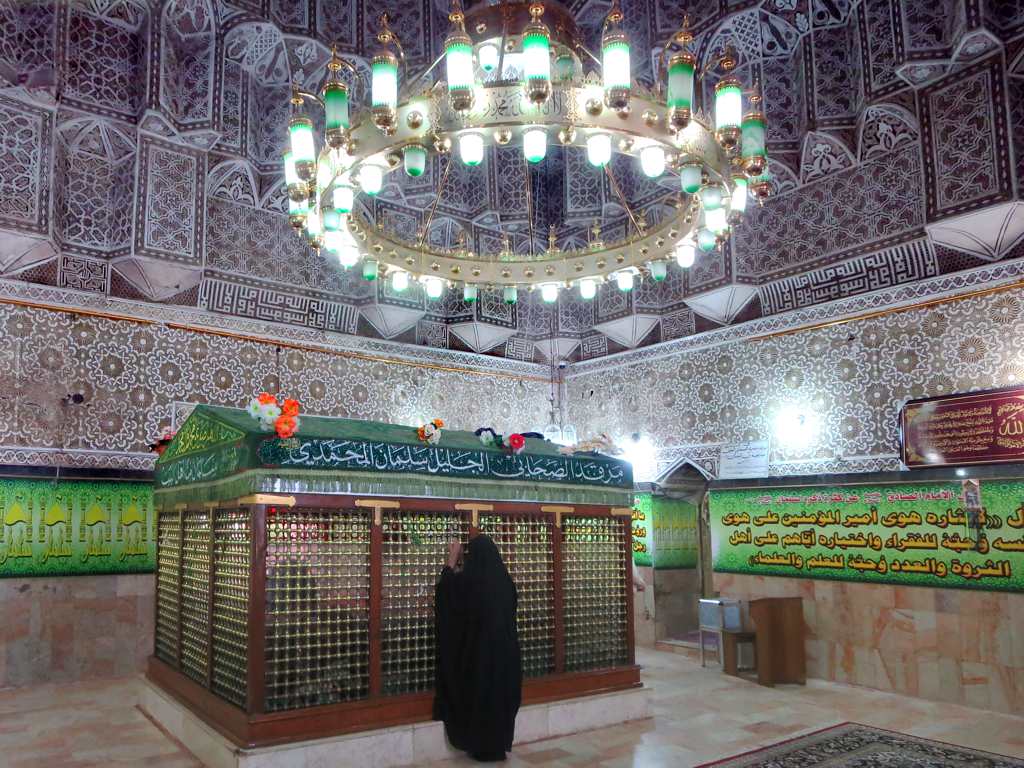
His tomb stands in the town of al-Mada’in, which took the name Salman Pak, “Salman the Pure”, from it. The shrine, rebuilt several times, lies a short distance from the great arch of the Sasanian palace, the Taq-e Kasra, so that the companion of the Prophet and the last monument of the Persian kings stand almost side by side. For the end of that empire, see why the Sasanian empire fell.
Persian words from this page
| سلمان فارسی | Salmân-e Fârsi | Salman the Persian |
| روزبه | Ruzbeh | Ruzbih, his birth name in tradition |
| اصفهان | Esfahân | Isfahan |
| خندق | khandaq | trench |
| مدائن | Madâ’en | al-Mada’in, Ctesiphon |
| طاق کسری | Tâq-e Kasrâ | Arch of Khosrow |
Sources and further reading
- Ibn Ishaq, The Life of Muhammad, translated by A. Guillaume (Oxford University Press, 1955), the story of Salman and the Battle of the Trench.
- Ibn Sa’d, Kitab al-Tabaqat al-Kabir, biography of Salman.
- Louis Massignon, Salman Pak et les prémices spirituelles de l’Islam iranien (Paris, 1934).
- G. Levi Della Vida, “Salman al-Farisi”, Encyclopaedia of Islam, 2nd edition.
- “Salman-e Farsi”, Encyclopaedia Iranica.
Want to learn Persian? Get the free Starter Pack
Get the 14-page printable Starter Pack (all 32 letters, a 7-day reading plan, 100 core words and 20 survival phrases) and a short 5-email course. Free.
More in The Arab Conquest and Early Islamic Iran (633–820 CE)
- Salman the Persian
- Why the Sasanian Empire Fell
- The Battle of the Bridge (634)
- The Battle of al-Qadisiyyah
- Rostam Farrokhzad
- The Fall of Ctesiphon
- The Battle of Jalula
- The Battle of Nahavand: “Victory of Victories”
- The Conquest of Fars, Khorasan and the East
- Peroz III and the Sasanian Exiles in China
- Iranian Resistance: Tabaristan and the Dabuyids
- Zoroastrians after the Arab Conquest
- Iran under the Umayyads
- The Mawali and the Shu’ubiyya Movement
- Abu Muslim and the Abbasid Revolution
- The Death of Abu Muslim and the Iranian Revolts
- The Barmakids: Persian Viziers of Baghdad
- Al-Ma’mun in Merv and the Civil War
- Tahir ibn Husayn
- Imam Reza and the Origins of Mashhad
- Babak Khorramdin’s Revolt
- Persian Influence on the Abbasid Caliphate
- The Birth of New Persian