From 661 to 750 Iran was ruled as part of the Umayyad Caliphate, governed from Damascus through powerful viceroys based in Iraq. In these ninety years the conquest was consolidated, Arab settlers moved into Khorasan, Arabic replaced Persian as the language of government, and tensions grew between the Arab ruling class and the Iranians who converted to Islam, tensions that ended in the Abbasid revolution.
| Dates | 661–750 CE |
|---|---|
| Capital of the caliphate | Damascus |
| Seat of eastern government | Kufa and Basra, later Wasit, with Merv as the capital of Khorasan |
| Key governors | Ziyad ibn Abihi (665–673), al-Hajjaj ibn Yusuf (694–714), Nasr ibn Sayyar in Khorasan (738–748) |
| Language of administration | Persian, then Arabic: about 697 in Iraq, 742 in Khorasan |
Governing Iran from Iraq
The first conquests, described on the conquest of Fars, Khorasan and the east, were shaken by the Muslim civil war of 656–661, when many Iranian districts stopped paying tribute. After Mu’awiya founded the Umayyad dynasty in 661, the east was reorganised under a single viceroy of Iraq, who appointed sub-governors for Khorasan, Sistan, Fars, Kerman and the rest. The great Umayyad governors were among the most powerful men in the empire, and their names fill the chronicles of Iran in this period.
Ziyad and the settlement of Khorasan
Ziyad ibn Abihi, governor of Basra and then of all Iraq from 665 to 673, made a decision with lasting effects. In 671 he sent some 50,000 Arab families from Basra and Kufa to settle in Khorasan, around Merv. Until then the Arabs had held the north-east with seasonal campaigns and small garrisons. Now they put down roots. Over the next two generations these settlers married local women, bought land, learned Persian and became a distinctively Khorasani Arab society.
Al-Hajjaj and the iron hand
Al-Hajjaj ibn Yusuf, viceroy of Iraq and the east from 694 to 714, is remembered in the sources as harsh and efficient. He destroyed the Kharijite rebels who had controlled parts of Fars and Kerman, and he crushed the great revolt of Ibn al-Ash’ath in 700–701, which drew support from Iraqi Arabs and many non-Arab converts. He founded the city of Wasit as his capital between Kufa and Basra. Under his authority Qutayba ibn Muslim conquered Bukhara and Samarqand beyond the Oxus between 705 and 715.

Coins, registers and the Arabic language
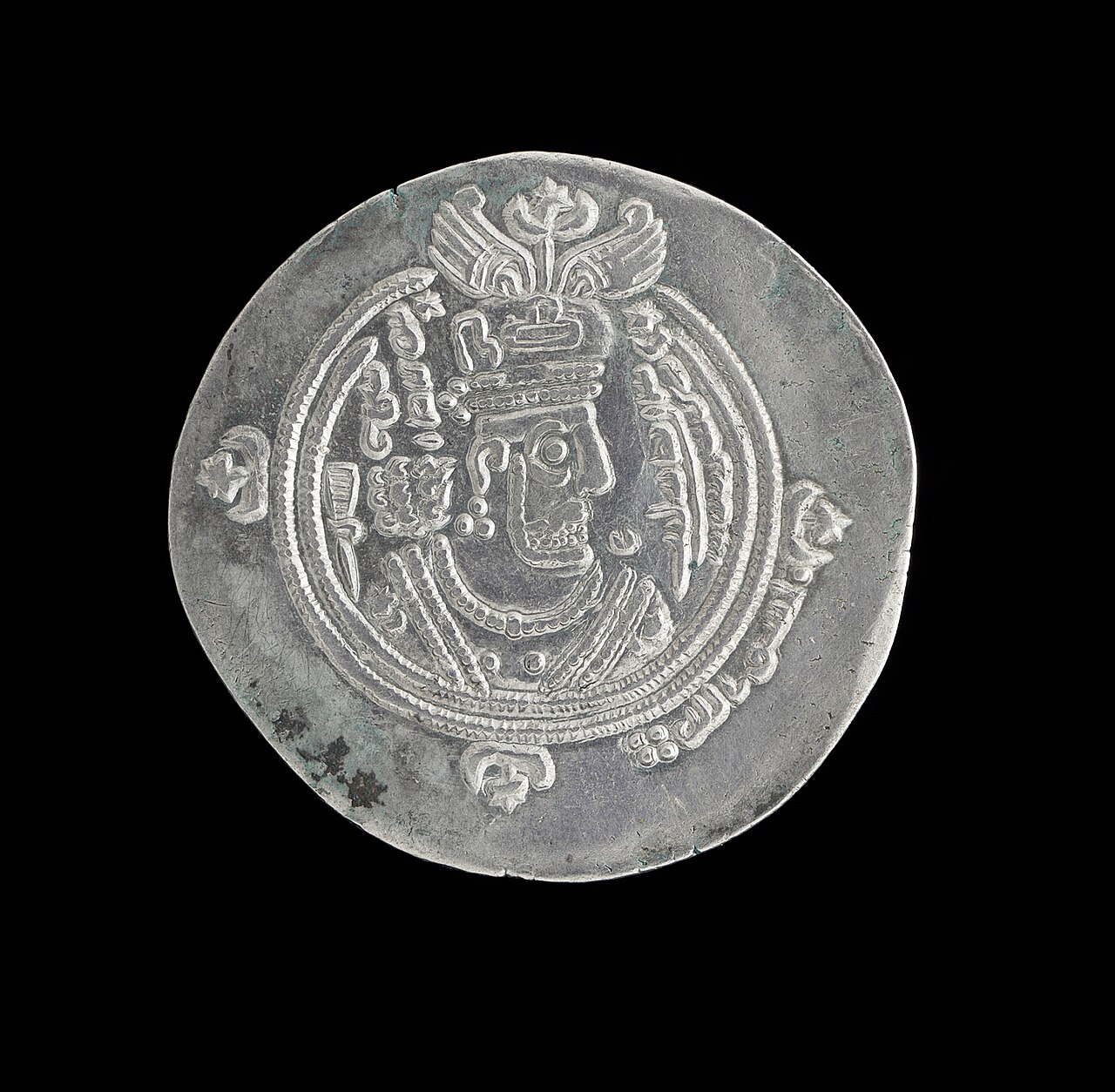
For the first half-century after the conquest, government in Iran looked very Sasanian. The conquerors struck silver coins on the model of those of Khosrow II, with the crowned king’s bust and a fire altar, adding short Arabic phrases and the names of Arab governors in Middle Persian script. Around 696–699 the caliph Abd al-Malik introduced a new silver dirham carrying only Arabic religious inscriptions, and the old type faded out over the following years, except in places such as Tabaristan.
The tax registers (diwan) were kept in Persian by Persian secretaries. In Iraq, around 697, al-Hajjaj had them translated into Arabic, a task carried out by Salih ibn Abd al-Rahman, a secretary from Sistan of non-Arab origin. In Khorasan the change came only in 742, under Nasr ibn Sayyar. Arabic became the language of law, religion and government. Persian, though, remained the spoken language of most people, and even of many Arab settlers in Khorasan, which helps explain the later birth of New Persian.
Dehqans and taxes
Day-to-day rule in the countryside still lay with the dehqans, the Iranian landed gentry, who collected the land tax (kharaj) and the poll tax (jizya) for the Arab authorities. This arrangement kept the old social order in place and gave the dehqans a strong interest in cooperation. It also produced the central grievance of the age. When Iranians converted to Islam, the tax collectors often kept charging them the poll tax that only non-Muslims were supposed to pay, because converts reduced revenue. Converts also had to attach themselves to an Arab tribe as clients (mawali) and were often treated as second-class Muslims. The problem is examined on the mawali and the Shu’ubiyya.
The pious caliph Umar II (717–720) tried to stop the taxation of converts, but his reforms did not last. In Khorasan the issue fed the revolt of al-Harith ibn Surayj, an Arab who between 734 and 746 rallied both Arabs and converts with calls for just government. Nasr ibn Sayyar finally reformed the Khorasan tax system around 739, separating a land tax paid by all from a poll tax paid only by non-Muslims, but by then the Umayyads had lost the trust of much of the province.
Rebels, sects and Karbala
Iran under the Umayyads was a land of opposition movements. Kharijites, who rejected both Umayyad and Alid claims, found refuges in Fars, Kerman and Sistan. In Kufa, supporters of the family of Ali gained strength after the killing of Ali’s son Husayn at Karbala in 680. The revolt of al-Mukhtar in Kufa in 685–687 drew heavily on non-Arab mawali, many of them of Iranian origin. These movements were mostly Arab-led and based in Iraq. Iran as a whole remained largely Sunni for centuries, and only became a mainly Shi’a country under the Safavids, as told on Twelver Shi’ism becomes Iran’s state religion.
The road to revolution
By the 740s the Umayyad state was split by tribal feuds among the Arabs themselves, especially between the Qays and Yaman factions, and by a civil war after 744. In Khorasan, Arab settlers who felt neglected by Damascus and Iranian converts who felt cheated found a common cause. The secret movement working for the family of the Prophet chose Khorasan as the place to rise, and in 747 its agent Abu Muslim raised the black banners near Merv.
Judging the Umayyads
Almost all the histories of the Umayyads were written under their Abbasid successors, who had every reason to paint them as worldly and unjust. Later Iranian nationalist writing adopted a similar view of the Umayyads as an “Arab kingdom” that despised Persians. Modern historians such as Gerald Hawting and Hugh Kennedy accept that Umayyad rule favoured Arabs, but also stress how much it relied on Persian officials, Sasanian methods and local elites. In practice the Umayyad period was when Iranian and Arab societies began to merge.
Persian words from this page
| امویان | Omaviyân | the Umayyads |
| دیوان | divân | government register; also a poetry collection |
| خراج | kharâj | land tax |
| دهقان | dehqân | landed gentry; today “farmer” |
| حجاج | Hajjâj | al-Hajjaj |
| درهم | derham | dirham, silver coin |
Sources and further reading
- al-Tabari, The History of al-Tabari, vols. 18–27, covering the Umayyad period (SUNY Press).
- al-Baladhuri, Futuh al-Buldan, translated as The Origins of the Islamic State, on the diwan and the coinage.
- G. R. Hawting, The First Dynasty of Islam: The Umayyad Caliphate AD 661–750 (2nd ed., 2000).
- Hugh Kennedy, The Prophet and the Age of the Caliphates (3rd ed., 2016).
- R. N. Frye (ed.), The Cambridge History of Iran, vol. 4, From the Arab Invasion to the Saljuqs (1975).
Want to learn Persian? Get the free Starter Pack
Get the 14-page printable Starter Pack (all 32 letters, a 7-day reading plan, 100 core words and 20 survival phrases) and a short 5-email course. Free.
More in The Arab Conquest and Early Islamic Iran (633–820 CE)
- Salman the Persian
- Why the Sasanian Empire Fell
- The Battle of the Bridge (634)
- The Battle of al-Qadisiyyah
- Rostam Farrokhzad
- The Fall of Ctesiphon
- The Battle of Jalula
- The Battle of Nahavand: “Victory of Victories”
- The Conquest of Fars, Khorasan and the East
- Peroz III and the Sasanian Exiles in China
- Iranian Resistance: Tabaristan and the Dabuyids
- Zoroastrians after the Arab Conquest
- Iran under the Umayyads
- The Mawali and the Shu’ubiyya Movement
- Abu Muslim and the Abbasid Revolution
- The Death of Abu Muslim and the Iranian Revolts
- The Barmakids: Persian Viziers of Baghdad
- Al-Ma’mun in Merv and the Civil War
- Tahir ibn Husayn
- Imam Reza and the Origins of Mashhad
- Babak Khorramdin’s Revolt
- Persian Influence on the Abbasid Caliphate
- The Birth of New Persian