The Barmakids were a family from Balkh, in today’s northern Afghanistan, who served the early Abbasid caliphs as administrators and, under Harun al-Rashid, ran the caliphate as viziers from 786 to 803. Their sudden fall in January 803, when Ja’far ibn Yahya was executed and his father and brother imprisoned, became one of the most retold stories in Arabic and Persian literature.
| Persian name | برمکیان (Barmakiyân) |
|---|---|
| Origin | Balkh, ancient Bactria; hereditary heads of the Buddhist monastery of Nawbahar |
| Key figures | Khalid ibn Barmak (d. c. 781), Yahya ibn Khalid (d. 805), al-Fadl ibn Yahya (d. 808), Ja’far ibn Yahya (d. 803) |
| Height of power | 786–803, under Harun al-Rashid |
| Fall | January 803 (Muharram 187 AH), at al-Anbar on the Euphrates |
From the Nawbahar monastery at Balkh
Before Islam, Balkh was a great Buddhist centre, and its largest monastery was known as Nawbahar, from Sanskrit nava vihara, “new monastery”. Arabic and Persian writers say that the word barmak was the title of its hereditary chief, not a personal name. Kevin van Bladel has argued that the title comes from a Sanskrit word for a monastic official, which fits the family’s Buddhist background. When Balkh came under Arab rule in the early eighth century, the head of the family converted to Islam, and the name Barmak passed to his descendants.
The family thus came from the eastern edge of the Iranian world, from a Bactrian rather than a Persian or Zoroastrian setting, which is one reason historians are careful about calling them simply “Persian” viziers. They were Iranians from Khorasan in the broad sense of the time, and they brought with them a tradition of written administration and learning that had little to do with Arabia.
Khalid ibn Barmak and the new dynasty
Khalid, son of the convert Barmak, joined the Abbasid cause in Khorasan and came west with the revolution described on Abu Muslim and the Abbasid Revolution. Under the first caliph, al-Saffah, he headed the financial and army offices, and under al-Mansur he served as governor of Fars, Tabaristan and Mosul. Al-Tabari tells that when al-Mansur wanted to pull down the great arched hall of the Sasanian palace at Ctesiphon to reuse its bricks for Baghdad, Khalid advised against it, saying it would show that the Arabs could destroy what the Persians had built. The caliph went ahead, gave up when the cost proved too high, and the arch still stands. Whether or not the exchange happened as told, it shows how later writers pictured Khalid: as a man who respected the Iranian past.
Yahya and his sons under Harun al-Rashid
Khalid’s son Yahya became tutor to the young prince Harun, and when Harun became caliph in 786 he handed Yahya the seal of government and broad authority over the administration. Harun is said to have called him “father”. Yahya’s sons rose with him. Al-Fadl was Harun’s milk-brother, nursed by Yahya’s wife, and served as governor of Khorasan in the early 790s. Ja’far became the caliph’s closest companion and the tutor of Harun’s son, the future al-Ma’mun.

For seventeen years the family controlled appointments, revenues and correspondence. They became immensely rich and spent lavishly on poets, scholars and charity. Sources credit them with supporting the translation of Indian works on medicine and astronomy and with bringing Indian physicians to Baghdad, and al-Fadl is credited by tradition with promoting the use of paper in government offices. These were part of a wider transfer of Iranian and eastern learning into the Abbasid capital, the subject of Persian influence on the Abbasid caliphate.
The fall of January 803
On the night of 28 January 803, as the court returned from pilgrimage and camped at al-Anbar on the Euphrates, Harun ordered Ja’far beheaded. His body was cut in pieces and displayed on the bridges of Baghdad. Yahya and al-Fadl were arrested and their property confiscated. Both died in prison at al-Raqqa, Yahya in 805 and al-Fadl in 808.
Competing explanations for the fall
The chroniclers themselves did not agree. The most famous explanation, told by al-Tabari and al-Mas’udi, is that Harun allowed Ja’far to marry his sister Abbasa on condition that the marriage remain formal, and that when he learned they had children he took revenge. The historian Ibn Khaldun, writing in the fourteenth century, rejected this as a slander unworthy of the family and the caliph. Other reports point to Ja’far’s release of an Alid rebel he had been ordered to hold, to rivalry with the chamberlain al-Fadl ibn al-Rabi’, and to the Barmakids’ role in the contested succession between Harun’s sons al-Amin and al-Ma’mun.
Most modern historians, including Hugh Kennedy, see a simpler cause behind the stories. The family had built a network of clients so wide that the caliph no longer controlled his own government, and Harun, by then in his late thirties and confident, decided to take it back.
The Barmakids in memory
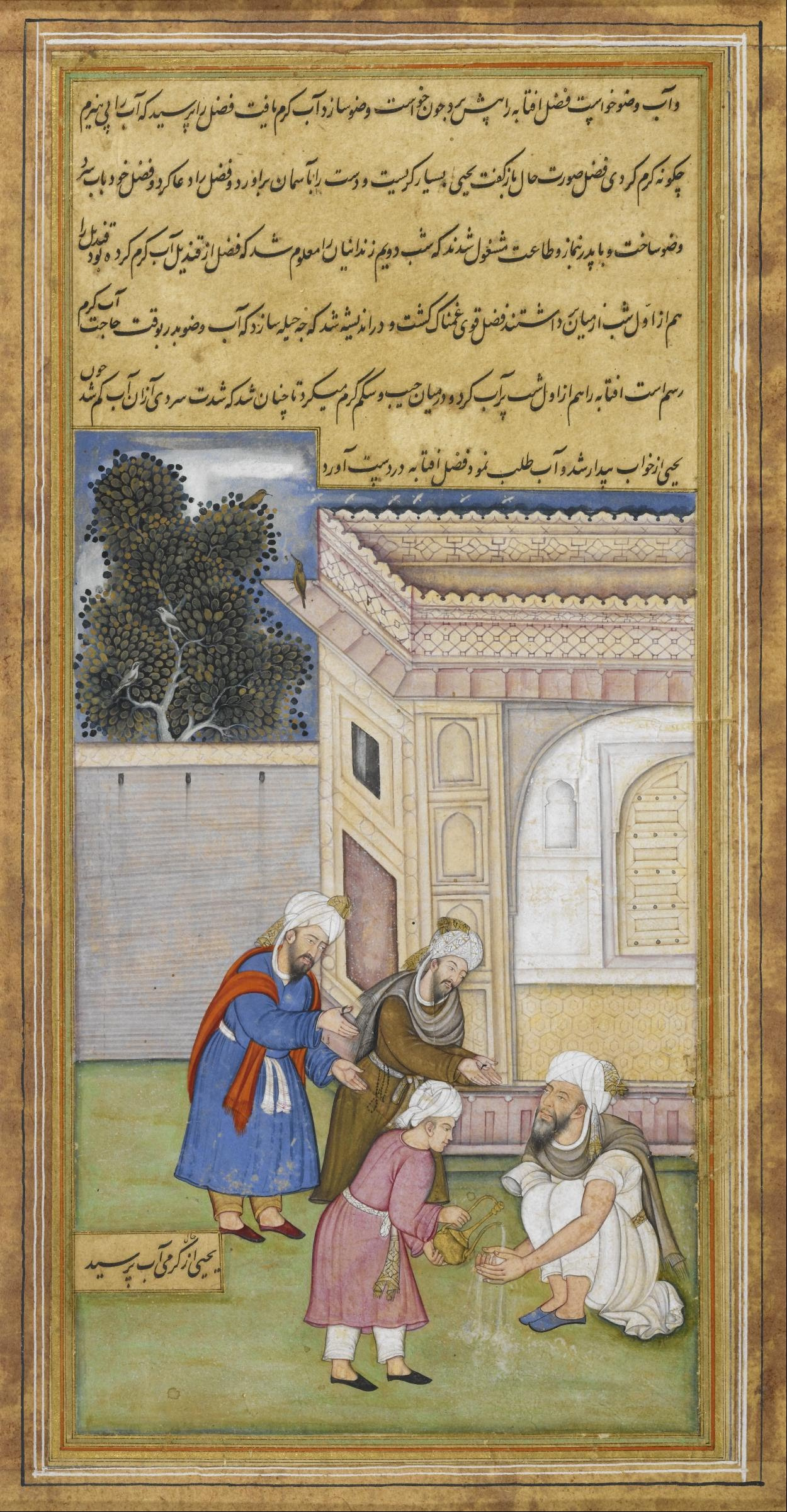
Their generosity became proverbial. In the Thousand and One Nights, Ja’far walks the streets of Baghdad at night beside Harun, and the tale of the beggar served an imaginary feast by a Barmakid host gave English the word “Barmecide” for an illusory benefit. Persian writers compiled whole books of Barmakid anecdotes, and the Mughal manuscript shown above comes from one of them. In Iranian memory the family stand for the idea, also central to the Shu’ubiyya, that Iranians ran the caliphate’s government with skills inherited from their own past.
Their fall did not end that role. The next generation of Iranian officials and generals, among them Tahir ibn Husayn, would make the eastern provinces the base of al-Ma’mun’s victory in the civil war, as told on al-Ma’mun in Merv.
Persian words from this page
| برمکیان | Barmakiyân | the Barmakids |
| بلخ | Balkh | Balkh |
| نوبهار | Nowbahâr | Nawbahar monastery |
| یحیی برمکی | Yahyâ Barmaki | Yahya the Barmakid |
| جعفر | Ja’far | Ja’far |
| هارونالرشید | Hârun ar-Rashid | Harun al-Rashid |
| وزیر | vazir | vizier, minister |
Sources and further reading
- al-Tabari, The History of al-Tabari, vol. 30, The ‘Abbasid Caliphate in Equilibrium, translated by C. E. Bosworth (SUNY Press, 1989).
- Ibn Khaldun, The Muqaddimah, translated by Franz Rosenthal, Introduction (on the story of Abbasa).
- “Barmakids”, Encyclopaedia Iranica.
- Kevin van Bladel, “The Bactrian Background of the Barmakids”, in Islam and Tibet: Interactions along the Musk Routes (2011).
- Hugh Kennedy, The Court of the Caliphs (2004), published in the US as When Baghdad Ruled the Muslim World.
Want to learn Persian? Get the free Starter Pack
Get the 14-page printable Starter Pack (all 32 letters, a 7-day reading plan, 100 core words and 20 survival phrases) and a short 5-email course. Free.
More in The Arab Conquest and Early Islamic Iran (633–820 CE)
- Salman the Persian
- Why the Sasanian Empire Fell
- The Battle of the Bridge (634)
- The Battle of al-Qadisiyyah
- Rostam Farrokhzad
- The Fall of Ctesiphon
- The Battle of Jalula
- The Battle of Nahavand: “Victory of Victories”
- The Conquest of Fars, Khorasan and the East
- Peroz III and the Sasanian Exiles in China
- Iranian Resistance: Tabaristan and the Dabuyids
- Zoroastrians after the Arab Conquest
- Iran under the Umayyads
- The Mawali and the Shu’ubiyya Movement
- Abu Muslim and the Abbasid Revolution
- The Death of Abu Muslim and the Iranian Revolts
- The Barmakids: Persian Viziers of Baghdad
- Al-Ma’mun in Merv and the Civil War
- Tahir ibn Husayn
- Imam Reza and the Origins of Mashhad
- Babak Khorramdin’s Revolt
- Persian Influence on the Abbasid Caliphate
- The Birth of New Persian