Between 811 and 813 the sons of Harun al-Rashid fought a civil war for the caliphate, known as the Fourth Fitna. Al-Amin held Baghdad; his half-brother al-Ma’mun held Khorasan from the city of Merv, and with an army of eastern Iranians under Tahir ibn Husayn he won. For six years afterwards the Abbasid caliphate was ruled from Merv, the only time its capital lay inside the Iranian lands.
| War | Fourth Fitna, 811–813 (preliminaries from 809) |
|---|---|
| Sides | Al-Amin (Baghdad, mother Zubayda) against al-Ma’mun (Merv, mother Marajil, an Iranian) |
| Decisive battle | Near Rey, 811: Tahir ibn Husayn defeats Ali ibn Isa ibn Mahan |
| End | Siege of Baghdad 812–813; al-Amin killed, September 813 |
| Al-Ma’mun in Merv | Until 818; enters Baghdad in August 819 |
Harun’s plan for two heirs
In 802, on pilgrimage at Mecca, Harun al-Rashid had his sons swear to a settlement and hung the documents in the Ka’ba. Al-Amin, son of the Abbasid princess Zubayda, would be caliph in Baghdad. Al-Ma’mun, slightly older but the son of Marajil, a concubine from Badghis in Khorasan, would succeed him and meanwhile govern Khorasan and the east with his own army and revenues. The plan almost invited a split between the Arab heartland and the Iranian east.
Harun died at Tus in March 809, on campaign against a revolt in Samarkand. Al-Ma’mun stayed in Merv. His closest adviser was al-Fadl ibn Sahl, a Persian from a family of Zoroastrian origin who had converted to Islam and who encouraged him to present himself as the ruler of Khorasan and the champion of its people.
From quarrel to war
Al-Amin, urged on by his own vizier al-Fadl ibn al-Rabi’, set about undoing the Mecca agreement. In 810 he had his own son Musa proclaimed heir in place of al-Ma’mun and demanded revenues and territory from the east. Al-Ma’mun refused, stopped sending his brother’s name on coins and in Friday prayers, and the two prepared for war.
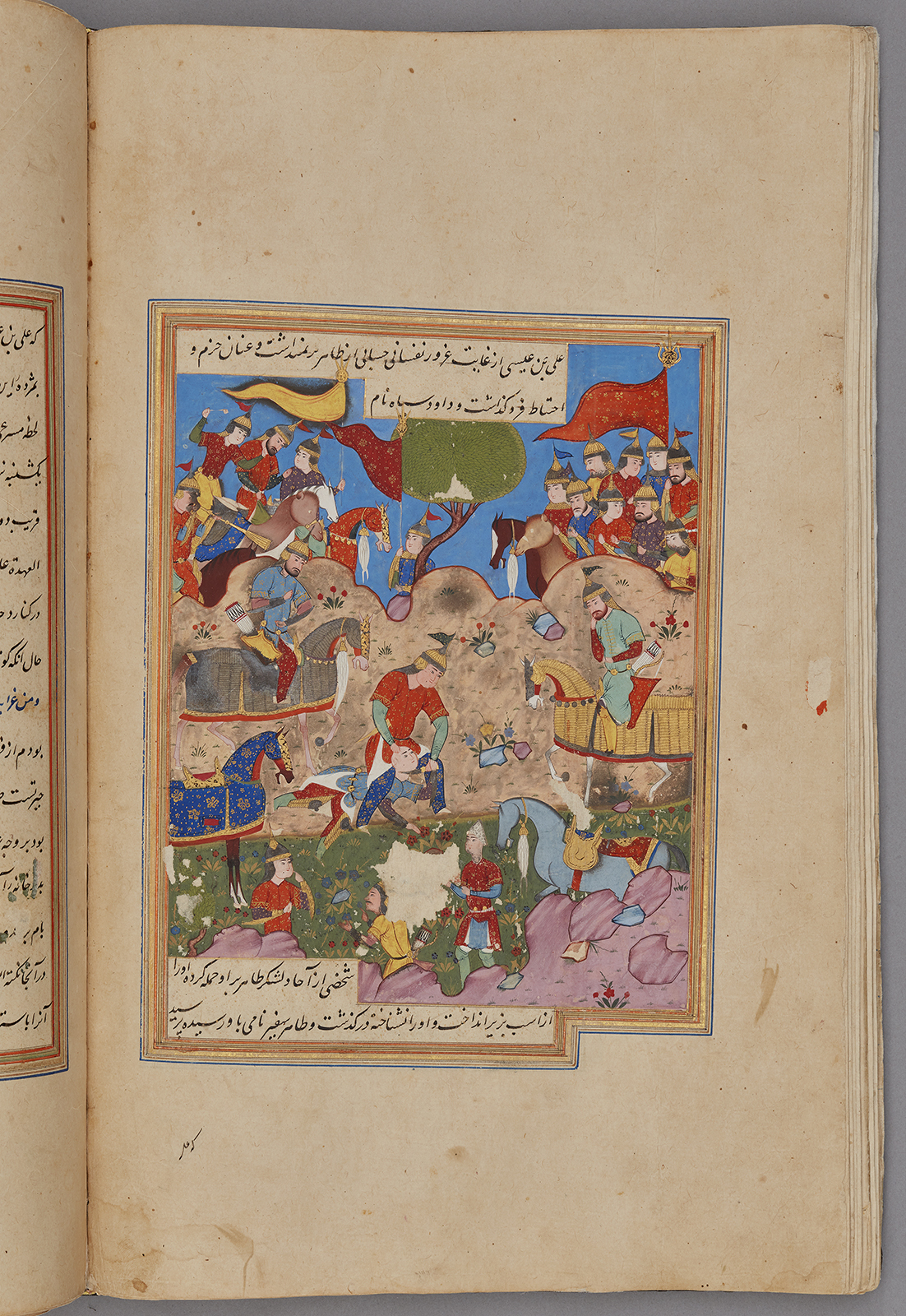
In 811 al-Amin sent a large army east under Ali ibn Isa ibn Mahan, a former governor of Khorasan whose harsh rule had made him hated there. The chroniclers put his force at about 40,000 men. Against him al-Ma’mun could send only a few thousand, under a little-known officer from a family of Khorasani clients, Tahir ibn Husayn. Near Rey, Tahir’s small army routed the caliphal force and Ali ibn Isa was killed. The full story of Tahir’s career is told on Tahir ibn Husayn.

The siege of Baghdad
Tahir pushed west through Hamadan and the Zagros, joined by the veteran general Harthama ibn A’yan. By 812 the two armies had surrounded Baghdad. The siege lasted about a year and wrecked much of Harun’s capital. Al-Tabari preserves poems of lament for the burned quarters and accounts of the city’s poor fighting the besiegers half-naked with slings and stones. In September 813 al-Amin tried to escape by river, was captured, and was killed by Tahir’s men. His head was sent to al-Ma’mun in Merv.
A caliphate ruled from Merv
Al-Ma’mun did not hurry west. For five more years he governed the whole caliphate from Merv, with al-Fadl ibn Sahl as his vizier, given the title Dhu’l-Riyasatayn, “holder of the two commands”, civil and military. To the Arab and Abbasid elite of Iraq this looked like a reversal of the order of things: the court, the treasury and the decisions had moved to Khorasan, in the hands of a Persian minister.
Baghdad and Iraq slid into disorder. Harthama, who went to Merv in 816 to warn the caliph of what was happening, was imprisoned and died there. Then, in March 817, al-Ma’mun took his most startling step. He named as his heir not an Abbasid but Ali ibn Musa al-Rida, a descendant of the Prophet through Ali and, for Twelver Shi’is, the eighth imam, and he replaced the black of the Abbasids with green as the dynasty’s colour. That episode, and the different ways it has been understood, is told on Imam Reza and the origins of Mashhad. The Abbasid family in Baghdad answered by proclaiming al-Ma’mun’s uncle, Ibrahim ibn al-Mahdi, caliph in July 817.
The return to Baghdad
Late in 817 al-Ma’mun at last set out for Iraq. On the way, in February 818, al-Fadl ibn Sahl was murdered in his bath at Sarakhs. In late summer 818 Ali al-Rida died suddenly at Tus. Many contemporaries, and Shi’i tradition, held al-Ma’mun responsible for one or both deaths; other historians think he was simply relieved of two figures who stood between him and reconciliation with Baghdad. With both gone, Ibrahim’s support collapsed. Al-Ma’mun entered Baghdad in August 819, still in green, and within days restored black.
- 802 Harun’s succession settlement at Mecca
- 809 Harun dies at Tus; al-Amin caliph, al-Ma’mun in Merv
- 810 Al-Amin names his son Musa heir
- 811 Tahir defeats Ali ibn Isa near Rey
- 812–813 Siege of Baghdad; al-Amin killed
- 817 Ali al-Rida named heir; Ibrahim ibn al-Mahdi proclaimed in Baghdad
- 818 Al-Fadl ibn Sahl murdered; Ali al-Rida dies at Tus
- 819 Al-Ma’mun enters Baghdad
- 821 Tahir appointed governor of Khorasan
An Iranian victory
Older histories described the war as Persians against Arabs, the eastern son of a Persian mother against the western son of an Arab princess. Modern historians such as Hugh Kennedy and Michael Cooperson prefer a more careful picture: al-Ma’mun’s support came from the army and landed gentry of Khorasan and their clients, many of them Arab settlers’ descendants, and the struggle was as much about regional power and money as about ethnicity. Still, the result mattered greatly for Iran. The men who won the war were Khorasanis, and they expected their reward.
It came in 821, when al-Ma’mun appointed Tahir governor of Khorasan. His family held the post for half a century, the first in a line of eastern dynasties described in the Tahirids of Khorasan. Merv’s moment as an imperial capital also left a cultural mark: the court that al-Ma’mun later brought to Baghdad carried eastern scholars and patterns of patronage with it, part of the story of Persian influence on the Abbasid caliphate.
Persian words from this page
| مأمون | Ma’mun | al-Ma’mun |
| امین | Amin | al-Amin |
| مرو | Marv | Merv |
| طوس | Tus | Tus |
| طاهر | Tâher | Tahir |
| فضل بن سهل | Fazl ebn-e Sahl | al-Fadl ibn Sahl |
Sources and further reading
- al-Tabari, The History of al-Tabari, vol. 31, The War between Brothers, translated by Michael Fishbein (SUNY Press, 1992), and vol. 32, The Reunification of the ‘Abbasid Caliphate, translated by C. E. Bosworth (1987).
- Michael Cooperson, Al-Ma’mun (Makers of the Muslim World, Oneworld, 2005).
- Hugh Kennedy, The Early Abbasid Caliphate: A Political History (1981).
- “Ma’mun”, Encyclopaedia Iranica.
- The Cambridge History of Iran, vol. 4, From the Arab Invasion to the Saljuqs, ed. R. N. Frye (1975).
Want to learn Persian? Get the free Starter Pack
Get the 14-page printable Starter Pack (all 32 letters, a 7-day reading plan, 100 core words and 20 survival phrases) and a short 5-email course. Free.
More in The Arab Conquest and Early Islamic Iran (633–820 CE)
- Salman the Persian
- Why the Sasanian Empire Fell
- The Battle of the Bridge (634)
- The Battle of al-Qadisiyyah
- Rostam Farrokhzad
- The Fall of Ctesiphon
- The Battle of Jalula
- The Battle of Nahavand: “Victory of Victories”
- The Conquest of Fars, Khorasan and the East
- Peroz III and the Sasanian Exiles in China
- Iranian Resistance: Tabaristan and the Dabuyids
- Zoroastrians after the Arab Conquest
- Iran under the Umayyads
- The Mawali and the Shu’ubiyya Movement
- Abu Muslim and the Abbasid Revolution
- The Death of Abu Muslim and the Iranian Revolts
- The Barmakids: Persian Viziers of Baghdad
- Al-Ma’mun in Merv and the Civil War
- Tahir ibn Husayn
- Imam Reza and the Origins of Mashhad
- Babak Khorramdin’s Revolt
- Persian Influence on the Abbasid Caliphate
- The Birth of New Persian