Peroz III was the son of Yazdegerd III, the last Sasanian king of Persia. After his father was killed near Merv in 651, Peroz tried for some twenty-five years to recover the throne with help from Central Asian princes and the Tang emperors of China, and he died in exile in the Tang capital Chang’an, probably around 679. His son Narsieh and other Persian refugees continued the cause into the early eighth century.
| Persian name | پیروز سوم (Piruz-e sevvom) |
|---|---|
| Chinese name | Beilusi, in Tang records |
| Born | c. 636 |
| Tang title | Governor of the “Persian Area Command” (from 661); later a general of the imperial guard |
| Died | Chang’an (Xi’an), c. 679 |
| Successor in exile | His son Narsieh, d. in Chang’an c. 708 |
A king without a kingdom
Yazdegerd III spent the last decade of his reign retreating east, from Ctesiphon to Isfahan, Fars, Kerman and finally Khorasan, as told on the conquest of Fars, Khorasan and the east and on Yazdegerd III. Even before his death he had sent envoys to the Tang court asking for help. Chinese sources record a Persian embassy in 638 and further missions afterwards.
Peroz, still a young man in 651, escaped to Tokharistan, the land around the upper Oxus in what is now northern Afghanistan, whose rulers were vassals of the Western Turks and, at a distance, of China. From there he continued to call himself King of Kings and to look for allies.
The “Persian Area Command”
China under Emperor Gaozong was then at the height of its power in Central Asia. After the Tang defeated the Western Turks in 657, they set up a network of nominal commands over the princes of the region. In 661, according to the Tang histories, they established one of these for Persia, the Bosi dudufu or “Persian Area Command”, with Peroz as its governor. Its seat is named as Jiling, which many scholars have identified with Zaranj in Sistan, though others have argued for a place in the southern Hindu Kush. The question is still open.
This was not a Chinese army marching to restore a Persian king. The Tang gave Peroz recognition, titles and a place in their system of protected states, but they sent no great force west. Meanwhile the Arabs, though slowed by their own civil war of 656–661, pushed steadily into Sistan and Khorasan. Some time after 670 Peroz lost his foothold and left for China.
A Persian prince in Chang’an
Peroz arrived in Chang’an in the 670s. The emperor gave him the rank of a general of the imperial guard, a court honour rather than a command. Tang records say that in 677 he asked permission to build a “Persian temple” in the city’s Liquan ward. Whether this was a Zoroastrian fire temple or a church of the Church of the East, which the Chinese also at first called “Persian”, is debated.
Chang’an at that time was one of the most international cities in the world. Merchants from Soghdia and Persia, many of them Zoroastrians, lived in its western market quarters, and Persian goods, music and fashions were popular at court. Peroz died there, probably around 679. A later echo of this community is a bilingual tombstone found in Xi’an in 1955, inscribed in Middle Persian and Chinese for the wife of a Persian officer named Su Liang, who died in 874; it is one of the latest dated Middle Persian inscriptions anywhere.
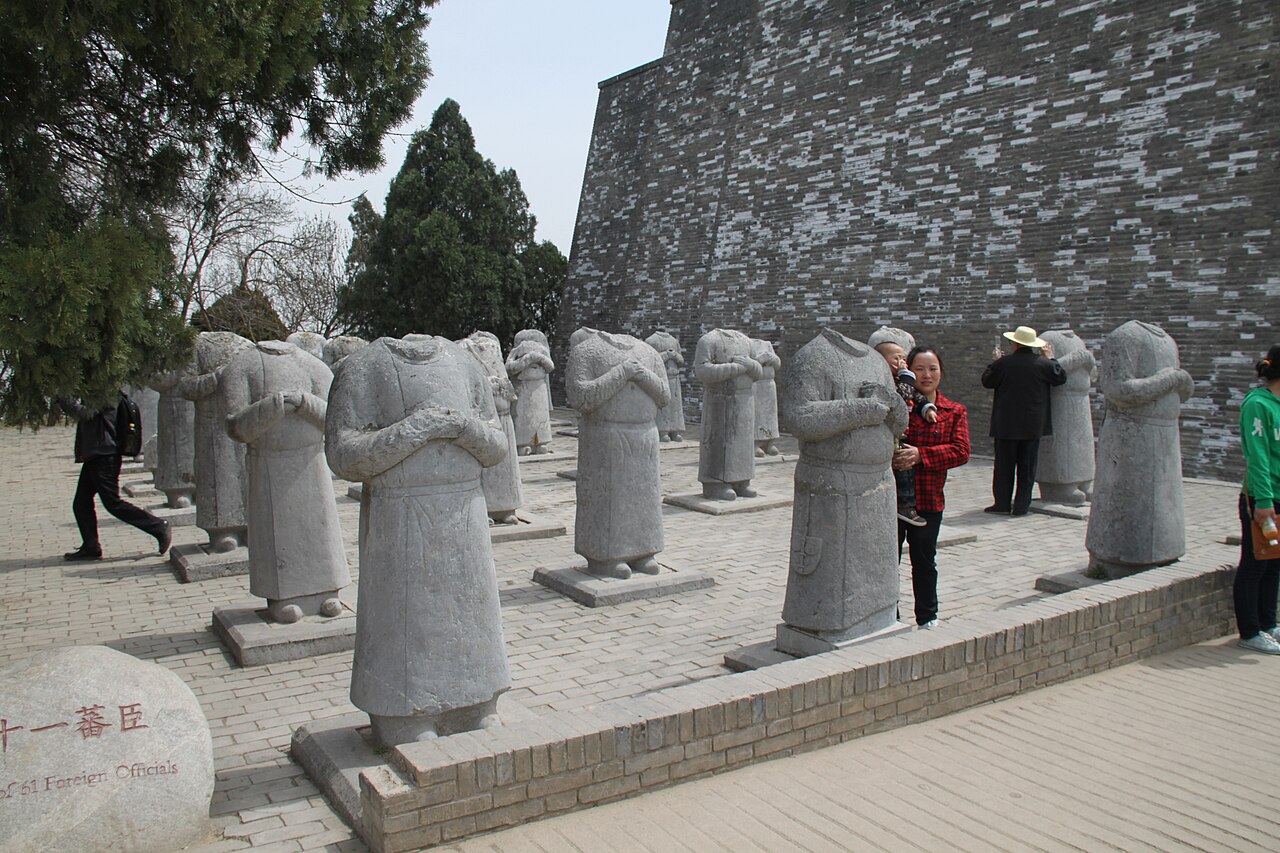

A statue at Gaozong’s tomb
When Gaozong died in 683, he was buried at Qianling, north-west of Chang’an, and his widow, later Empress Wu Zetian, had statues of sixty-one foreign rulers and envoys set up near the approach to the tomb as if in permanent attendance. Inscriptions on their backs, recorded before most wore away, named one of them as Peroz, King of Persia, general of the guard and governor of the Persian Area Command. The statues still stand, headless, in two groups. They are the only portrait, of a kind, of the last Sasanian claimant.
Narsieh’s attempt
After Peroz’s death the Tang recognised his son, whom Chinese records call Ninieshi, probably Narseh or Narsieh. In 679 the general Pei Xingjian was ordered to escort him west and restore him. Pei, however, used the expedition to deal with a Western Turkish rebel and stopped at Suyab in today’s Kyrgyzstan. Narsieh went on alone to Tokharistan, where he is said to have stayed for some twenty years fighting the Arabs with dwindling support. Around 707–708 he returned to Chang’an, was given a guard title like his father, and died there soon afterwards.
Chinese records mention later “Persian” embassies to the Tang court well into the eighth century, some perhaps from Sasanian descendants, others from merchants using the name. The Arabic sources also speak of a Sasanian prince called Khosrow who joined the Turks against the Arabs in Transoxiana around 728. After that, the line disappears from history.
- 638 First recorded Persian embassy to the Tang
- 651 Yazdegerd III killed near Merv; Peroz flees to Tokharistan
- 661 Tang create the Persian Area Command under Peroz
- 670s Peroz settles in Chang’an
- 677 Persian temple built in Chang’an at his request
- c. 679 Peroz dies; Pei Xingjian escorts Narsieh west
- c. 707–708 Narsieh returns to Chang’an and dies
Why the exile matters
The story of Peroz is a reminder that the fall of the Sasanians took place inside a wider Eurasian world. The Persian kings had long exchanged envoys with China along the routes described on Iran and the Silk Road, and the Tang court naturally saw a fallen ally as a client to protect. Persian memory, by contrast, largely forgot Peroz; the Shahnameh ends with Yazdegerd’s death. The fullest record of the last Sasanian claimants is in Chinese, in the dynastic histories of the Tang.
Persian words from this page
| پیروز | Piruz | Peroz; also “victorious” |
| یزدگرد سوم | Yazdgerd-e sevvom | Yazdegerd III |
| چین | Chin | China |
| نرسی | Narsi | Narseh |
| تخارستان | Tokhârestân | Tokharistan |
| ساسانیان | Sâsâniyân | the Sasanians |
Sources and further reading
- Jiu Tangshu (Old Book of Tang) and Xin Tangshu (New Book of Tang), chapters on Bosi (Persia).
- “China xv. The Last Sasanians in China”, Encyclopaedia Iranica.
- Matteo Compareti, “The Last Sasanians in China”, Eurasian Studies 2 (2003).
- Domenico Agostini and Sören Stark, “Zawulistan, Kawulistan and the Land Bosi: On the Question of a Sasanian Court-in-Exile in the Southern Hindukush”, Studia Iranica 45 (2016).
- Touraj Daryaee, Sasanian Persia: The Rise and Fall of an Empire (I. B. Tauris, 2009).
Want to learn Persian? Get the free Starter Pack
Get the 14-page printable Starter Pack (all 32 letters, a 7-day reading plan, 100 core words and 20 survival phrases) and a short 5-email course. Free.
More in The Arab Conquest and Early Islamic Iran (633–820 CE)
- Salman the Persian
- Why the Sasanian Empire Fell
- The Battle of the Bridge (634)
- The Battle of al-Qadisiyyah
- Rostam Farrokhzad
- The Fall of Ctesiphon
- The Battle of Jalula
- The Battle of Nahavand: “Victory of Victories”
- The Conquest of Fars, Khorasan and the East
- Peroz III and the Sasanian Exiles in China
- Iranian Resistance: Tabaristan and the Dabuyids
- Zoroastrians after the Arab Conquest
- Iran under the Umayyads
- The Mawali and the Shu’ubiyya Movement
- Abu Muslim and the Abbasid Revolution
- The Death of Abu Muslim and the Iranian Revolts
- The Barmakids: Persian Viziers of Baghdad
- Al-Ma’mun in Merv and the Civil War
- Tahir ibn Husayn
- Imam Reza and the Origins of Mashhad
- Babak Khorramdin’s Revolt
- Persian Influence on the Abbasid Caliphate
- The Birth of New Persian