New Persian, the language spoken in Iran, Afghanistan and Tajikistan today, grew out of the spoken Persian of the late Sasanian empire and emerged as a written language between the eighth and tenth centuries, after the Arab conquest. It kept Persian grammar, took in many Arabic words and adopted the Arabic alphabet with four added letters, and by the time of the Samanid court poets in the tenth century it had become a literary language that a modern reader of Persian can still follow.
| Persian names | فارسی (Fârsi), دری (Dari), پارسی (Pârsi) |
|---|---|
| Ancestor | Middle Persian, the language of the Sasanian empire |
| Earliest texts | Judeo-Persian letters and inscriptions in Hebrew script, 8th century |
| First poetry in Arabic script | 9th century, at the courts of the Tahirids and Saffarids |
| Literary flowering | 10th century, Samanid Bukhara: Rudaki, Bal’ami, Ferdowsi’s sources |
| Added letters | پ چ ژ گ (p, ch, zh, g) |
What came before: Middle Persian
Under the Sasanians, the written language of the state and of the Zoroastrian church was Middle Persian, often called Pahlavi, set down in a difficult script derived from Aramaic in which many words were written as Aramaic “ideograms” and read aloud in Persian. That written form is described on Middle Persian language and literature. Alongside it, people spoke a range of related Iranian languages: Parthian in the north-east, Soghdian in Central Asia, Khwarazmian, Bactrian and many local dialects.
Dari, the language of the court
A report going back to Ibn al-Muqaffa’, the eighth-century translator, and preserved by Ibn al-Nadim, lists the languages of Iran and calls one of them Dari: the language spoken at the royal court, dar or darbar, and in the capital. This spoken court Persian, simpler in grammar than written Pahlavi, is the direct ancestor of New Persian.
It spread east with Sasanian administration, and then, paradoxically, faster still under Arab rule. The Arab armies that conquered Khorasan and Transoxiana, described on the conquest of Fars and Khorasan, included many Persian-speaking soldiers and converts, and Persian became the common language of Muslim towns such as Merv, Nishapur, Balkh, Bukhara and Samarkand. There it gradually replaced Parthian, Bactrian and Soghdian. This is why New Persian was born as a written language in the east, in Khorasan and Central Asia, rather than in Fars, the old Persian homeland.
A new alphabet
For two centuries after the conquest, educated Iranians wrote in Arabic, the language of religion and government, while Zoroastrian priests kept copying Pahlavi books. When Persian speakers began to write their own spoken language, they used the script they already knew, the Arabic alphabet, and added four letters for sounds Arabic lacks: پ (p), چ (ch), ژ (zh) and گ (g). The result is the Persian alphabet learners use today; the site’s guide to the Persian alphabet and the post on Persian script explain how it works, and Farsi vs Arabic sets out why the two languages, despite sharing a script, are unrelated.
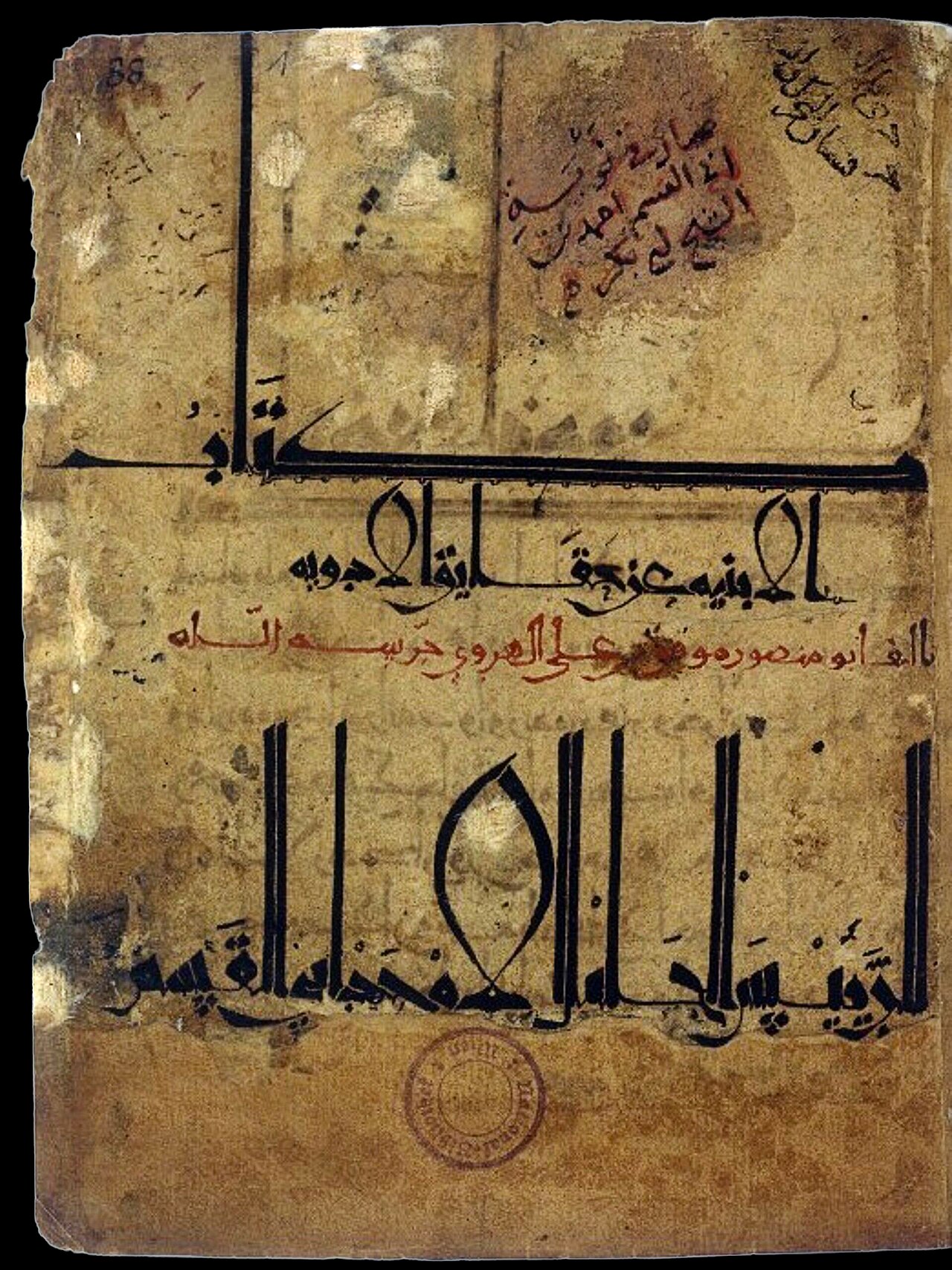

The earliest texts
The oldest surviving New Persian is not in Arabic script at all. Jewish communities in Iran and Central Asia wrote their Persian in Hebrew letters, and a few of their documents survive from the eighth century: a business letter found at Dandan-Uiliq near Khotan in Xinjiang, usually dated to the eighth century, and short rock inscriptions at Tang-i Azao in central Afghanistan from the middle of the same century. Manichaeans in Central Asia also wrote early Persian in their own script. These texts show a language already close to classical Persian.
The first poets
Persian literary tradition likes to find a first poet. One story makes the Sasanian king Bahram Gur the inventor of Persian verse; another, told by the thirteenth-century anthologist Awfi, credits a poet called Abbas of Merv with a Persian ode for al-Ma’mun on his arrival in Merv in 809. Neither can be trusted. The first reliable names belong to the ninth century: Hanzala of Badghis, linked with the Tahirids, and Muhammad ibn Wasif, secretary of the Saffarid ruler Ya’qub ibn Layth. According to the Tarikh-e Sistan, when poets praised Ya’qub in Arabic he asked why they recited something he could not understand, and Muhammad ibn Wasif then composed a poem in Persian. The story may be polished, but it captures the moment: new rulers from Iranian backgrounds wanted to be praised in their own language. The rest of that dynasty’s story is on the Saffarids.
The Samanid flowering
The decisive step came at the court of the Samanids in Bukhara in the tenth century, covered on the Samanid Empire. There Persian became a language of high poetry and of serious prose. Rudaki, often called the father of Persian poetry, wrote verses that Iranian schoolchildren still learn. The vizier Bal’ami produced a Persian version of al-Tabari’s history, and a Persian translation of Tabari’s Qur’an commentary was made with the approval of the religious scholars, an important sign that Persian could be used for religious learning. The prose preface to the Shahnameh compiled for Abu Mansur of Tus in 957 survives as one of the oldest pieces of Persian prose. The wider movement is described on the Samanid Persian renaissance.
What the new language was like
New Persian continued the simplification of grammar already well advanced in spoken Middle Persian, and absorbed a large vocabulary from Arabic, especially for religion, law, science and abstract ideas. The core of everyday words and the structure of the language stayed Persian. That is why a learner today meets words such as کتاب (ketâb, book, from Arabic) alongside خانه (khâne, house, inherited from Middle Persian), in sentences built on purely Persian grammar.
The name of the language reflects this history. Persians called it pârsi or dari; the Arabic form fârsi, from Arabic’s lack of a “p”, became the usual name in Iran. The modern differences between Farsi, Dari and Tajik are explained on Farsi vs Persian vs Dari vs Tajik, and the whole story from Old Persian to the present is on a history of the Persian language.
Persian words from this page
| فارسی | Fârsi | Persian |
| دری | Dari | Dari, the court language |
| پهلوی | Pahlavi | Middle Persian writing |
| دربار | darbâr | royal court |
| رودکی | Rudaki | Rudaki |
| کتاب | ketâb | book |
| خانه | khâne | house |
Sources and further reading
- Gilbert Lazard, “The Rise of the New Persian Language”, in The Cambridge History of Iran, vol. 4 (1975).
- Gilbert Lazard, La formation de la langue persane (Paris, 1995).
- Ludwig Paul, “Persian Language i. Early New Persian”, Encyclopaedia Iranica.
- Ibn al-Nadim, The Fihrist, translated by Bayard Dodge (1970), chapter 1 on languages and scripts.
- Tarikh-e Sistan, translated by Milton Gold as The Tarikh-e Sistan (Rome, 1976).
Want to learn Persian? Get the free Starter Pack
Get the 14-page printable Starter Pack (all 32 letters, a 7-day reading plan, 100 core words and 20 survival phrases) and a short 5-email course. Free.
More in The Arab Conquest and Early Islamic Iran (633–820 CE)
- Salman the Persian
- Why the Sasanian Empire Fell
- The Battle of the Bridge (634)
- The Battle of al-Qadisiyyah
- Rostam Farrokhzad
- The Fall of Ctesiphon
- The Battle of Jalula
- The Battle of Nahavand: “Victory of Victories”
- The Conquest of Fars, Khorasan and the East
- Peroz III and the Sasanian Exiles in China
- Iranian Resistance: Tabaristan and the Dabuyids
- Zoroastrians after the Arab Conquest
- Iran under the Umayyads
- The Mawali and the Shu’ubiyya Movement
- Abu Muslim and the Abbasid Revolution
- The Death of Abu Muslim and the Iranian Revolts
- The Barmakids: Persian Viziers of Baghdad
- Al-Ma’mun in Merv and the Civil War
- Tahir ibn Husayn
- Imam Reza and the Origins of Mashhad
- Babak Khorramdin’s Revolt
- Persian Influence on the Abbasid Caliphate
- The Birth of New Persian