The mawali were non-Arab Muslims, most of them Iranian converts, who in the first Islamic centuries had to attach themselves as clients to an Arab tribe and were often treated as second-class believers. Out of their struggle for equal standing grew the Shu’ubiyya, an 8th- to 10th-century literary movement, written in Arabic, in which Persian writers defended the culture of the non-Arab peoples against claims of Arab superiority.
| Mawali | Plural of mawla, “client”; non-Arab converts and freed slaves attached to an Arab patron or tribe |
|---|---|
| Shu’ubiyya | From shu’ub, “peoples”, in Qur’an 49:13 |
| Main period | Mawali grievances: 7th–8th century; Shu’ubiyya debate: mid-8th to 10th century |
| Centres | Basra, Kufa and Abbasid Baghdad |
| Key figures | Ibn al-Muqaffa, Bashshar ibn Burd, Abu Ubayda, Sahl ibn Harun; opponents al-Jahiz and Ibn Qutayba |
Becoming a client
Early Islamic society was built on Arab tribes. A non-Arab who converted, or a prisoner of war who was freed, needed a place in that system, and the solution was clientage (wala’). The convert became the mawla of an Arab patron and through him of his tribe, taking its name in his own. In the first generations after the conquest thousands of Iranians, from captured soldiers to townspeople and landowners, entered Muslim society this way.
In law, Islam made all believers equal. In practice the Arab conquerors kept a clear distinction. Mawali who fought in the armies often received lower pay than Arabs and served on foot rather than horseback. Marriages between mawali men and Arab women were frowned on. And above all, many converts were still charged the poll tax (jizya) intended for non-Muslims, because tax collectors and governors did not want to lose revenue. A report preserved by the chroniclers says that al-Hajjaj ordered converts who had moved to the towns to go back to their villages, and had the names of their villages marked on their hands. The wider political setting is described on Iran under the Umayyads.
Mawali in religion and learning
Despite their lower status, mawali soon dominated many fields. Townsmen of Iranian, Aramaean and other backgrounds made up a large share of the early scholars of law, Qur’an recitation and hadith. The founder of Arabic grammar as a systematic science, Sibawayh, who died around 796, was a Persian from Fars, and his book on Arabic, known simply as al-Kitab, became the foundation of the subject. That an Iranian wrote the classic grammar of the Arabic language says much about how quickly the communities mixed.
Mawali also joined opposition movements in large numbers, from the revolt of al-Mukhtar in Kufa in the 680s to the movement that brought the Abbasids to power. The question of who exactly made up Abu Muslim’s army is discussed on Abu Muslim and the Abbasid revolution.

The Shu’ubiyya
After 750 the clientage system faded, and Iranians rose to the highest offices of the Abbasid state, as told on the Barmakids and Persian influence on the Abbasid caliphate. The argument about status moved into literature. The name comes from the Qur’anic verse “We made you into peoples (shu’ub) and tribes so that you may know one another; the noblest of you in God’s sight is the most righteous.” Writers of Persian descent used it to argue that no people was better than another, and some went further, claiming that the Persians, with their kings, laws and sciences, had been the more civilised.
The writers
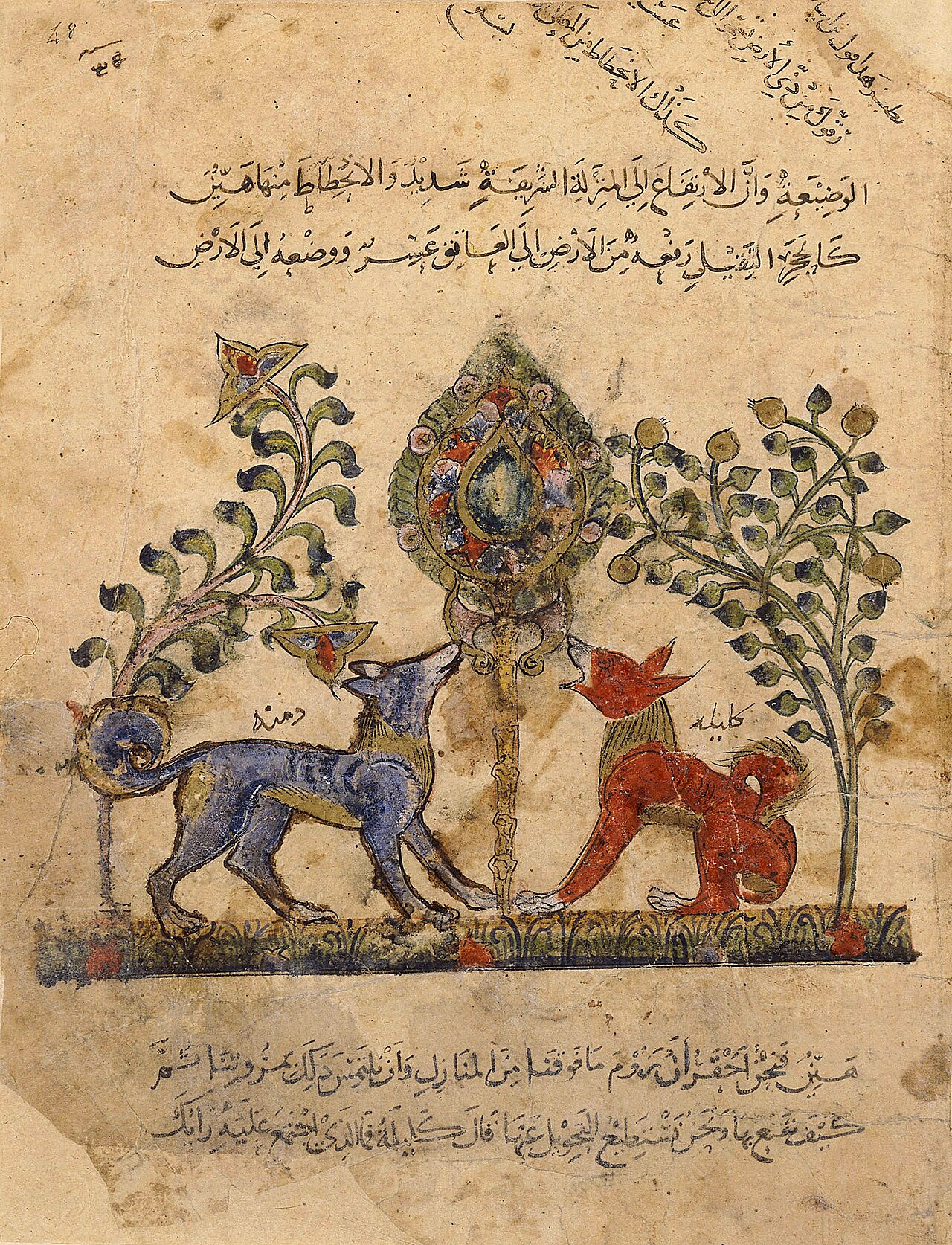
- Ibn al-Muqaffa, born Ruzbih in Fars, translated Middle Persian books into elegant Arabic prose, including Kalila wa Dimna and a version of the Sasanian book of kings. He was executed in about 756–759. He was not a polemicist, but his translations brought Sasanian wisdom into the centre of Arabic literature. The book’s earlier journey from India is told on Borzuya, chess and Kalila wa Dimna.
- Bashshar ibn Burd, a blind poet of Persian descent from Basra, wrote verses boasting of his Persian ancestors and mocking the desert Arabs. He was put to death in 783 on charges of heresy.
- Abu Ubayda, a philologist of Basra of non-Arab origin, collected material on the faults of the Arab tribes, and Sahl ibn Harun, a Persian who worked in the library of the caliph al-Ma’mun, wrote in praise of Persian ways.
The answer
The Shu’ubiyya provoked strong replies. Al-Jahiz of Basra, one of the greatest Arabic prose writers, attacked the Shu’ubis in several works, defending Arab eloquence and customs. Ibn Qutayba, who died in 889, wrote a book on the virtues of the Arabs against them. Ibn Qutayba was himself of Persian descent. The debate was therefore not simply Persians against Arabs: it divided Muslims of Iranian background as well, between those who identified with the Arab-Islamic tradition and those who wanted the Persian past honoured within it.
What the movement was about
Historians have read the Shu’ubiyya in different ways. Ignaz Goldziher in the 19th century saw it as a national reaction by conquered peoples. H. A. R. Gibb argued in 1953 that it was mainly the voice of the secretary class, Persian-trained bureaucrats who wanted the caliphate to be run on Sasanian lines, and that it challenged Arab-Islamic culture from within. Roy Mottahedeh, in 1976, stressed that it was a dispute about status inside a shared Muslim society, not a movement to restore Iranian independence or the old religion. Almost everything it produced was written in Arabic, by Muslims.
Later echoes
The real Persian revival came in a different form: the new Persian literature of the 9th and 10th centuries, culminating in Ferdowsi’s Shahnameh, written in Persian for Persian-speaking courts. The background is on the birth of New Persian.
In the 20th century the word acquired new political meanings. Some Arab nationalist writers used “shu’ubi” as an insult for anyone accused of hostility to Arabs, a usage common in Ba’thist Iraq. Some Iranian nationalists, in turn, claimed the Shu’ubiyya as an early sign of Iranian national feeling. Both uses say more about modern politics than about Basra and Baghdad in the 8th century.
Persian words from this page
| موالی | mavâli | mawali, clients |
| شعوبیه | Sho’ubiye | the Shu’ubiyya |
| ابن مقفع | Ebn-e Moqaffa’ | Ibn al-Muqaffa |
| کلیله و دمنه | Kelile va Demne | Kalila wa Dimna |
| سیبویه | Sibeveyh | Sibawayh |
| عرب | arab | Arab |
For how Persian and Arabic relate as languages today, see Farsi vs Arabic.
Sources and further reading
- Ignaz Goldziher, Muslim Studies, vol. 1 (English translation 1967; German original 1889).
- H. A. R. Gibb, “The Social Significance of the Shu’ubiya” (1953), reprinted in his Studies on the Civilization of Islam (1962).
- Roy P. Mottahedeh, “The Shu’ubiyah Controversy and the Social History of Early Islamic Iran”, International Journal of Middle East Studies 7 (1976).
- Patricia Crone, Slaves on Horses: The Evolution of the Islamic Polity (1980), on clientage.
- al-Jahiz, Kitab al-Bayan wa’l-Tabyin.
Want to learn Persian? Get the free Starter Pack
Get the 14-page printable Starter Pack (all 32 letters, a 7-day reading plan, 100 core words and 20 survival phrases) and a short 5-email course. Free.
More in The Arab Conquest and Early Islamic Iran (633–820 CE)
- Salman the Persian
- Why the Sasanian Empire Fell
- The Battle of the Bridge (634)
- The Battle of al-Qadisiyyah
- Rostam Farrokhzad
- The Fall of Ctesiphon
- The Battle of Jalula
- The Battle of Nahavand: “Victory of Victories”
- The Conquest of Fars, Khorasan and the East
- Peroz III and the Sasanian Exiles in China
- Iranian Resistance: Tabaristan and the Dabuyids
- Zoroastrians after the Arab Conquest
- Iran under the Umayyads
- The Mawali and the Shu’ubiyya Movement
- Abu Muslim and the Abbasid Revolution
- The Death of Abu Muslim and the Iranian Revolts
- The Barmakids: Persian Viziers of Baghdad
- Al-Ma’mun in Merv and the Civil War
- Tahir ibn Husayn
- Imam Reza and the Origins of Mashhad
- Babak Khorramdin’s Revolt
- Persian Influence on the Abbasid Caliphate
- The Birth of New Persian