Tahir ibn Husayn (775/6–822) was the Khorasani general who won the Abbasid civil war for al-Ma’mun, defeating the caliphal army near Rey in 811 and taking Baghdad in 813. In 821 al-Ma’mun made him governor of Khorasan, and his descendants ruled there for half a century, the first of the Iranian dynasties that grew up inside the caliphate.
| Full name | Tahir ibn al-Husayn ibn Mus’ab |
|---|---|
| Persian | طاهر ذوالیمینین (Tâher-e Zu’l-yamineyn) |
| Born | 775 or 776, Bushanj (Pushang), near Herat |
| Known for | Victory over Ali ibn Isa near Rey (811); siege of Baghdad (812–813) |
| Governor of Khorasan | From 821 |
| Died | 822, at Merv |
A family of clients in Bushanj
Tahir came from Bushanj, a small town in the Herat valley in what is now western Afghanistan. His grandfather Ruzayq was a mawla, a client, of the Arab governor Talha ibn Abd Allah al-Khuza’i, and so the family carried the tribal label “al-Khuza’i” while being of local Iranian stock. The client system they belonged to is described on the mawali and the Shu’ubiyya. Tahir’s grandfather and father had supported the Abbasid revolution, and his father Husayn held local office in Bushanj and Herat. Later the family’s court circle gave it a grander ancestry reaching back to the heroes of Iranian epic, a common practice among Iranian dynasties of the period.
Tahir had lost the sight of one eye, and a poet’s line calling him “one-eyed, with two right hands” fixed his nickname, Dhu’l-Yaminayn, “the man with two right hands”. The chroniclers explain it in different ways: that he could strike with a sword held in either hand, or that al-Ma’mun gave it to him in praise. Before the civil war he had served in the campaign against the rebel Rafi’ ibn Layth in Transoxiana.
The battle near Rey, 811
When the quarrel between Harun al-Rashid’s sons turned to war, described on al-Ma’mun in Merv and the civil war, al-Ma’mun’s adviser al-Fadl ibn Sahl gave Tahir command of the small force sent to hold the road at Rey. Al-Amin’s general Ali ibn Isa ibn Mahan advanced from Iraq with an army the chroniclers put at around 40,000. Tahir is said to have had about 4,000 or 5,000 men.
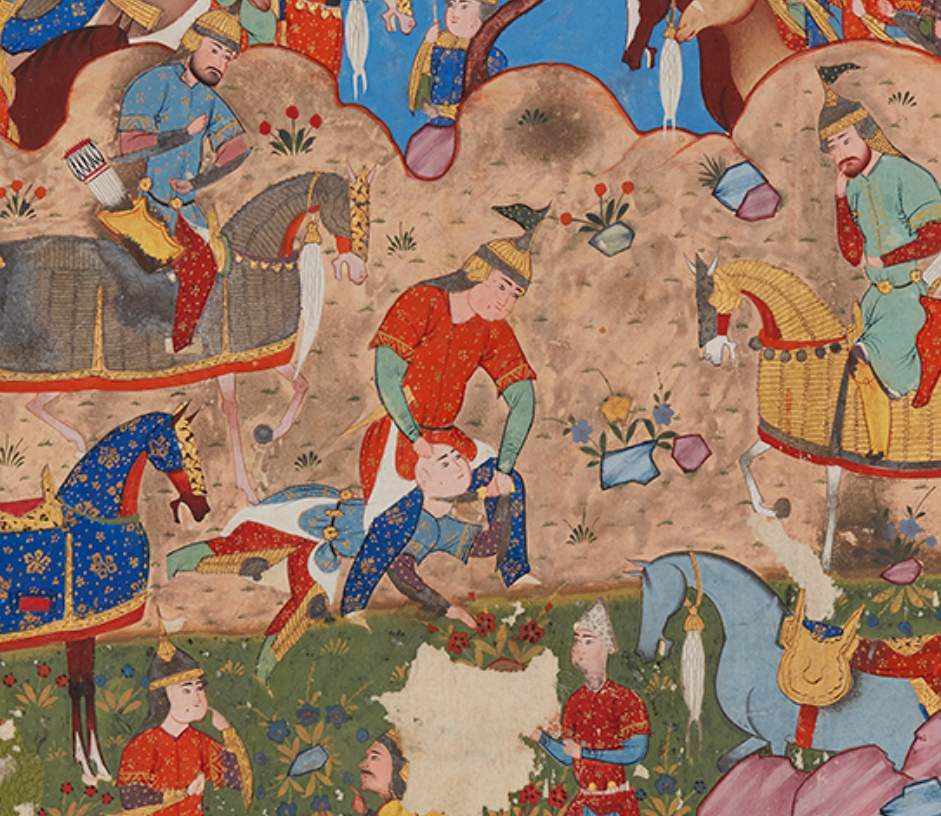
In the battle, fought in 811 just outside Rey, Ali ibn Isa was killed and his army broke. Al-Tabari reports the dispatch Tahir is supposed to have sent to Merv as a model of brevity: Ali’s head was before him, his ring on Tahir’s finger, his army under Tahir’s command. Whatever its exact wording, the news transformed the war, and soon afterwards al-Ma’mun was proclaimed caliph in Merv.

From Hamadan to Baghdad
Tahir pushed west. Near Hamadan he defeated a second army under Abd al-Rahman ibn Jabala, then crossed the Zagros by Hulwan. Rather than march straight on Baghdad, he turned south through Khuzestan, taking Ahvaz, then Wasit and al-Mada’in, cutting the capital off from its southern provinces. The veteran Harthama ibn A’yan approached from the north-east.
The siege of Baghdad lasted from 812 into September 813. Tahir’s troops held the western side of the city and fought street by street through its suburbs. When al-Amin finally tried to slip out by boat to surrender to Harthama, whom he trusted more, Tahir’s men caught him and killed him. Tahir sent the head to al-Ma’mun. For the caliph this was victory; it was also the killing of a brother and a caliph, and later writers suggest it left a lasting coolness between him and the general who did it.
Years in the west
Tahir was not rewarded with the east at once. Al-Fadl ibn Sahl, wary of a rival, kept him in the west, and Tahir spent several years at al-Raqqa in northern Mesopotamia fighting the Arab rebel Nasr ibn Shabath. When al-Ma’mun finally came to Baghdad in 819, Tahir met him and was made commander of the city’s security forces, the shurta, and given other high offices in Iraq.
The letter to his son
Around 821, when his son Abd Allah was given a western command, Tahir wrote him a long letter of advice on government: to rule with justice, keep watch over officials, protect taxpayers and be pious. Al-Tabari and Ibn Abi Tahir Tayfur preserved it, and Tabari reports that al-Ma’mun admired it so much that he had copies sent to his governors. It is one of the earliest examples in Islamic literature of the “mirror for princes”, a genre that continued the Sasanian tradition of advice to kings and would later flourish in Persian.
Governor of Khorasan, 821
In 821 al-Ma’mun appointed Tahir governor of Khorasan and all the lands east of Iraq. Why he did so is uncertain. The chroniclers tell stories of intrigue and of Tahir weeping before the caliph; historians more often point to the plain need for a strong, loyal Khorasani in a province still unsettled after the war and the death of al-Fadl ibn Sahl. Tahir left for Merv, and his career from that point belongs to the history of his dynasty: his short rule, the questions about his loyalty, and the long governorship of his son Abd Allah from Nishapur are told on the Tahirids of Khorasan.
How historians see him
Tahir is often called the first of the Iranian dynasties that ruled after the Arab conquest, the opening of what Vladimir Minorsky called the “Iranian intermezzo”. That needs a qualification. Tahir and his sons were loyal Abbasid servants, Arabic-speaking in their court culture, governing in the caliph’s name. Their importance lies in what their appointment showed: that the caliphate now depended on Iranian commanders and was ready to hand them hereditary power over the east. The dynasties that followed, the Saffarids and the Samanids, would push that much further.
Persian words from this page
| طاهر | Tâher | Tahir |
| ذوالیمینین | Zu’l-yamineyn | man with two right hands |
| پوشنگ | Pushang | Bushanj |
| هرات | Herât | Herat |
| ری | Rey | Rey |
| طاهریان | Tâheriyân | the Tahirids |
Sources and further reading
- al-Tabari, The History of al-Tabari, vol. 31, The War between Brothers, translated by Michael Fishbein (1992), and vol. 32, The Reunification of the ‘Abbasid Caliphate, translated by C. E. Bosworth (1987), which includes Tahir’s letter to his son.
- C. E. Bosworth, “The Tahirids and Saffarids”, in The Cambridge History of Iran, vol. 4 (1975).
- “Taherids”, Encyclopaedia Iranica.
- Michael Cooperson, Al-Ma’mun (Oneworld, 2005).
- Hugh Kennedy, The Prophet and the Age of the Caliphates (2nd ed., 2004).
Want to learn Persian? Get the free Starter Pack
Get the 14-page printable Starter Pack (all 32 letters, a 7-day reading plan, 100 core words and 20 survival phrases) and a short 5-email course. Free.
More in The Arab Conquest and Early Islamic Iran (633–820 CE)
- Salman the Persian
- Why the Sasanian Empire Fell
- The Battle of the Bridge (634)
- The Battle of al-Qadisiyyah
- Rostam Farrokhzad
- The Fall of Ctesiphon
- The Battle of Jalula
- The Battle of Nahavand: “Victory of Victories”
- The Conquest of Fars, Khorasan and the East
- Peroz III and the Sasanian Exiles in China
- Iranian Resistance: Tabaristan and the Dabuyids
- Zoroastrians after the Arab Conquest
- Iran under the Umayyads
- The Mawali and the Shu’ubiyya Movement
- Abu Muslim and the Abbasid Revolution
- The Death of Abu Muslim and the Iranian Revolts
- The Barmakids: Persian Viziers of Baghdad
- Al-Ma’mun in Merv and the Civil War
- Tahir ibn Husayn
- Imam Reza and the Origins of Mashhad
- Babak Khorramdin’s Revolt
- Persian Influence on the Abbasid Caliphate
- The Birth of New Persian