The Battle of Jalula was fought in late 637 on the road from Ctesiphon to the Zagros mountains, when Persian troops covering Yazdegerd III’s retreat entrenched themselves and were defeated by an Arab army under Hashim ibn Utba. The victory gave the Arabs all of lowland Iraq up to the foot of the Iranian plateau and pushed the Sasanian king back into Iran proper.
| Date | Late 637 (Dhu al-Qa’da AH 16 in Tabari); some writers place it in 638 |
|---|---|
| Place | Jalula, modern Jalawla in Diyala province, Iraq, on the main road to the Zagros passes |
| Sasanian commanders | Mihran Razi and Khorrazad, a brother of Rostam Farrokhzad |
| Arab commanders | Hashim ibn Utba, nephew of Sa’d ibn Abi Waqqas, with al-Qa’qa ibn Amr |
| Result | Arab victory; the Persians fall back to Hulwan and beyond |
Retreat towards the mountains
When Ctesiphon fell in 637, Yazdegerd III did not go far at first. He stopped at Hulwan, where the great road known later as the Khorasan Road climbs from the Mesopotamian plain into the Zagros. Between Hulwan and the lost capital lay the valley of the Diyala river, and there the Persian commanders gathered the troops who had escaped from al-Qadisiyyah and Ctesiphon, together with fresh levies from the plateau. Their task was to stop the Arabs reaching the king.
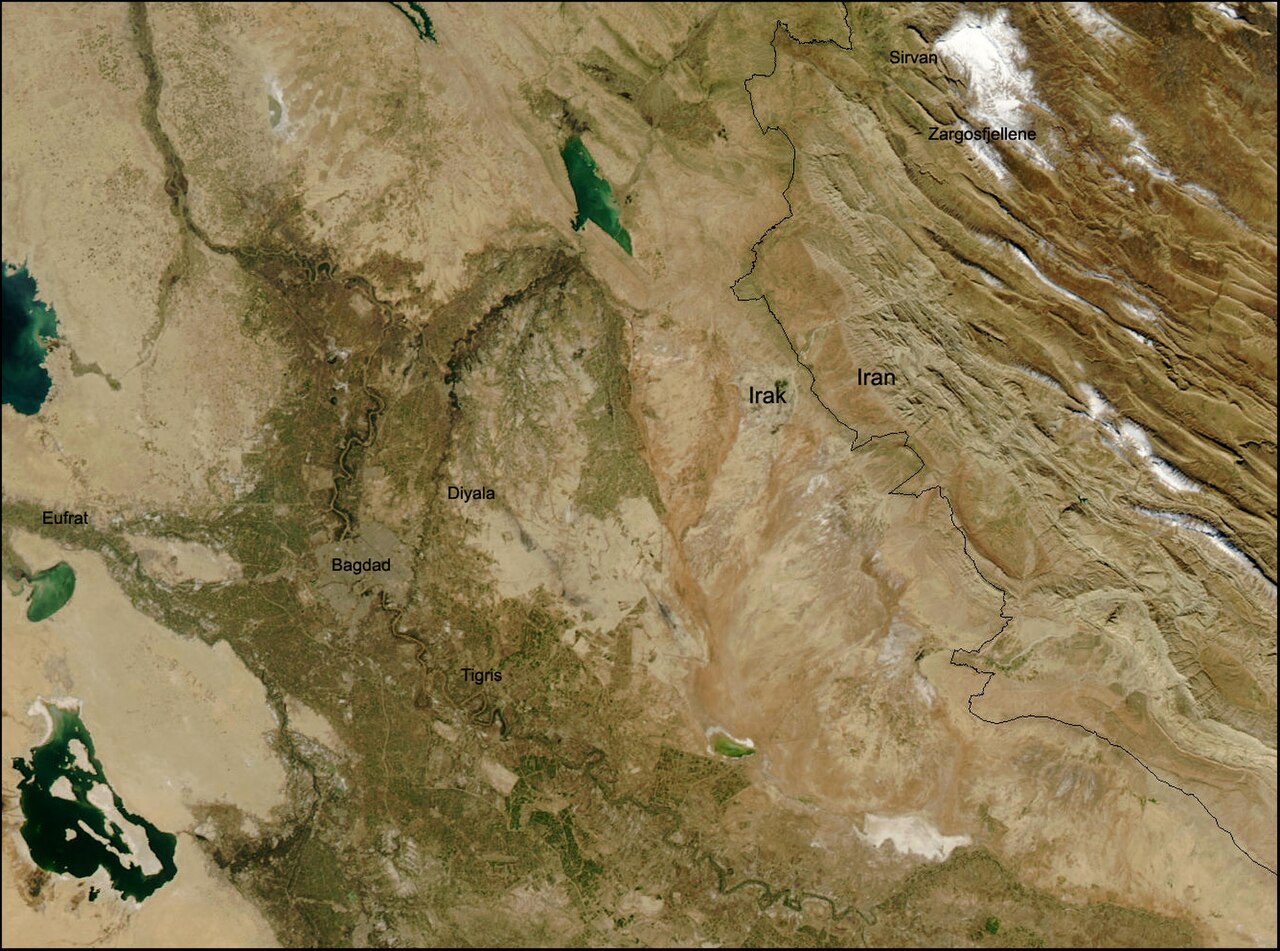

A fortified camp
The Persians chose to defend rather than attack. At Jalula they built a fortified camp, dug a trench around it and, according to the Arabic accounts, scattered iron caltrops on the approaches to cripple horses. The arrangement suited an army that had learned at al-Qadisiyyah how dangerous the Arab cavalry could be in open ground, and that could be supplied from the hills behind it.
Sa’d ibn Abi Waqqas stayed at Ctesiphon and sent his nephew Hashim ibn Utba with an army of several thousand men. Tabari describes a long stand-off with repeated skirmishes and sorties. The chronicles do not agree on how long it lasted, but they give the impression of weeks rather than days.
The battle
The decisive fight came when the Persians made a large sortie from their camp. In the confused fighting that followed, al-Qa’qa ibn Amr, the commander who had brought reinforcements to al-Qadisiyyah, is said to have seized one of the entrances through the trench and announced that the Arabs were inside. The Persian line gave way, and the trench and caltrops that had protected the camp now hampered the retreat. Tabari reports heavy Persian losses; like all such figures, his numbers are not reliable.
Al-Qa’qa pursued the survivors towards Hulwan. Mihran was killed at Khaniqin, a short distance up the road. Yazdegerd left Hulwan and withdrew deeper into Iran, to Ray and later to Isfahan and Fars, as told on the page on Yazdegerd III. Hulwan itself was taken and became the Arab frontier post at the foot of the mountains.
Booty and a pause
The camp at Jalula held much of what the Persians had carried out of Ctesiphon, and the Arabic sources describe a booty almost as great as that of the capital. The chroniclers tell that when the caliph Umar’s share arrived in Medina he wept, fearing that such wealth would bring discord among the Muslims.
A saying attributed to Umar in the same period expresses a wish that there were a barrier of fire between the Arabs in Iraq and the Persians in the mountains, so that neither could reach the other. Whether or not he said it, the policy of the next few years matches it. The caliph held the line at the edge of the Zagros and did not send his armies onto the plateau. Meanwhile, separate forces took Tikrit and Mosul to the north and pressed into Khuzestan in the south-east.
Why Jalula mattered
Jalula completed the conquest of the Sawad, the irrigated lowland that had paid a large share of the empire’s taxes. From now on the Sasanian state was an Iranian highland kingdom without its richest province. It could still raise armies, as it did a few years later, but it would have to fight in the mountains with the resources of the plateau alone.
The pause after Jalula also explains what came next. The Sasanian court used the time to call on the governors of the plateau for a great new army, and it was news of that army that persuaded Umar to change his policy. The result was the battle of Nahavand in 642.
Sources and their limits
Almost all of the detail above comes from Arabic reports collected by al-Tabari and al-Baladhuri in the 9th and 10th centuries, many of them through the 8th-century compiler Sayf ibn Umar, whose accounts tend to give leading roles to members of his own tribe, the Tamim, among them al-Qa’qa ibn Amr. Some modern historians have even wondered whether al-Qa’qa was as central as Sayf makes him. The broad sequence, a Persian stand on the Diyala road after the fall of the capital followed by an Arab victory and the occupation of Hulwan, is not in doubt. The Persian tradition preserved in the Shahnameh passes over Jalula entirely.
Persian words from this page
| جلولا | Jalulâ | Jalula |
| حلوان | Holvân | Hulwan |
| خندق | khandaq | trench, moat |
| غنیمت | ghanimat | booty, spoils |
| زاگرس | Zâgros | the Zagros mountains |
Sources and further reading
- al-Tabari, The History of al-Tabari, vol. 13, The Conquest of Iraq, Southwestern Persia, and Egypt, translated by G. H. A. Juynboll (SUNY Press).
- al-Baladhuri, Futuh al-Buldan, translated as The Origins of the Islamic State.
- Fred M. Donner, The Early Islamic Conquests (1981).
- Hugh Kennedy, The Great Arab Conquests (2007).
- Michael Morony, Iraq after the Muslim Conquest (1984).
Want to learn Persian? Get the free Starter Pack
Get the 14-page printable Starter Pack (all 32 letters, a 7-day reading plan, 100 core words and 20 survival phrases) and a short 5-email course. Free.
More in The Arab Conquest and Early Islamic Iran (633–820 CE)
- Salman the Persian
- Why the Sasanian Empire Fell
- The Battle of the Bridge (634)
- The Battle of al-Qadisiyyah
- Rostam Farrokhzad
- The Fall of Ctesiphon
- The Battle of Jalula
- The Battle of Nahavand: “Victory of Victories”
- The Conquest of Fars, Khorasan and the East
- Peroz III and the Sasanian Exiles in China
- Iranian Resistance: Tabaristan and the Dabuyids
- Zoroastrians after the Arab Conquest
- Iran under the Umayyads
- The Mawali and the Shu’ubiyya Movement
- Abu Muslim and the Abbasid Revolution
- The Death of Abu Muslim and the Iranian Revolts
- The Barmakids: Persian Viziers of Baghdad
- Al-Ma’mun in Merv and the Civil War
- Tahir ibn Husayn
- Imam Reza and the Origins of Mashhad
- Babak Khorramdin’s Revolt
- Persian Influence on the Abbasid Caliphate
- The Birth of New Persian