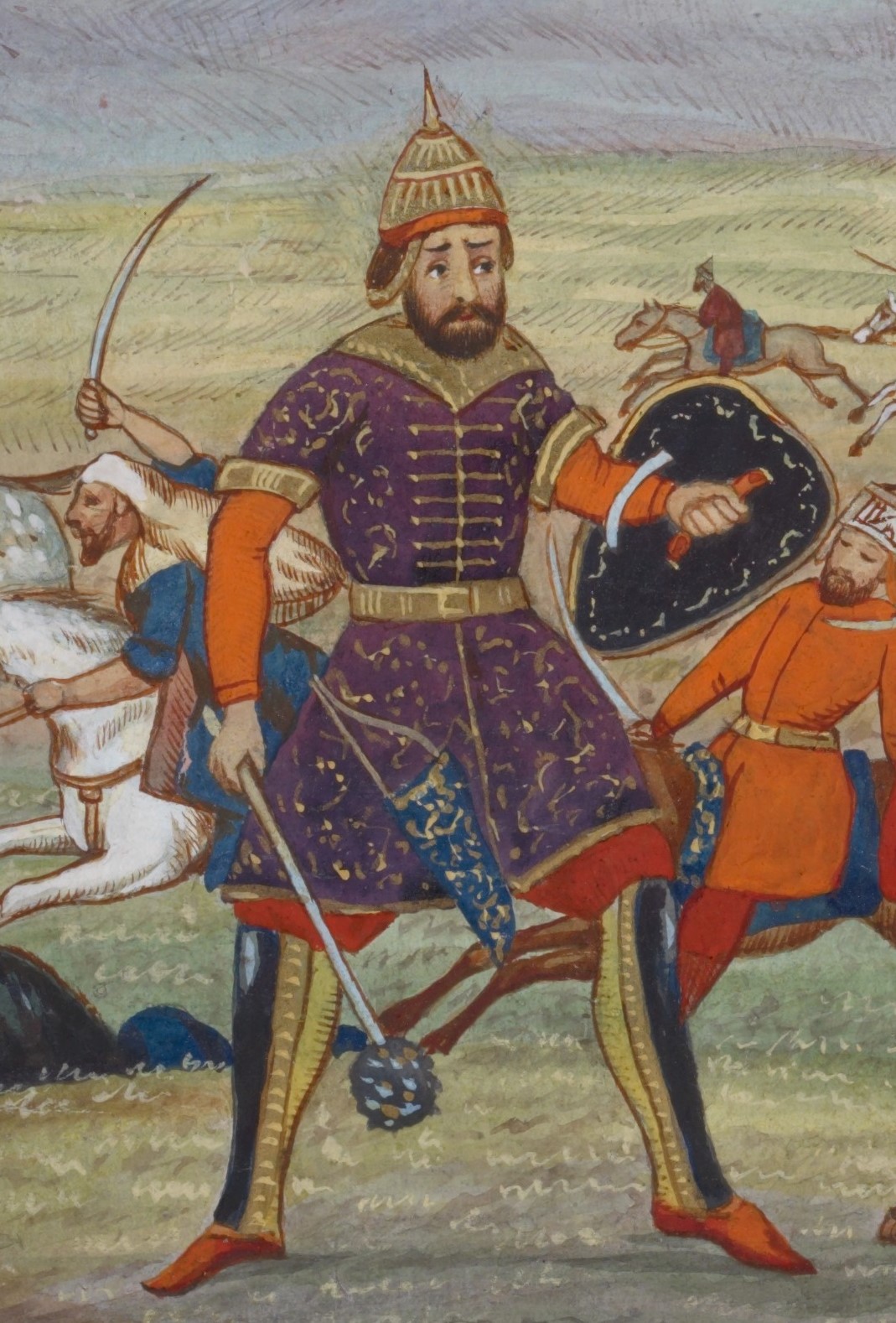
Rostam Farrokhzad was the most powerful general of the last Sasanian years, a Parthian-descended nobleman who made and unmade queens in the civil wars of 630–632 and then commanded the Persian army against the Arabs. He was killed at the battle of al-Qadisiyyah, around 636, and Ferdowsi’s Shahnameh made him a tragic figure who reads in the stars that Iran’s kingdom is about to fall.
| Persian name | رستم فرخزاد (Rostam-e Farrokhzâd) |
|---|---|
| Father | Farrukh Hormizd, a leading general of the Sasanian north |
| Family | Probably the Ispahbudhan, one of the great Parthian noble houses |
| Role | Regent and commander-in-chief for Queen Boran and Yazdegerd III |
| Died | At al-Qadisiyyah, Iraq, c. 636 (the date is disputed, 636–638) |
A son of the Parthian nobility
The Sasanian kings ruled with, and often against, a small group of great families, several of them descended from the Parthian aristocracy of the Arsacid age. Rostam belonged to one of these. His father, Farrukh Hormizd, commanded the armies of the north, and Parvaneh Pourshariati, in Decline and Fall of the Sasanian Empire, identifies the family as the Ispahbudhan, whose power lay in the north and north-east of the empire. Her wider argument, that the empire’s collapse was driven by a breakdown of the alliance between the crown and the Parthian houses, puts Rostam at the centre of the story.
After the murder of Khosrow II in 628, the throne changed hands with bewildering speed. Al-Tabari counts about ten rulers in four years. The background is told on why the Sasanian empire fell.
Kingmaker in the civil wars
In 631 Farrukh Hormizd sought to marry Queen Azarmidokht, Khosrow II’s daughter, and with her the throne. The chronicles say she had him killed. Rostam, then commanding in Khorasan, marched on Ctesiphon, took the capital, and had the queen blinded and killed. He restored her sister Boran, who had reigned before, and governed as her chief minister and commander.
In 632 the nobility settled on a young grandson of Khosrow II, Yazdegerd III, as king, and Rostam and his rival Piruz Khosrow, the leader of the Persian faction at court, agreed to share power behind him. It was an uneasy arrangement between rival groups of nobles at the very moment the Arab armies were entering Iraq.

Commander against the Arabs
Rostam’s first response to the Arab advance was to send other commanders. A Persian army under Bahman Jadhuyih won the Battle of the Bridge in 634, but defeats followed. When the Arab commander Sa’d ibn Abi Waqqas gathered a new army on the edge of the Iraqi desert, Yazdegerd ordered Rostam to lead the main imperial army himself.
The Arabic sources agree on a surprising point: Rostam did not want to fight a pitched battle. They report that he advised the king to keep the army in reserve and wear the enemy down with smaller forces, and that Yazdegerd overruled him. He advanced slowly, spent weeks or months in negotiation, and received a series of Arab envoys whose scenes are described on the battle of al-Qadisiyyah. Historians cannot be sure how much of his reluctance is real and how much is the chroniclers’ way of foreshadowing defeat, but it fits a commander who knew how fragile his political base was.
Death at al-Qadisiyyah
The battle lasted several days. On the last, a dust storm blew into the Persians’ faces, the Arabs broke through to the Persian centre, and Rostam was killed. In al-Tabari’s account he had taken shelter from the heat in the shade of a baggage mule; when an Arab warrior named Hilal ibn Ullafa cut the load loose, it fell on Rostam, who tried to escape into the canal and was dragged out and killed. Other reports differ on the details. With his death, the Persian army collapsed.
The date of the battle is itself debated, with the Arabic sources pointing to anything from 635 to 638; most modern accounts settle on 636 or 637.
Rostam in the Shahnameh
Ferdowsi, writing around 1000, tells a different story. He calls the general Rostam son of Hormozd and gives him one of the most famous passages at the end of the epic. Before the battle, Rostam studies the stars and sees that the turn of fortune is against Iran. He writes a long letter to his brother, telling him to take their family and treasure to the king in Azerbaijan and prepare for disaster. In it he foresees what the coming age will bring: the throne overthrown, the lowly raised up, faith and loyalty abandoned, and the old order of the Iranian world lost. The letter does not appear in the Arabic chronicles and is best read as Ferdowsi’s own lament, written in the voice of a man who knew he would die.
Ferdowsi also has Rostam exchange letters with Sa’d, defending the glory of the Persian kings against the Arab general’s call to Islam, and in his version the two meet in single combat and Sa’d kills him. That version is shown in a painting on the Qadisiyyah page.
Two Rostams
For Iranian readers the name carries a double weight. Rostam is also the greatest hero of the Shahnameh’s legendary age, the champion who saves Iran again and again. The historical Rostam Farrokhzad is in some sense his opposite: a capable, realistic commander who could not save it. Modern Iranian writers have often used him as the voice of grief for the end of ancient Iran, and the letter is still widely quoted. For the epic itself, see the blog’s introduction to the Shahnameh; for the king Rostam served, see Yazdegerd III, the last Sasanian king.
Persian words from this page
| رستم | Rostam | Rostam |
| قادسیه | Qâdesiye | al-Qadisiyyah |
| یزدگرد | Yazdgerd | Yazdegerd |
| پوراندخت | Purândokht | Queen Boran |
| نامه | nâme | letter |
| شاهنامه | Shâhnâme | the Book of Kings |
Sources and further reading
- al-Tabari, The History of al-Tabari, vol. 12, The Battle of al-Qadisiyyah and the Conquest of Syria and Palestine, translated by Yohanan Friedmann (SUNY Press, 1992).
- Ferdowsi, Shahnameh, the reign of Yazdegerd III; English translation by Dick Davis, Shahnameh: The Persian Book of Kings (Penguin, 2006).
- Parvaneh Pourshariati, Decline and Fall of the Sasanian Empire: The Sasanian-Parthian Confederacy and the Arab Conquest of Iran (I. B. Tauris, 2008).
- “Rostam Farroksad”, Encyclopaedia Iranica.
- Hugh Kennedy, The Great Arab Conquests (2007).
Want to learn Persian? Get the free Starter Pack
Get the 14-page printable Starter Pack (all 32 letters, a 7-day reading plan, 100 core words and 20 survival phrases) and a short 5-email course. Free.
More in The Arab Conquest and Early Islamic Iran (633–820 CE)
- Salman the Persian
- Why the Sasanian Empire Fell
- The Battle of the Bridge (634)
- The Battle of al-Qadisiyyah
- Rostam Farrokhzad
- The Fall of Ctesiphon
- The Battle of Jalula
- The Battle of Nahavand: “Victory of Victories”
- The Conquest of Fars, Khorasan and the East
- Peroz III and the Sasanian Exiles in China
- Iranian Resistance: Tabaristan and the Dabuyids
- Zoroastrians after the Arab Conquest
- Iran under the Umayyads
- The Mawali and the Shu’ubiyya Movement
- Abu Muslim and the Abbasid Revolution
- The Death of Abu Muslim and the Iranian Revolts
- The Barmakids: Persian Viziers of Baghdad
- Al-Ma’mun in Merv and the Civil War
- Tahir ibn Husayn
- Imam Reza and the Origins of Mashhad
- Babak Khorramdin’s Revolt
- Persian Influence on the Abbasid Caliphate
- The Birth of New Persian