After the Abbasids moved the centre of the caliphate from Damascus to Iraq in 750, their court and government took on much of the shape of the Sasanian Persian state they had replaced: its ceremonies, its offices and its idea of kingship. Baghdad, founded in 762 a few miles from the old Sasanian capital Ctesiphon, became the place where Persian administrative skill, Middle Persian books and Iranian scholars helped build classical Islamic civilisation in Arabic.
A capital beside Ctesiphon
The caliph al-Mansur chose a site on the Tigris close to the ruins of Ctesiphon, the city whose fall is told on the fall of Ctesiphon. The surrounding land was the old heart of the Sasanian empire, farmed by Aramaic-speaking villagers and run by Persian landowners. The name Baghdad was already in use for a village on the spot, and many scholars derive it from Middle Persian words meaning “given by God”, though other explanations exist.
According to later writers, two astrologers fixed the moment to begin building: Nawbakht, a Persian who is said to have converted from Zoroastrianism, and Masha’allah, a Jew from Basra. The date they chose was in July 762. Casting horoscopes for the foundation of a city was a Sasanian royal practice, and Nawbakht’s descendants stayed at court for generations as astronomers, translators and, later, Shi’i theologians.
The new capital was a round city with the caliph’s palace and mosque at its centre, a plan that some historians compare with circular Iranian cities such as Ardashir’s foundation at Gur (Firuzabad) in Fars, though the comparison is debated.
Kingship on the Sasanian model
The Umayyad caliphs in Damascus had remained fairly accessible tribal leaders. The Abbasids withdrew. Visitors to Baghdad met a ruler who sat behind a curtain, approached through layers of guards and chamberlains, and was greeted by kissing the ground. The book of court etiquette known as Kitab al-Taj, “the book of the crown”, traditionally attributed to al-Jahiz, openly takes the Sasanian kings as its model and cites their customs as the right way for a ruler to behave. The Persian festivals of Nowruz and Mehregan were marked at court, with officials expected to bring gifts, as they had been under the Sasanians.
Political ideas came with the ceremony. The Middle Persian “testament of Ardashir” and other advice literature taught that religion and kingship were twins, each needing the other. Translated into Arabic, these texts shaped how the caliphs and their officials thought about rule.
The machinery of government
The caliphate’s administration ran through diwans, government offices for taxation, the army, correspondence and the post. The word itself is of Persian origin, and the system built on the methods of the Sasanian chancery, which the Umayyads had already begun to translate into Arabic. The secretaries, the kuttab, were very often Iranian by origin, trained in accounting and a polished style of letter writing. The most powerful official, the vizier, became a fixture under the early Abbasids; the origin of the word wazir is still debated between Arabic and Middle Persian.
The best-known family of administrators, the Barmakids from Balkh, is the subject of its own page, the Barmakids. Persian secretaries also took a cultural position, sometimes arguing for the superiority of Persian traditions in the controversy described on the mawali and the Shu’ubiyya.

From Middle Persian books to Arabic
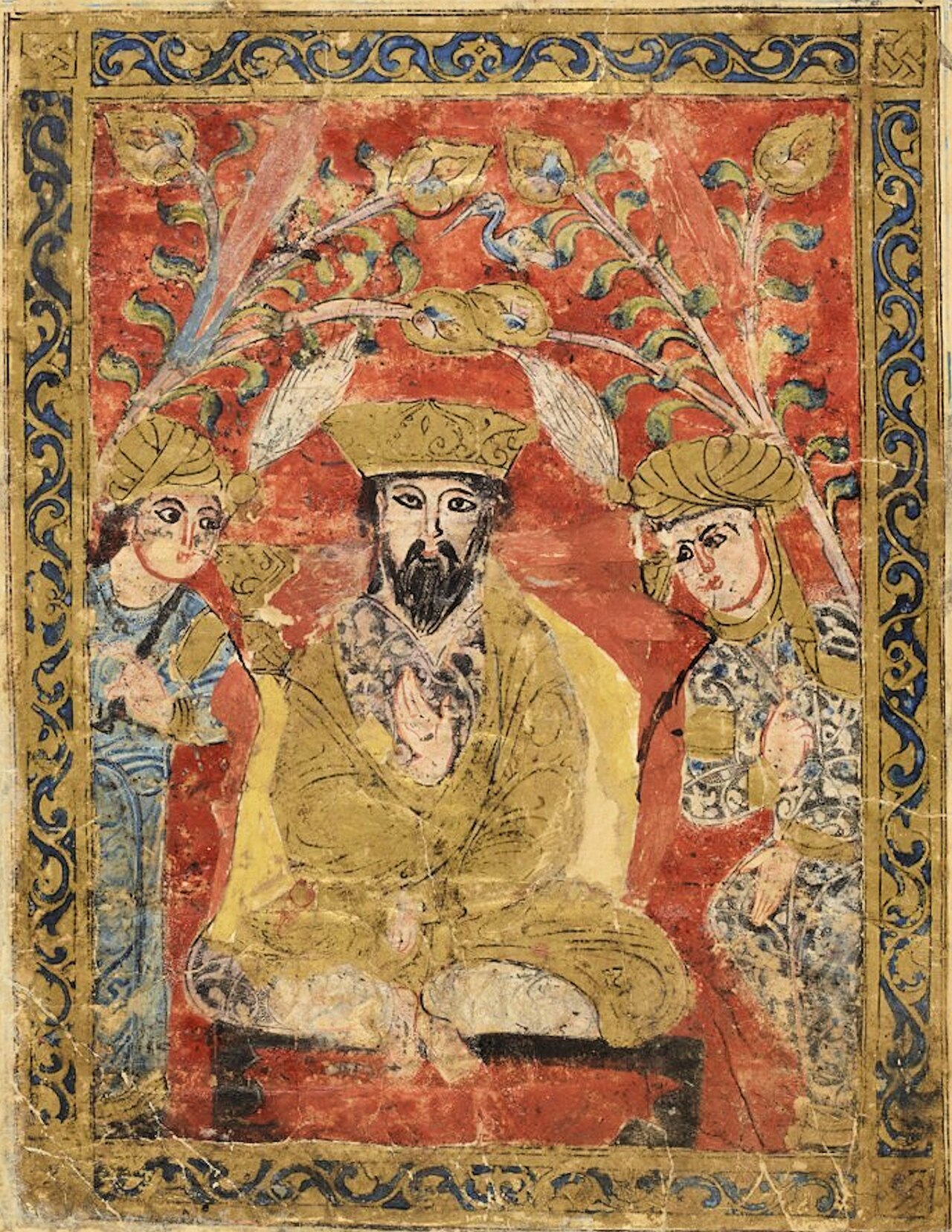
A large part of early Arabic prose was translated from Middle Persian. The pioneer was Ibn al-Muqaffa’, born Ruzbih, a Persian secretary from Fars who was executed around 757. He put into Arabic Kalila wa Dimna, the book of animal fables that Sasanian scholars had adapted from the Indian Panchatantra, as well as a version of the Sasanian royal chronicle, the Khwaday-namag or “Book of Lords”, which later fed into Ferdowsi’s Shahnameh. His Arabic was so admired that it became a model of style.
Translators also turned Pahlavi works on astronomy, astrology and medicine into Arabic. The Sasanian astronomical tables, the Zij-i Shahriyar, appeared in Arabic as the Zij al-Shah. Dimitri Gutas, in Greek Thought, Arabic Culture, has argued that the Abbasid translation movement grew partly out of a Sasanian imperial ideology which held that all knowledge, including Greek science, had originally come from Iran and was being recovered by translation. On that view the famous House of Wisdom of al-Ma’mun’s time began as a palace library in the Sasanian manner rather than an academy.
Doctors from Gondishapur and scholars from the east
In 765 al-Mansur, seriously ill, summoned Jurjis ibn Bukhtishu’, head of the hospital at Gondishapur in Khuzestan, a Sasanian foundation where Christian physicians taught medicine. His family served as court doctors in Baghdad for some two and a half centuries.
Iranians were prominent in nearly every field of learning written in Arabic. Sibawayh, from Fars, wrote the founding grammar of the Arabic language. Al-Khwarizmi, from Khwarazm south of the Aral Sea, worked under al-Ma’mun and gave algebra its name; see al-Khwarizmi and Persian mathematics. The great hadith collectors al-Bukhari and Muslim came from Bukhara and Nishapur. In the fourteenth century the historian Ibn Khaldun devoted a chapter of his Muqaddimah to the observation that most of the scholars of Islam had been non-Arabs, above all Persians.
Persian culture in an Arabic dress
For about two centuries this Iranian contribution was made almost entirely in Arabic. Educated Iranians wrote, prayed and governed in it, while Persian lived on as the spoken language of Iran. Only in the ninth and tenth centuries did a new written Persian emerge, at eastern courts far from Baghdad, a story told on the birth of New Persian. The arrangement of Abbasid Baghdad, with Iranian forms inside an Arabic and Islamic frame, set the pattern for the Persianate courts that followed.
Persian words from this page
| بغداد | Baghdâd | Baghdad |
| دیوان | divân | government office; also a poetry collection |
| وزیر | vazir | vizier, minister |
| کلیله و دمنه | Kelile va Demne | Kalila wa Dimna |
| نوروز | Nowruz | Persian New Year |
| مهرگان | Mehregân | autumn festival of Mehr |
| گندیشاپور | Gondishâpur | Gondishapur |
Sources and further reading
- Dimitri Gutas, Greek Thought, Arabic Culture: The Graeco-Arabic Translation Movement in Baghdad and Early ‘Abbasid Society (Routledge, 1998).
- Ibn Khaldun, The Muqaddimah, translated by Franz Rosenthal.
- Hugh Kennedy, The Court of the Caliphs (2004).
- Jacob Lassner, The Topography of Baghdad in the Early Middle Ages (1970).
- “Ebn al-Moqaffa'” and “Baghdad”, Encyclopaedia Iranica.
Want to learn Persian? Get the free Starter Pack
Get the 14-page printable Starter Pack (all 32 letters, a 7-day reading plan, 100 core words and 20 survival phrases) and a short 5-email course. Free.
More in The Arab Conquest and Early Islamic Iran (633–820 CE)
- Salman the Persian
- Why the Sasanian Empire Fell
- The Battle of the Bridge (634)
- The Battle of al-Qadisiyyah
- Rostam Farrokhzad
- The Fall of Ctesiphon
- The Battle of Jalula
- The Battle of Nahavand: “Victory of Victories”
- The Conquest of Fars, Khorasan and the East
- Peroz III and the Sasanian Exiles in China
- Iranian Resistance: Tabaristan and the Dabuyids
- Zoroastrians after the Arab Conquest
- Iran under the Umayyads
- The Mawali and the Shu’ubiyya Movement
- Abu Muslim and the Abbasid Revolution
- The Death of Abu Muslim and the Iranian Revolts
- The Barmakids: Persian Viziers of Baghdad
- Al-Ma’mun in Merv and the Civil War
- Tahir ibn Husayn
- Imam Reza and the Origins of Mashhad
- Babak Khorramdin’s Revolt
- Persian Influence on the Abbasid Caliphate
- The Birth of New Persian