The Battle of al-Qadisiyyah, fought over several days on the edge of the desert south-west of al-Hira in about 636, was the decisive defeat of the Sasanian army in Iraq. The Persian commander Rostam Farrokhzad was killed and his army broken, and within a year the Arab forces of Sa’d ibn Abi Waqqas had taken the Sasanian capital, Ctesiphon.
| Date | AH 15 in most accounts, about 636; Arabic sources also give AH 14 or 16 (635–637) |
|---|---|
| Place | al-Qadisiyyah, on the desert edge west of the Euphrates in southern Iraq |
| Sasanian commander | Rostam Farrokhzad (killed), with Jalinus, Bahman Jadhuyih, Hormozan and others |
| Arab commander | Sa’d ibn Abi Waqqas, under the caliph Umar |
| Result | Decisive Arab victory; Sasanian Iraq left open |
| Persian name | نبرد قادسیه (nabard-e Qâdesiye) |
Two armies gather
After the Arab defeat at the Battle of the Bridge in 634, the caliph Umar raised a much larger army for Iraq and gave it to Sa’d ibn Abi Waqqas, an early companion of the Prophet. Sa’d camped at al-Qadisiyyah, a halting place on the road from Arabia, where he had water, desert behind him for retreat and the rich farmland of the Sawad in front.
On the Persian side the young king Yazdegerd III pressed for a full field army. Its commander was Rostam Farrokhzad, the leading noble of the court. The Arabic sources portray Rostam as reluctant to fight a pitched battle and inclined to wear the Arabs down, while the king pushed him forward. The same picture of a general who saw what was coming appears, in a different form, in the Shahnameh. Rostam’s career and his place in Persian memory are told on the page on Rostam Farrokhzad.
Envoys before the battle
The armies faced each other for weeks, perhaps months. Tabari preserves several accounts of Arab envoys sent to Rostam’s camp, including Rib’i ibn Amir and al-Mughira ibn Shu’ba. In these scenes the plainly dressed envoy walks across Rostam’s carpets with his spear, refuses the luxuries of the court and offers three choices: Islam, payment of tribute, or war. The stories are literary set pieces, written to contrast the simplicity of the believers with Persian splendour, but they also reflect the real terms the conquerors offered to towns and lords across Iran.

The days of fighting
The Arabic tradition divides the battle into named days, which suggests how it was remembered rather than an exact log. Sa’d himself was ill, suffering from boils and sciatica according to the sources, and directed the fighting from a building overlooking the field.
The elephants
The Persians brought war elephants, and on the first day they threw the Arab cavalry into confusion as they had at the Bridge. On the following days the Arabs learned to fight them. Tabari tells of men who cut the girths of the howdahs, of camels dressed in cloth and veils to frighten the Persian horses, and of two brothers who put out the eyes of the white elephant that led the rest, after which the wounded animals stampeded back through the Persian lines.
Reinforcements from Syria
On the second day Arab reinforcements arrived from Syria, where the Byzantines had recently been defeated at the Yarmuk. Tabari says their leader, al-Qa’qa ibn Amr, brought them in small groups through the day so that the Persians would think a great army was coming. The fighting went on through a night remembered as Laylat al-Harir, the “Night of Clamour”.
The death of Rostam
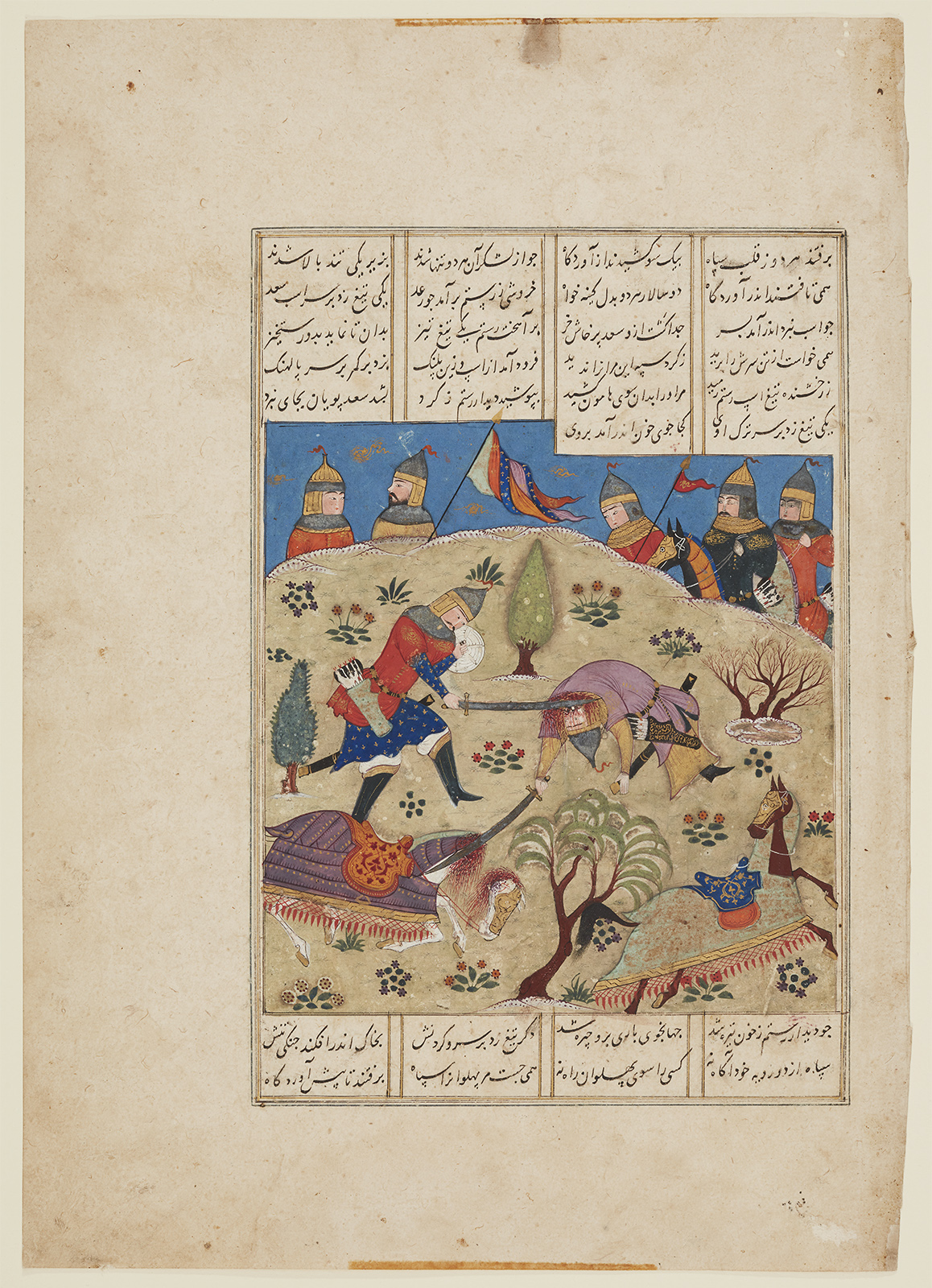
On the final day a strong wind blew dust into the Persians’ faces and, in one account, tore away the awning over Rostam’s seat. Rostam was killed near the canal behind his lines. Tabari names his killer as Hilal ibn Ulfa, a man of the Tamim; Ferdowsi has Sa’d kill him in single combat, the scene shown in the painting above. With their commander dead the Persian centre collapsed. Jalinus covered the retreat and was killed in the pursuit, and Bahman Jadhuyih also fell. Arabic tradition says the great royal banner, the Derafsh-e Kaviani, was captured and its jewels divided.
How large were the armies
The Arabic sources give the Persians 60,000, 120,000 or more men, and the Muslims about 30,000 or fewer. These numbers grew in the retelling and cannot be trusted. Modern historians generally think both armies were much smaller, and their estimates differ widely. What the sources agree on is that the Persians had more men and the elephants, and that the Arabs had a unified command and fresh troops arriving.
After the battle
Al-Qadisiyyah broke the main Sasanian army in the west. A contingent of Persian soldiers from Daylam, about 4,000 men in the sources, went over to the Arabs and settled with them, an early example of Iranians joining the new order. The way to the capital was open, and Sa’d advanced to Ctesiphon, which fell in 637. The garrison camp the Arabs built at Kufa, founded around 638, grew into one of the great cities of early Islam.
A battle with many meanings
For Muslim tradition al-Qadisiyyah became a model of faith rewarded, and the stories around it, such as that of the poet Abu Mihjan, released from Sa’d’s custody to fight and then returning to his chains, became classics of Arabic literature. For Persian memory, shaped by the Shahnameh, it is the moment the old kingdom died. In the 20th century the name was used again: Iraq’s government called its 1980–1988 war with Iran “Saddam’s Qadisiyyah”, while in Iran the battle was discussed both as a national defeat and as the gateway through which Islam came to the country. Historians treat these later uses as part of the battle’s afterlife, not as evidence for what happened in 636.
Persian words from this page
| قادسیه | Qâdesiye | al-Qadisiyyah |
| رستم فرخزاد | Rostam Farrokhzâd | Rostam Farrokhzad |
| سعد وقاص | Sa’d-e Vaqqâs | Sa’d ibn Abi Waqqas |
| درفش کاویانی | Derafsh-e Kâviyâni | the royal banner of Kaveh |
| فیل | fil | elephant |
| شکست | shekast | defeat |
Sources and further reading
- al-Tabari, The History of al-Tabari, vol. 12, The Battle of al-Qadisiyyah and the Conquest of Syria and Palestine, translated by Yohanan Friedmann (SUNY Press, 1992).
- al-Baladhuri, Futuh al-Buldan, translated as The Origins of the Islamic State.
- Ferdowsi, Shahnameh, the reign of Yazdegerd III (Rostam’s letter and death).
- Fred M. Donner, The Early Islamic Conquests (1981).
- Hugh Kennedy, The Great Arab Conquests (2007).
- “Qadesiya, Battle of”, Encyclopaedia Iranica.
Want to learn Persian? Get the free Starter Pack
Get the 14-page printable Starter Pack (all 32 letters, a 7-day reading plan, 100 core words and 20 survival phrases) and a short 5-email course. Free.
More in The Arab Conquest and Early Islamic Iran (633–820 CE)
- Salman the Persian
- Why the Sasanian Empire Fell
- The Battle of the Bridge (634)
- The Battle of al-Qadisiyyah
- Rostam Farrokhzad
- The Fall of Ctesiphon
- The Battle of Jalula
- The Battle of Nahavand: “Victory of Victories”
- The Conquest of Fars, Khorasan and the East
- Peroz III and the Sasanian Exiles in China
- Iranian Resistance: Tabaristan and the Dabuyids
- Zoroastrians after the Arab Conquest
- Iran under the Umayyads
- The Mawali and the Shu’ubiyya Movement
- Abu Muslim and the Abbasid Revolution
- The Death of Abu Muslim and the Iranian Revolts
- The Barmakids: Persian Viziers of Baghdad
- Al-Ma’mun in Merv and the Civil War
- Tahir ibn Husayn
- Imam Reza and the Origins of Mashhad
- Babak Khorramdin’s Revolt
- Persian Influence on the Abbasid Caliphate
- The Birth of New Persian