Persian is one of the few languages whose history can be followed in writing for about 2,500 years. It appears first as Old Persian on the rock inscriptions of Darius the Great (from c. 520 BCE), continues as Middle Persian, the language of the Sasanian empire, and re-emerges after the Arab conquest as New Persian, written in Arabic script, which is the language spoken today in Iran as Farsi, in Afghanistan as Dari and in Tajikistan as Tajik.
| Language family | Indo-European, Iranian branch, south-western group |
|---|---|
| Old Persian | c. 520–330 BCE, cuneiform royal inscriptions |
| Middle Persian | c. 300 BCE–900 CE, Pahlavi script |
| New Persian | written from the 9th century CE, Perso-Arabic script |
| Modern standard forms | Farsi (Iran), Dari (Afghanistan), Tajik (Tajikistan, Cyrillic script) |
| Persian name | زبان فارسی (zabân-e fârsi) |
This page follows the language through its three stages and its spread far beyond Iran. Each stage has its own detailed page in the era sections; here the aim is to show how they connect, and why a learner today can read a poem written a thousand years ago.
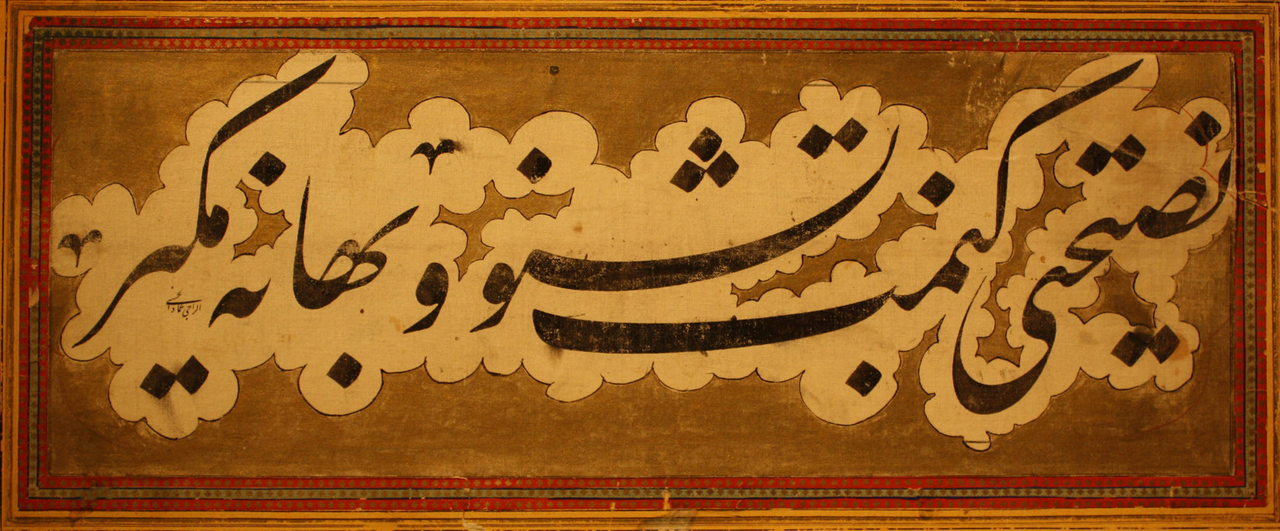

Where Persian comes from
Persian belongs to the Iranian languages, a branch of Indo-European that also includes Kurdish, Balochi, Pashto and the Avestan language of the Zoroastrian scriptures. The speakers of these languages entered the Iranian plateau in the late second and early first millennium BCE (see the arrival of the Iranian peoples). Persian is the language of one group among them, the Persians of Pârsa, the region that is still called Fars. The name Fârsi itself comes from that province: when Arabic, which lacks a “p” sound, took over the name Pârsi, it became Fârsi.
Because Persian is Indo-European, a learner from Europe meets familiar words: mâdar (mother), barâdar (brother), nâm (name), setâre (star). These are not borrowings but cousins, inherited from a common ancestor.
Old Persian: the language of the kings
The oldest Persian we have is carved in stone. Darius I (522–486 BCE) had his account of his rise to power inscribed at Behistun in three languages, Old Persian, Elamite and Babylonian, and the Old Persian version is the longest text in the language (see the Behistun inscription). The script was a simplified cuneiform of about three dozen signs, and many scholars think it was devised under Darius for exactly these royal monuments. Old Persian survives almost only in such inscriptions, at Persepolis, Naqsh-e Rostam, Susa and a few other sites. Day-to-day government was not written in Persian at all but in Elamite and Aramaic, as the clay tablets from Persepolis show.
Old Persian was a heavily inflected language, with noun cases and verb endings rather like Sanskrit or Latin. The page on Old Persian language and cuneiform explains the script and how it was deciphered in the nineteenth century.
Middle Persian: Pahlavi
Over the following centuries the case endings wore away, and by the time of the Sasanian empire (224–651 CE) the language had become Middle Persian, already much closer in structure to the Persian of today. Under the Parthians (247 BCE–224 CE) a sister language, Parthian, was used at court and in records (see the Parthian language), and it left many words in Persian.
Middle Persian was written in scripts derived from Aramaic. The best known, called Pahlavi, was hard to read: it had few letters, several of which looked alike, and writers kept Aramaic words as fixed spellings to be read aloud as Persian. The Aramaic word for king, malkâ, was written but pronounced shâh. Most surviving Middle Persian literature is Zoroastrian religious writing put into its final form in the ninth and tenth centuries, together with inscriptions of the Sasanian kings and texts of the Manichaeans. The detailed story is on Middle Persian (Pahlavi) language and literature.
After the Arab conquest: the birth of New Persian
When the Arab armies overthrew the Sasanians in the 640s, Arabic became the language of religion, scholarship and, after about 700, government. Persian did not die out, though. It remained the spoken language of the population, and in the east, in Khorasan and Transoxiana, a court form of spoken Persian called Dari (from dar, “court”) spread as a common language among soldiers, merchants and settlers.
In the ninth century this spoken language began to be written in the Arabic alphabet, with four added letters for Persian sounds that Arabic lacks: پ p, چ ch, ژ zh and گ g. The new script was far easier to read than Pahlavi, and the alphabet you learn today is essentially that alphabet (see our guide to the 32 letters of the Persian alphabet). Early local dynasties such as the Saffarids and above all the Samanids of Bukhara encouraged Persian poetry and prose. Rudaki (d. c. 941) is remembered as the first great poet of New Persian, and Bal’ami’s Persian version of al-Tabari’s history is one of the first large prose works. The whole process is told on the birth of New Persian and the Samanid Persian renaissance.
What Arabic changed, and what it did not
New Persian took in a large Arabic vocabulary, especially for religion, law, science and abstract ideas: ketâb (book), vaqt (time) and fekr (thought) are all Arabic in origin. Its grammar, though, stayed Persian. Verbs, pronouns, word order and the everyday core vocabulary are Iranian, and Persian is not related to Arabic as Spanish is to Italian. Our comparison of Farsi and Arabic sets out the differences a learner notices.
A language of empires and poets
Around 1010 Ferdowsi completed the Shahnameh, a verse history of the Iranian kings of some 50,000 couplets, written with comparatively few Arabic words (see Ferdowsi and the Shahnameh and our article on the Shahnameh). Later Iranians credited him with saving the language, a view that simplifies a longer process but shows how the poem was valued.
A striking feature of Persian history is that many of its greatest patrons were not Persian. The Turkic Ghaznavids and Seljuks, the Mongol Ilkhans, the Timurids and the Ottomans all used Persian at court. It became the language of administration and high culture from Anatolia to Bengal. In India it served as the official language of the Delhi Sultanate and the Mughal empire; the Mughal emperor Humayun returned from his exile in Persia with Persian painters and poets. The British East India Company used Persian in its courts until 1837. Urdu grew up in this world and is full of Persian words, which is why Farsi and Urdu share so much vocabulary.
The classical poets, Rumi, Saadi and Hafez among them, wrote between the thirteenth and fourteenth centuries in a language that a modern reader in Tehran can still follow with some help. Grammar and spelling have changed far less in a thousand years than English has since Chaucer.
One language, three national standards
From the nineteenth century, new borders split the Persian-speaking world. In Iran the language came to be called Farsi. In Afghanistan, where Persian had long been the language of the court and government, the 1964 constitution named it Dari. In Soviet Central Asia, Persian speakers in Tajikistan were given a separate written standard, Tajik: it was written first in a Latin alphabet from 1928 and then, from around 1940, in Cyrillic, which cut readers off from the classical literature in Arabic script. The three forms are largely mutually intelligible in their written standards, with differences in pronunciation, vocabulary and loanwords (Russian in Tajik, English and French in Farsi). Our guide to Farsi, Persian, Dari and Tajik explains which name to use and why.
In twentieth-century Iran the state took an active role in shaping the language. Reza Shah’s Academy of Iran (Farhangestân), founded in 1935, coined Persian words to replace Arabic and European terms, and many of them are now ordinary vocabulary. Mass schooling, radio and television spread the Tehran pronunciation as the national standard, while Iran’s other languages, from Azerbaijani Turkish to Kurdish and Balochi, continued in the home and in local life (see languages spoken in Iran).
- c. 520 BCE Behistun inscription of Darius I, the oldest long Old Persian text
- 3rd century CE Sasanian kings write their inscriptions in Middle Persian
- 9th century first New Persian texts in Arabic script
- 10th century Rudaki and the Samanid court in Bukhara
- c. 1010 Ferdowsi completes the Shahnameh
- 1837 English replaces Persian in British Indian administration
- 1935 Academy of Iran founded in Tehran
- c. 1940 Tajik switches to Cyrillic script
- 1964 Afghan constitution names the language Dari
Why this history matters to a learner
The history explains several things that puzzle beginners. Persian grammar is simple compared with Old Persian because the endings were lost two thousand years ago. Persian spelling has several letters for the same sound (four for “z”) because Arabic words keep their Arabic spelling. Short vowels are not written, which is why learning to read Persian takes practice. And because the written language has changed so little, once you can read modern Persian you are not far from reading Hafez.
Persian words from this page
| فارسی | Fârsi | Persian (the language) |
| دری | Dari | Dari, Persian of Afghanistan |
| تاجیکی | Tâjiki | Tajik |
| زبان | zabân | language |
| پهلوی | Pahlavi | Middle Persian; its script |
| فرهنگستان | Farhangestân | academy |
| کتاب | ketâb | book (from Arabic) |
Sources and further reading
- Encyclopaedia Iranica, “Persian Language” (articles on Early New Persian and later stages) and “Iran vi. Iranian Languages and Scripts”.
- Gilbert Lazard, “The Rise of the New Persian Language”, in The Cambridge History of Iran, vol. 4 (1975).
- John R. Perry, “New Persian: Expansion, Standardization, and Inclusivity”, in Brian Spooner and William L. Hanaway (eds.), Literacy in the Persianate World (2012).
- Roland G. Kent, Old Persian: Grammar, Texts, Lexicon (1953).
- Nile Green (ed.), The Persianate World: The Frontiers of a Eurasian Lingua Franca (2019).
Want to learn Persian? Get the free Starter Pack
Get the 14-page printable Starter Pack (all 32 letters, a 7-day reading plan, 100 core words and 20 survival phrases) and a short 5-email course. Free.
More in Themes Across Iranian History (3000 BCE–today)
- A History of the Persian Language
- Zoroastrianism through the Ages
- Shi’a Islam in Iranian History
- The Jews of Iran
- The Armenians of Iran
- Christians of Iran
- The Baha’i Faith in Iran
- The Kurds in Iranian History
- Azerbaijanis in Iranian History
- The History of the Iranian Calendar
- Nowruz through History
- The Persian Garden (Pardis) through History
- Qanats: Iran’s Ancient Water Tunnels
- A History of Persian Carpets
- A History of Persian Architecture
- A History of Persian Painting
- A History of Persian Music
- Science in Iranian History
- Women in Iranian History
- Iran and the Silk Road
- Iran and China through History
- Iran and India through History
- Iran and Greece: Perceptions and Exchanges
- Persia and Rome: Seven Centuries of Rivalry
- Iran and the Ottoman Empire
- Iran and Russia through History
- Iran and Britain through History
- Iran and the United States
- How Iran’s Borders Changed
- The Capitals of Iran through History
- Coins of Iran through History: From the Daric to the Rial
- Flags and Symbols of Iran through History
- Myth and History in the Shahnameh: The Epic’s Kings and the Real Past
- Timeline of Iranian History: Key Dates from Elam to Today
- A History of Persian Cuisine: From Royal Banquets to Chelow Kabab
- A History of Persian Poetry: From Rudaki to Forough
- Wine in Iranian History: From Hajji Firuz to Hafez and Prohibition
- Sports in Iranian History: Polo, the Zurkhaneh and Wrestling
- List of Iranian Dynasties and Rulers