Jalal al-Din Mingburnu (also Mankubirni, died 1231) was the last Khwarazmshah, the son of Ala al-Din Muhammad II, who kept fighting for eleven years after the Mongols destroyed his father’s empire. He beat a Mongol army at Parwan in 1221, escaped Genghis Khan by swimming the Indus, and then carved out a short-lived kingdom in western Iran and the Caucasus before he was killed in the mountains of eastern Anatolia in August 1231.
| Persian name | جلالالدین منکبرنی (Jalâl od-Din Mankoberni) |
|---|---|
| Father | Ala al-Din Muhammad II, Khwarazmshah |
| Ruled | 1220/21–1231, mostly without a fixed capital; Tabriz from 1225 |
| Key battles | Parwan 1221 (victory); Indus 1221 (defeat); Garni 1225 (victory); Isfahan 1227 or 1228 (indecisive); Yassıçemen 1230 (defeat) |
| Died | August 1231, near Mayyafariqin (Silvan, in today’s south-east Turkey) |
| Main source | His secretary Nasawi’s biography, Sirat al-Sultan Jalal al-Din |
An heir without a kingdom
The Mongol conquest of Transoxiana and Khorasan in 1219–1221 is told on the page on Genghis Khan’s invasion of Iran, and the background on the page on the Otrar incident. Jalal al-Din’s own story begins at the end of it. On an island in the Caspian, shortly before he died in the winter of 1220–21, Muhammad II set aside his younger son Uzlagh Shah, the candidate of his mother Terken Khatun, and named Jalal al-Din his heir.
The new sultan went first to Gurganj, the old capital of Khwarazm, but the Qipchaq commanders there were loyal to Terken Khatun’s party and plotted against him. He left with a small escort, slipped across the Karakum to Khorasan, and made for Ghazni in today’s Afghanistan, where his father’s governors still held out.
Parwan and the Indus, 1221
At Ghazni he gathered a mixed army of Turkish regiments, Khalaj and Afghan tribesmen, and the troops of his father-in-law Amin al-Malik. In 1221 he met a Mongol force under Shigi Qutuqu at Parwan, north of Kabul, and defeated it, one of the very few Mongol defeats of the whole war. The victory did not hold his coalition together. The commanders fell out over the booty, a quarrel the sources often reduce to a dispute over a horse, and many of the Khalaj and Afghan contingents rode away.
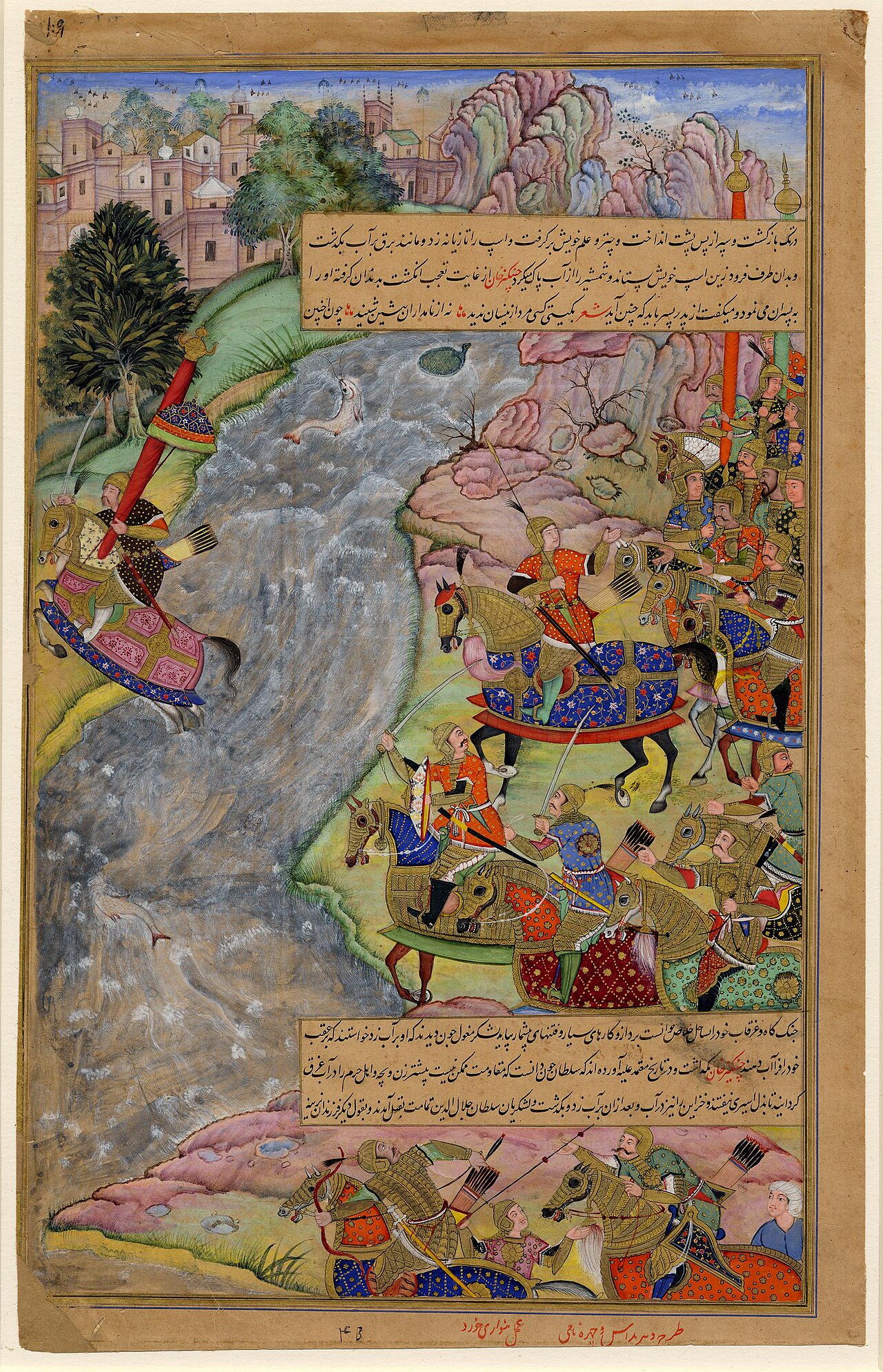
Genghis Khan came south in person and caught the weakened army on the bank of the Indus in late 1221. Jalal al-Din’s force was destroyed and his family was drowned or captured. He himself rode his horse off the bank into the river and swam to the far side. Juvayni says Genghis watched in admiration and told his sons that such a son was what every father should wish for.

Three years in India
On the Indian side of the river Jalal al-Din had only a few followers. He rebuilt a following in the Punjab and Sind between 1221 and 1224, allying with the local Khokhar chiefs and fighting Nasir al-Din Qubacha, the ruler of Multan. He asked Sultan Iltutmish of Delhi for refuge, and Iltutmish, unwilling to draw Mongol armies after his guest, politely refused. With a Mongol detachment still on his trail and no secure base, Jalal al-Din decided to return to Iran.
A new kingdom in the west, 1224–1225
He crossed the deserts of Makran into Kerman in 1224. There Buraq Hajib, a former Qara Khitai officer who had seized the province, submitted to him; Buraq later founded the Qutlugh-Khanid dynasty of Kerman. The atabeg of Fars, Sa’d ibn Zangi, made peace and gave him a daughter in marriage. In Isfahan and Hamadan his younger brother Ghiyath al-Din, who had set up for himself in western Iran, accepted his authority.
Jalal al-Din then turned on the caliph al-Nasir in Baghdad, who had been his father’s enemy. He defeated a caliphal army and plundered the country around Baghdad in 1225 but could not take the city. He moved north instead and, on 25 July 1225, entered Tabriz, the capital of the Eldiguzid atabeg Özbeg. Özbeg fled, and Jalal al-Din married his wife Malika Khatun. Azerbaijan became the centre of his new state.
Georgia, Akhlat and a ring of enemies
From Tabriz he attacked the kingdom of Georgia. He defeated the Georgian army at Garni in 1225 and took Tbilisi in March 1226. Georgian and Armenian writers describe a massacre of the Christian population who refused to convert; the very large figures they give cannot be checked, but the sack left a lasting memory in the Caucasus.
His next target was Akhlat, on the north-west shore of Lake Van, held by the Ayyubid prince al-Ashraf. After a long siege he took it in April 1230 and sacked it. This alarmed every neighbour at once. The Ayyubids joined the Seljuk sultan of Rum, Kayqubad I, and in August 1230 their combined army defeated Jalal al-Din at Yassıçemen, near Erzincan.
Meanwhile the Mongols had not forgotten him. In 1227 or 1228, the sources differ, a Mongol army reached Isfahan. Jalal al-Din fought it outside the city. He lost much of his army, but the Mongols suffered so heavily that they withdrew, and some historians count the battle as his last success.
The end, 1231
In 1230 the new Great Khan Ögedei sent a large army under Chormaqan into Iran with orders to finish him. Jalal al-Din, his army already worn down by Yassıçemen, was surprised in Azerbaijan and fled west with a dwindling escort. In mid-August 1231 he was killed in the mountains near Mayyafariqin by a Kurd. Nasawi and Ibn al-Athir report that the killer was avenging a brother who had died at Khwarazmian hands at Akhlat.
His death was hard to believe for many of his followers. Rumours that he had survived went on for years, and more than one impostor claimed his name. His leaderless soldiers, the Khwarazmiyya, became mercenaries in Syria and Mesopotamia. In 1244 they sacked Jerusalem and fought for the Egyptian Ayyubids at La Forbie, before they were finally broken in 1246.
How he has been judged
Nasawi, who served as his secretary and wrote his biography, admired his courage and described his hardships with sympathy; he also wrote a Persian memoir of those years, Nafthat al-masdur. Ibn al-Athir was harsher, blaming Jalal al-Din for fighting fellow Muslim rulers instead of uniting them against the Mongols. Modern historians tend to agree that he was a brave and gifted soldier with little political skill: in six years he made enemies of the caliph, the Ayyubids, the Seljuks of Rum and the Georgians, and left no state behind him. In modern Uzbekistan he is celebrated as a national hero.
Persian words from this page
| خوارزمشاه | Khârazmshâh | Khwarazmshah, king of Khwarazm |
| رود سند | rud-e Sand | the Indus river |
| غزنین | Ghaznin | Ghazni |
| تبریز | Tabriz | Tabriz |
| گرجستان | Gorjestân | Georgia |
| اخلاط | Akhlât | Akhlat |
What came after him in Iran is described on the page on Iran under the Great Khans, and the city he made his capital in Tabriz.
Sources and further reading
- Shihab al-Din Muhammad al-Nasawi, Sirat al-Sultan Jalal al-Din Mankubirni (French translation by O. Houdas).
- Ata-Malik Juvayni, The History of the World-Conqueror, translated by J. A. Boyle.
- Ibn al-Athir, al-Kamil fi’l-Tarikh, years 617–628 AH.
- J. A. Boyle, “Dynastic and Political History of the Il-Khans”, in The Cambridge History of Iran, vol. 5.
- Peter Jackson, The Mongols and the Islamic World (Yale University Press, 2017).
Want to learn Persian? Get the free Starter Pack
Get the 14-page printable Starter Pack (all 32 letters, a 7-day reading plan, 100 core words and 20 survival phrases) and a short 5-email course. Free.
More in Ghaznavids, Seljuks and Khwarazmshahs (977–1231)
- The Ghaznavid Empire
- Mahmud of Ghazni
- The Rise of the Seljuks
- The Battle of Dandanaqan (1040)
- Tughril Beg Enters Baghdad
- Alp Arslan
- Seljuk Architecture: Tomb Towers and Caravanserais
- The Battle of Manzikert (1071)
- Malik Shah I
- The Seljuks of Kerman
- Nizam al-Mulk and the Siyasatnama
- The Seljuk Domes of Isfahan’s Jameh Mosque
- Omar Khayyam: Poet and Scientist
- Al-Ghazali
- Sana’i of Ghazni
- Hassan-i Sabbah and the Fortress of Alamut
- The Nizari Ismailis and the “Assassins” Legend
- Sultan Sanjar and the Qara Khitai
- The Battle of Qatwan (1141)
- Anvari and Seljuk Court Poetry
- Seljuk Decline and the Atabegs
- The Ghurids
- Attar of Nishapur
- Nizami Ganjavi
- The Khwarazmian Empire
- Ala al-Din Muhammad II
- The Otrar Incident (1218): How Khwarazm Provoked Genghis Khan
- Jalal al-Din Mingburnu