The Battle of Ankara was fought on 28 July 1402 on the Çubuk plain north-east of Ankara, between Timur and the Ottoman sultan Bayezid I. Timur won decisively and took Bayezid prisoner, the only time an Ottoman sultan was captured in battle; the Ottoman state fell into a decade of civil war, and Timur stood at the height of his power over Iran, Iraq and Anatolia.
| Date | 28 July 1402 (some accounts give 20 July) |
|---|---|
| Place | Çubuk plain, north-east of Ankara, central Anatolia |
| Commanders | Timur; Sultan Bayezid I, with his sons Süleyman and Mehmed and the Serbian prince Stefan Lazarević |
| Armies | Modern estimates: about 140,000 for Timur, up to 85,000 for Bayezid. Medieval figures run into the hundreds of thousands and are not credible. |
| Result | Timurid victory; Bayezid captured and died in captivity in March 1403 |
| Aftermath | Ottoman Interregnum (1402–1413); Anatolian beyliks restored |
Two conquerors on one frontier
By 1400 Timur ruled from Samarkand to Baghdad and Bayezid, called Yıldırım (“Thunderbolt”), had built an Ottoman empire stretching from the Danube to the upper Euphrates. They met in eastern Anatolia, where small Turkmen lords had to choose between them. Bayezid demanded tribute from Taharten, the emir of Erzincan, who had accepted Timur’s overlordship. Timur took this as an insult.
Refugees made things worse. The Jalayirid sultan Ahmad of Baghdad and the Qara Qoyunlu leader Qara Yusuf, both driven out by Timur, found shelter with Bayezid, while Anatolian princes whom Bayezid had dispossessed fled to Timur’s camp. Both rulers wrote insulting letters. In 1400 Timur took Sivas from the Ottomans and, according to the chroniclers, had its defenders buried alive. He then turned south against the Mamluks, sacking Aleppo and Damascus, and took Baghdad in 1401. Qara Yusuf’s later return to Tabriz is told on our page on the Qara Qoyunlu. Only in 1402 did Timur come back to Anatolia to settle with Bayezid. Bayezid broke off his long blockade of Constantinople and marched east to meet him.
The battle on the Çubuk plain
The campaign was won before the fighting began. While Bayezid waited for Timur to the east, near Sivas, Timur marched round him to the south-west, rested his army and came up behind the Ottomans at Ankara. He camped on the ground Bayezid had chosen, with its water. Ottoman soldiers, marching back in the heat of July, arrived tired and thirsty. Accounts say Timur also diverted the Çubuk stream into a reservoir so that the Ottoman army had no water during the battle.
On the day of battle Timur’s troops included war elephants brought from his Indian campaign. The decisive blow came from inside Bayezid’s own army. The Black Tatars, recently brought under Ottoman rule, went over to Timur, and so did cavalry from the Anatolian beyliks (Aydın, Saruhan, Germiyan and others) who saw their dispossessed princes in Timur’s camp. With these troops gone, Bayezid’s line broke.
The Serbian contingent under Stefan Lazarević, the sultan’s vassal and brother-in-law, fought on the right with heavy armour and cut repeatedly through the Timurid ranks. Timur is said to have remarked that the Serbs fought like lions. Stefan urged Bayezid to break out with him; Bayezid refused and stayed on a hill with his Janissaries. The Serbs escaped with one of the sultan’s sons and part of the treasury. Bayezid fled at nightfall with a few hundred horsemen, was surrounded in the hills and was captured.
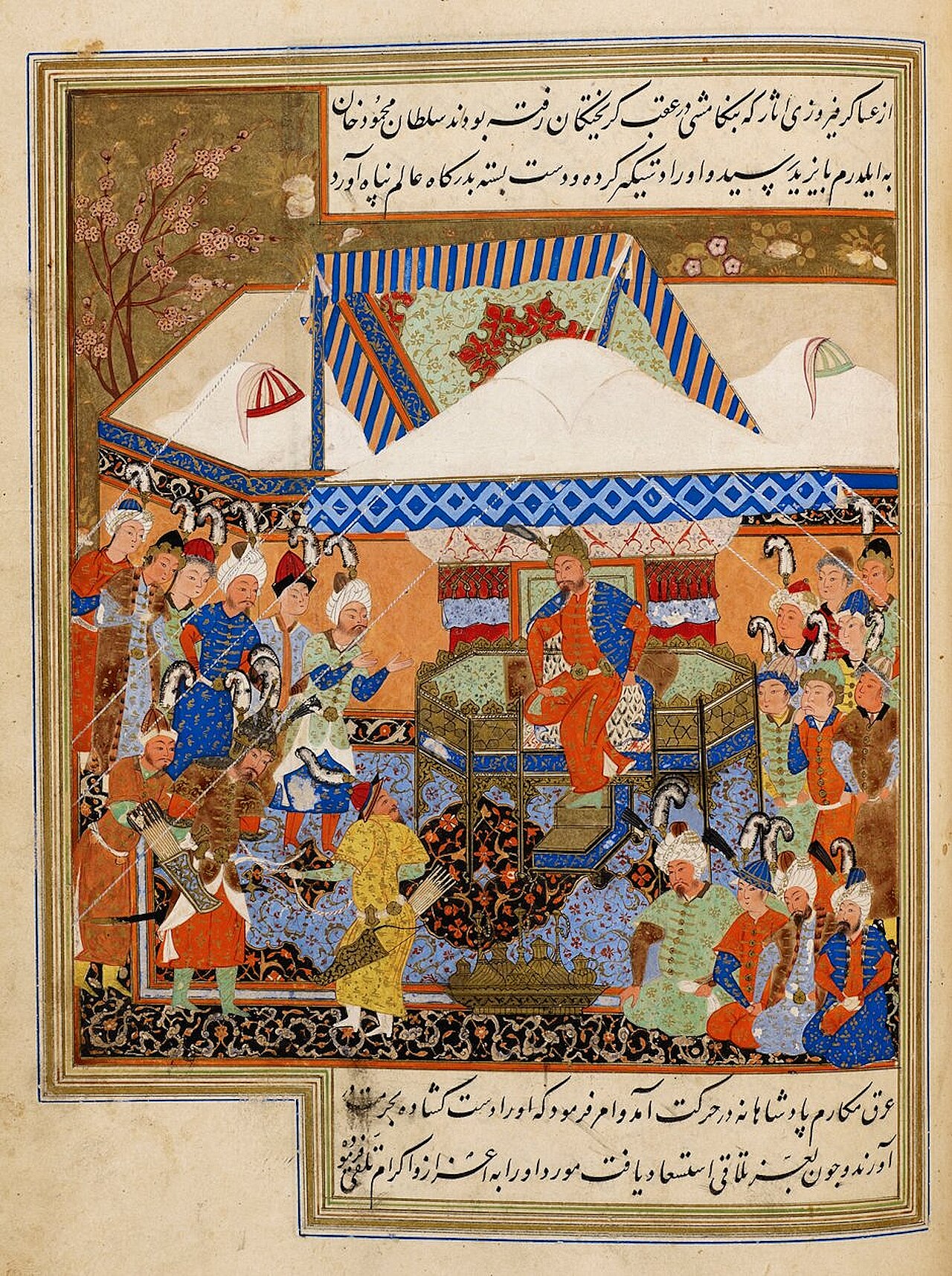

The captive sultan
Bayezid travelled with Timur’s army as a prisoner and died at Akşehir in March 1403, eight months after the battle. Later writers told how Timur shut him in an iron cage and used him as a footstool. The cage is probably a misunderstanding: the Ottoman word kafes could mean a barred litter, and he may have been carried in one under guard. The legend grew in Europe and reached the stage in Christopher Marlowe’s Tamburlaine (c. 1587). Persian court histories of Timur, such as Sharaf al-Din Ali Yazdi’s Zafarnama, present the meeting instead as a scene of royal generosity, with Timur receiving the defeated sultan with honour.
Consequences
For the Ottomans
Ankara nearly ended the Ottoman state. Timur restored the Anatolian beyliks Bayezid had absorbed and left Bayezid’s sons to fight each other. Süleyman, İsa, Musa and Mehmed contested the throne until Mehmed I reunited the realm in 1413. Constantinople gained half a century: it fell to the Ottomans only in 1453. After the battle Timur’s army also took Smyrna (İzmir) from the Knights Hospitaller.
For Iran and Timur
For Timur, Ankara was the last great victory of the “seven-year campaign” that had begun in 1399. With the Mamluks humbled and the Ottomans broken, no power in western Asia could stand against him, and European rulers took notice: the Castilian envoy Ruy González de Clavijo travelled to Samarkand in 1403–1404 and left the fullest European description of Timur’s court. Timur went home and in late 1404 set out to invade Ming China; he died at Otrar in February 1405.
In the long run Ankara had a further consequence for Iran. Timur’s empire did not hold together after his death, and the Turkmen confederations that rose in its place in eastern Anatolia and Azerbaijan, the Qara Qoyunlu and the Aq Qoyunlu, grew in the space between a weakened Ottoman state and the Timurid east. The Ottomans and the rulers of Iran would meet again on the same frontier at Otlukbeli in 1473 and at Chaldiran in 1514.
Sources and their problems
The main narratives come from Timur’s side (Nezam al-Din Shami and Sharaf al-Din Ali Yazdi), from Ibn Arabshah, a Syrian who had been carried off to Samarkand and hated Timur, and from later Ottoman chronicles. They disagree on numbers and on how Bayezid was treated. Ibn Arabshah gives Timur 800,000 men, and a German soldier who fought at Ankara, Johann Schiltberger, gave even larger figures. Modern historians reduce both armies to well under 200,000 combined. For Timur’s life and campaigns as a whole, see Timur (Tamerlane) and Timur’s campaigns in Iran.
- 1399 Timur begins the “seven-year campaign” in the west
- 1400 Timur takes Sivas from the Ottomans
- 1400–1401 Aleppo and Damascus sacked; Baghdad taken
- 28 July 1402 Battle of Ankara; Bayezid captured
- Late 1402 Smyrna taken from the Hospitallers
- March 1403 Bayezid dies at Akşehir
- 1405 Timur dies at Otrar
- 1413 Mehmed I ends the Ottoman civil war
Persian words from this page
| تیمور | Teymur | Timur |
| آنکارا | Ânkârâ | Ankara |
| عثمانی | Osmâni | Ottoman |
| ظفرنامه | Zafar-nâme | “Book of Victory”, history of Timur |
| فیل | fil | elephant |
| جنگ | jang | battle, war |
Sources and further reading
- Sharaf al-Din Ali Yazdi, Zafarnama (completed 1424–1425).
- Ahmad ibn Arabshah, Tamerlane, or Timur the Great Amir, trans. J. H. Sanders, London, 1936.
- Ruy González de Clavijo, Embassy to Tamerlane, 1403–1406, trans. Guy Le Strange, London, 1928.
- Beatrice Forbes Manz, The Rise and Rule of Tamerlane, Cambridge University Press, 1989.
- Colin Imber, The Ottoman Empire, 1300–1650, Palgrave Macmillan, 2002.
Want to learn Persian? Get the free Starter Pack
Get the 14-page printable Starter Pack (all 32 letters, a 7-day reading plan, 100 core words and 20 survival phrases) and a short 5-email course. Free.
More in Post-Mongol Dynasties, Timurids and Turkmens (1335–1501)
- The Chobanids and Jalayirids
- The Injuids and Muzaffarids of Shiraz
- The Sarbadars of Sabzevar
- Khwaju Kermani and Poets of the 14th Century
- Hafez of Shiraz
- Timur (Tamerlane)
- Timur’s Campaigns in Iran
- Timur and the Battle of Ankara (1402)
- Shahrukh and Herat
- Goharshad Begum
- Ulugh Beg and the Samarkand Observatory
- The Timurid Renaissance
- The Qara Qoyunlu (Black Sheep Turkmen)
- The Blue Mosque of Tabriz
- Sultan Husayn Bayqara
- Jami: The Last Great Classical Persian Poet
- Kamal al-Din Behzad and Persian Miniature Painting
- The Aq Qoyunlu (White Sheep Turkmen)
- The Safaviyya Sufi Order of Ardabil