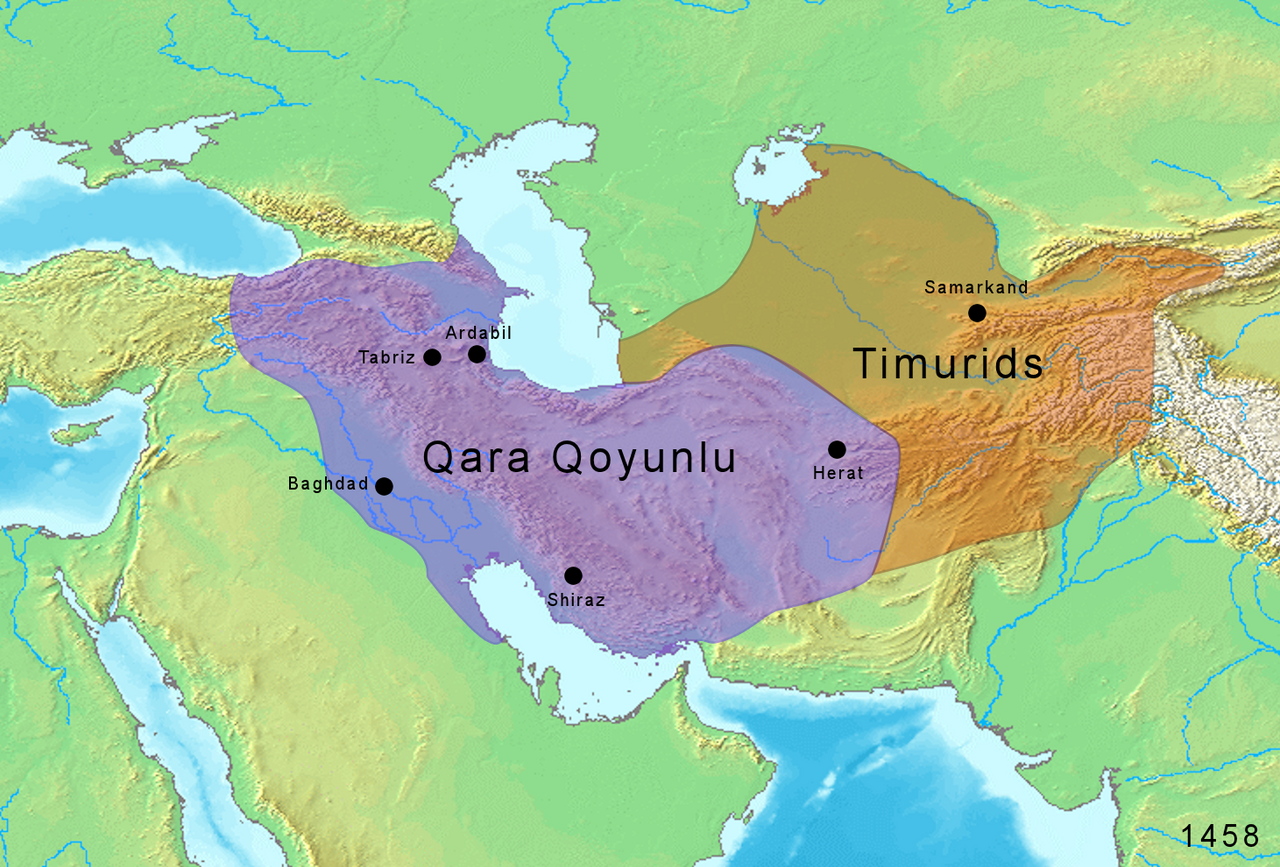
The Qara Qoyunlu (“Black Sheep”) were a confederation of Oghuz Turkmen tribes who ruled Azerbaijan, Armenia and Iraq from Tabriz between about 1406 and 1468, and under Jahan Shah (r. 1438–1467) most of western and central Iran as well. They filled the space Timur’s empire left in the west, fought his heirs for half a century, and were destroyed in 1467–1468 by their Turkmen rivals, the Aq Qoyunlu.
| Period | c. 1375–1468 (independent rulers in Tabriz from 1406–1410) |
|---|---|
| Capital | Tabriz; earlier bases around Lake Van (Erciş) and Mosul |
| Key rulers | Qara Muhammad, Qara Yusuf (d. 1420), Iskandar, Jahan Shah (1438–1467), Hasan Ali (d. 1468) |
| Greatest extent | From eastern Anatolia and Iraq to Fars, Kerman and, briefly in 1458, Herat |
| Ended | Jahan Shah killed by Uzun Hasan, November 1467; Hasan Ali defeated 1468 |
| Best-known monument | The Blue Mosque of Tabriz, completed 1465 |
Black Sheep tribes around Lake Van
The name probably comes from a tribal emblem or from the colour of the confederation’s flocks; historians do not agree. In the fourteenth century the leading clan, the Baharlu, grazed their herds between Lake Van and Mosul and served the Jalayirid sultans of Baghdad as vassals. Under Bayram Khwaja and then Qara Muhammad (d. c. 1389) they became the strongest power in the region between Erzurum and Mosul, taking Mardin in 1384.
Then came Timur. His armies broke the Qara Qoyunlu in the 1390s and again in 1400, and their leader Qara Yusuf, son of Qara Muhammad, became a refugee together with the Jalayirid Sultan Ahmad. Both sheltered with the Ottoman sultan Bayezid, which helped bring on the Battle of Ankara, and then fled to the Mamluks in Syria. The Mamluk sultan held them in prison in Damascus, and a story told in the chronicles has the two exiles swear to divide the future between them: Iraq for Ahmad, Azerbaijan for Qara Yusuf.
Qara Yusuf takes Tabriz
Timur’s death in 1405 freed them. Qara Yusuf returned east and in October 1406 defeated Timur’s grandson Abu Bakr near Nakhchivan and entered Tabriz. On 20 April 1408 he beat Abu Bakr and his father Miran Shah, Timur’s son and governor of the west, at Sardrud south of Tabriz; Miran Shah was killed. The pact with Ahmad did not survive success. When Ahmad tried to take Tabriz in 1410, Qara Yusuf defeated him and had him killed, and the Qara Qoyunlu took Baghdad. The Jalayirid dynasty, whose rise is told in the Chobanids and Jalayirids, survived only in southern Iraq.
Qara Yusuf now ruled Azerbaijan, Armenia and Iraq. In 1420 Timur’s son Shahrukh marched from Herat to reclaim the west, and Qara Yusuf died in his camp in December 1420 just before the armies met.

Three Timurid campaigns and a vassal king
Qara Yusuf’s son Iskandar fought Shahrukh three times. Shahrukh defeated him in 1420–1421, again in 1429, and on a third expedition in 1434–1435. Each time the Timurid army went home to Khorasan and the Turkmens came back. On the third campaign Shahrukh tried a different solution: he recognised Iskandar’s brother Jahan Shah as ruler of Azerbaijan under Timurid overlordship. Jahan Shah was crowned in 1438, and Iskandar was killed by one of his own sons the same year.
Jahan Shah, “Padishah of Iran”
Jahan Shah respected Shahrukh while he lived. When Shahrukh died in 1447 and the Timurid princes fell to fighting, Jahan Shah began to expand. Between 1452 and 1453 his armies took Saveh, Qom, Isfahan, Shiraz and Yazd. In summer 1458 he went further and occupied Herat itself, the Timurid capital, for a few months. He withdrew when his son Hasan Ali rebelled in Azerbaijan and the Timurid prince Abu Sa’id advanced against him. Coins and inscriptions call him sultan, khan and “padishah of Iran”.
His family gave him as much trouble as his enemies. His son Pir Budaq, made governor of Shiraz and later of Baghdad, rebelled twice and was put to death in 1464. Hasan Ali spent years in prison for rebellion.
Jahan Shah was a patron and a poet. He wrote lyric poems in Persian and in Azerbaijani Turkish under the pen name Haqiqi (“the True”). He restored the eastern portal of the Friday Mosque of Yazd in 1457 and added a portal to the Darb-e Imam shrine in Isfahan. In Tabriz his wife Khatun Jan Begum endowed the Mozaffariyye complex, the building now called the Blue Mosque of Tabriz, finished in 1465.
Defeat by the White Sheep
The Aq Qoyunlu of Diyarbakr were the Qara Qoyunlu’s old rivals, and under Uzun Hasan they had grown strong. In 1467 Jahan Shah marched against him. Late in the campaigning season, camped in the hills near Muş in eastern Anatolia, his army had begun to disperse to winter quarters when Uzun Hasan made a surprise attack in November 1467. Jahan Shah was killed while trying to escape. His son Hasan Ali, released from prison to take the throne, called on the Timurid Abu Sa’id for help, but by 1468 Uzun Hasan had beaten him and taken Tabriz and Baghdad. The Qara Qoyunlu never recovered. Their story continues on the Aq Qoyunlu page.
Shi’ites or not
Older scholarship, following Vladimir Minorsky, described the Qara Qoyunlu as Shi’ite in sympathy and called them forerunners of the Safavids. Later historians are more cautious. Qara Yusuf, Iskandar and Jahan Shah all struck coins with the names of the first four caliphs, which a committed Twelver Shi’ite ruler would not have done, and Bosworth found no strong evidence for definite Shi’ite loyalties. What is clear is that Turkmen religion in this period mixed Sunni practice, devotion to Ali and the Prophet’s family, and popular Sufism, the same mixture from which the Safavid order drew its followers.
Turkmen rule and Iran
The Qara Qoyunlu ruled through tribal chiefs (beys) and princes who governed provinces and passed them from father to son, with Persian officials running finance and the chancery. Their state was the first of the Turkmen confederations to rule Iran from Tabriz, and its pattern of tribal power at the top and Persian bureaucracy beneath was taken over by the Aq Qoyunlu and then by the early Safavids.
Persian words from this page
| قراقویونلو | Qarâ Qoyunlu | the Black Sheep Turkmens |
| جهانشاه | Jahânshâh | Jahan Shah |
| قرایوسف | Qarâ Yusof | Qara Yusuf |
| تبریز | Tabriz | Tabriz |
| ترکمن | torkaman | Turkmen |
| پادشاه | pâdshâh | king, sovereign |
For the city they ruled from, see our guide to Tabriz.
Sources and further reading
- Encyclopaedia Iranica, articles on the Qara Qoyunlu and on Jahan Shah.
- H. R. Roemer, “The Türkmen dynasties”, in The Cambridge History of Iran, vol. 6, Cambridge University Press, 1986.
- John E. Woods, The Aqquyunlu: Clan, Confederation, Empire, revised edition, University of Utah Press, 1999.
- Vladimir Minorsky, “Jihān-Shāh Qara-Qoyunlu and his Poetry”, Bulletin of the School of Oriental and African Studies 16 (1954).
- C. E. Bosworth, The New Islamic Dynasties, Edinburgh University Press, 1996.
Want to learn Persian? Get the free Starter Pack
Get the 14-page printable Starter Pack (all 32 letters, a 7-day reading plan, 100 core words and 20 survival phrases) and a short 5-email course. Free.
More in Post-Mongol Dynasties, Timurids and Turkmens (1335–1501)
- The Chobanids and Jalayirids
- The Injuids and Muzaffarids of Shiraz
- The Sarbadars of Sabzevar
- Khwaju Kermani and Poets of the 14th Century
- Hafez of Shiraz
- Timur (Tamerlane)
- Timur’s Campaigns in Iran
- Timur and the Battle of Ankara (1402)
- Shahrukh and Herat
- Goharshad Begum
- Ulugh Beg and the Samarkand Observatory
- The Timurid Renaissance
- The Qara Qoyunlu (Black Sheep Turkmen)
- The Blue Mosque of Tabriz
- Sultan Husayn Bayqara
- Jami: The Last Great Classical Persian Poet
- Kamal al-Din Behzad and Persian Miniature Painting
- The Aq Qoyunlu (White Sheep Turkmen)
- The Safaviyya Sufi Order of Ardabil