Shahrukh (1377–1447), Timur’s youngest son, won the succession war after his father’s death and ruled the Timurid empire from Herat from 1409 until 1447. Where Timur had conquered, Shahrukh consolidated: he held Khorasan, central Iran and Fars, fought the Qara Qoyunlu Turkmens for Azerbaijan, presented himself as a pious Muslim king, and with his wife Goharshad turned Herat into the leading city of Persian culture.

| Persian name | شاهرخ (Shâhrokh) |
|---|---|
| Born | 20 August 1377 |
| Ruled | Khorasan from 1397 (governor); Timurid ruler 1405/1409–1447 |
| Capital | Herat |
| Chief wife | Goharshad |
| Sons | Ulugh Beg, Baysunghur, Ibrahim Sultan and others |
| Died | 13 March 1447, in winter quarters near Rey |
A son kept at a distance
Shahrukh grew up at Timur’s court, raised by Timur’s senior wife Saray Mulk Khanum. He was not his father’s favourite. He fought in the Iranian campaigns of the 1390s, and the Timurid historian Sharaf al-Din Yazdi says that in 1393, still in his teens, he cut off the head of the Muzaffarid Shah Mansur outside Shiraz (see Timur’s campaigns in Iran). In 1397 Timur made him governor of Khorasan, with Herat as his seat, and never promoted him further.
Winning the succession, 1405–1409
When Timur died in February 1405, his chosen heir, the grandson Pir Muhammad, was far away in Kandahar. Another grandson, Khalil Sultan, seized Samarkand and the treasury. The empire split into regional commands under rival princes, and for four years they fought each other. Shahrukh stayed in Khorasan, built up his army, and waited. Pir Muhammad was murdered by one of his own officers in 1407; Khalil Sultan lost the support of the Samarkand emirs. In 1409 Shahrukh took Samarkand. He did not move there. He gave Transoxiana to his fifteen-year-old son Ulugh Beg and kept his own capital at Herat, which from then on was the centre of the empire.
Holding Iran
The western conquests were harder to keep. Fars, Isfahan and Kerman were held by grandsons and great-nephews of Timur who had their own ambitions. Shahrukh brought Fars under control in 1414, crushed a rebellion by his nephew Iskandar, who was put to death in 1415, and took Kerman soon after. By about 1420 central and southern Iran answered to Herat, governed by Shahrukh’s own sons, including Ibrahim Sultan in Shiraz.
Azerbaijan was another matter. During the succession war the Qara Qoyunlu Turkmen leader Qara Yusuf had taken Tabriz and killed Timur’s son Miranshah (1408) and the Jalayirid Sultan Ahmad (1410). Shahrukh led three great campaigns to the north-west, in 1420–21, 1429 and 1434–35. He won battles and occupied Tabriz, but could not hold it, and in the end he accepted Qara Yusuf’s son Jahan Shah as a vassal governor. The Turkmen problem was not solved; within twenty years of Shahrukh’s death the Qara Qoyunlu had taken most of western Iran (see the Qara Qoyunlu).
A Muslim king rather than a Mongol khan
Shahrukh’s style of rule differed sharply from his father’s. Timur had kept a puppet Chinggisid khan and Mongol law, the yasa, alongside Islam. Shahrukh dropped the puppet khan and stressed the sharia. In letters to the Ming emperor Yongle he invited the Chinese ruler to accept Islam and contrasted Islamic law with the yasa. He built mosques and madrasas, and supported Sufi shaikhs and religious scholars.
His piety had a harsh side. In 1427, as he left Friday prayers in the Herat mosque, a man associated with the Hurufis, a sect that built a mystical system on the letters of the alphabet, stabbed him. He survived, and the attack was followed by arrests and executions of suspected sympathisers.
His government relied on long-serving officials. A few men held the top military, secretarial and financial posts for thirty years or more, which gave the empire unusual continuity.
Herat, capital of culture
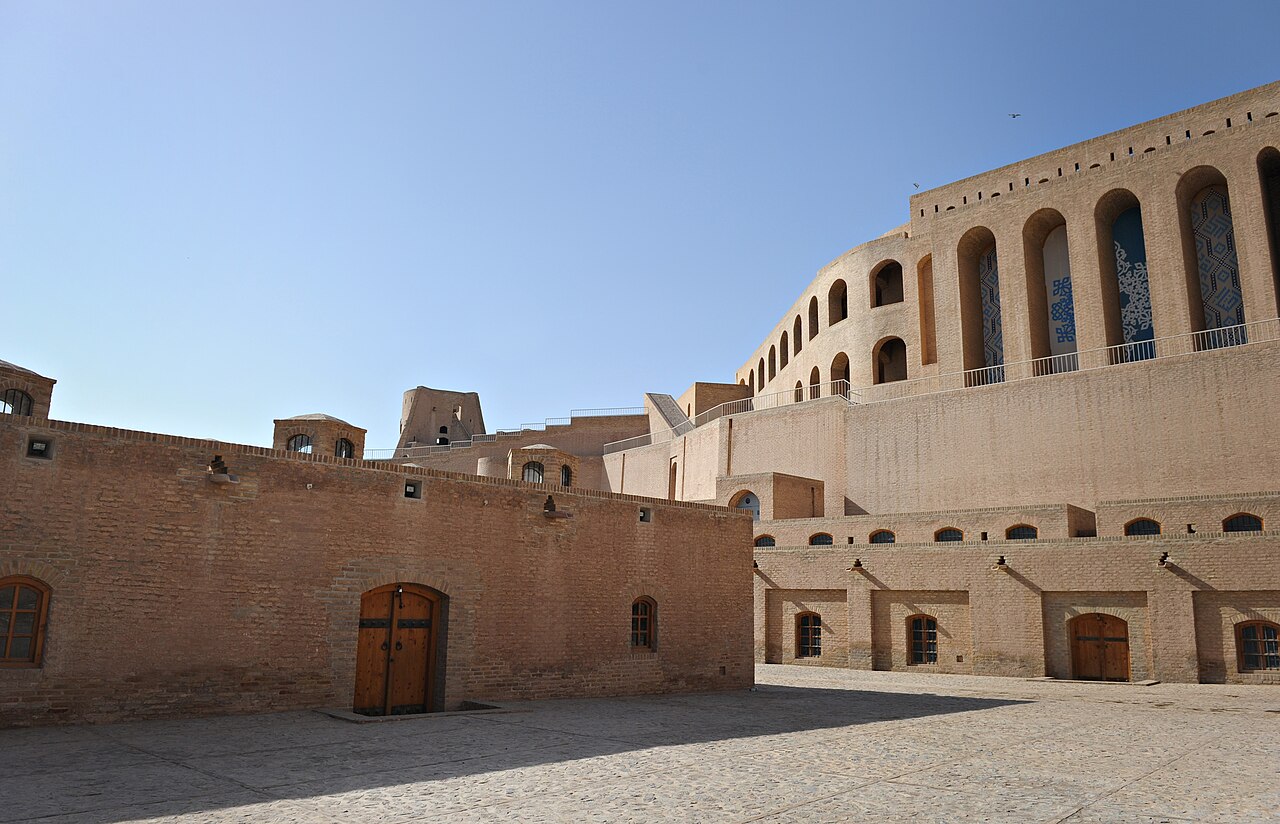
Shahrukh rebuilt the walls and citadel of Herat, which Timur had pulled down in 1381, and the city grew rich on the trade of Khorasan. He commissioned the historian Hafiz-i Abru to write a universal history continuing Rashid al-Din’s great Ilkhanid chronicle, and embassies went from Herat to China, India and Egypt; Ghiyath al-Din Naqqash’s account of the embassy to the Ming court in 1419–1422 and Abd al-Razzaq Samarqandi’s account of his mission to Vijayanagara in south India in the 1440s are famous travel texts.
The great building patron of the reign was his wife, Goharshad, who founded the mosque at the shrine of Imam Reza in Mashhad and the musalla complex in Herat. Their son Baysunghur ran a royal library-workshop whose painters and calligraphers made some of the finest Persian manuscripts ever produced, among them the Baysunghur Shahnameh of 1430. That world is described in the Timurid renaissance.
Death and the scramble that followed
In 1446, nearly seventy, Shahrukh marched west to put down a revolt by his grandson Sultan Muhammad. He died in his winter camp near Rey on 13 March 1447. His army broke up in confusion, and Goharshad and the grandson Abd al-Latif set out to carry his body east. Ulugh Beg succeeded, but within two and a half years he too was dead, killed on the orders of his own son. The long, stable reign was followed by decades of family war, and the empire shrank to Khorasan and Transoxiana.
Persian words from this page
| شاهرخ | Shâhrokh | Shahrukh |
| هرات | Herât | Herat |
| شریعت | shari’at | Islamic law |
| ارگ | arg | citadel |
| سفیر | safir | envoy, ambassador |
| گوهرشاد | Gowharshâd | Goharshad |
Sources and further reading
- Beatrice Forbes Manz, Power, Politics and Religion in Timurid Iran (Cambridge University Press, 2007).
- Hafiz-i Abru, Zubdat al-tawarikh, and Abd al-Razzaq Samarqandi, Matla’-i sa’dayn.
- Ghiyath al-Din Naqqash, account of the Timurid embassy to China, 1419–1422.
- H. R. Roemer, “The Successors of Timur”, in The Cambridge History of Iran, vol. 6 (1986).
- “Shahrokh”, Encyclopaedia Iranica.
Want to learn Persian? Get the free Starter Pack
Get the 14-page printable Starter Pack (all 32 letters, a 7-day reading plan, 100 core words and 20 survival phrases) and a short 5-email course. Free.
More in Post-Mongol Dynasties, Timurids and Turkmens (1335–1501)
- The Chobanids and Jalayirids
- The Injuids and Muzaffarids of Shiraz
- The Sarbadars of Sabzevar
- Khwaju Kermani and Poets of the 14th Century
- Hafez of Shiraz
- Timur (Tamerlane)
- Timur’s Campaigns in Iran
- Timur and the Battle of Ankara (1402)
- Shahrukh and Herat
- Goharshad Begum
- Ulugh Beg and the Samarkand Observatory
- The Timurid Renaissance
- The Qara Qoyunlu (Black Sheep Turkmen)
- The Blue Mosque of Tabriz
- Sultan Husayn Bayqara
- Jami: The Last Great Classical Persian Poet
- Kamal al-Din Behzad and Persian Miniature Painting
- The Aq Qoyunlu (White Sheep Turkmen)
- The Safaviyya Sufi Order of Ardabil