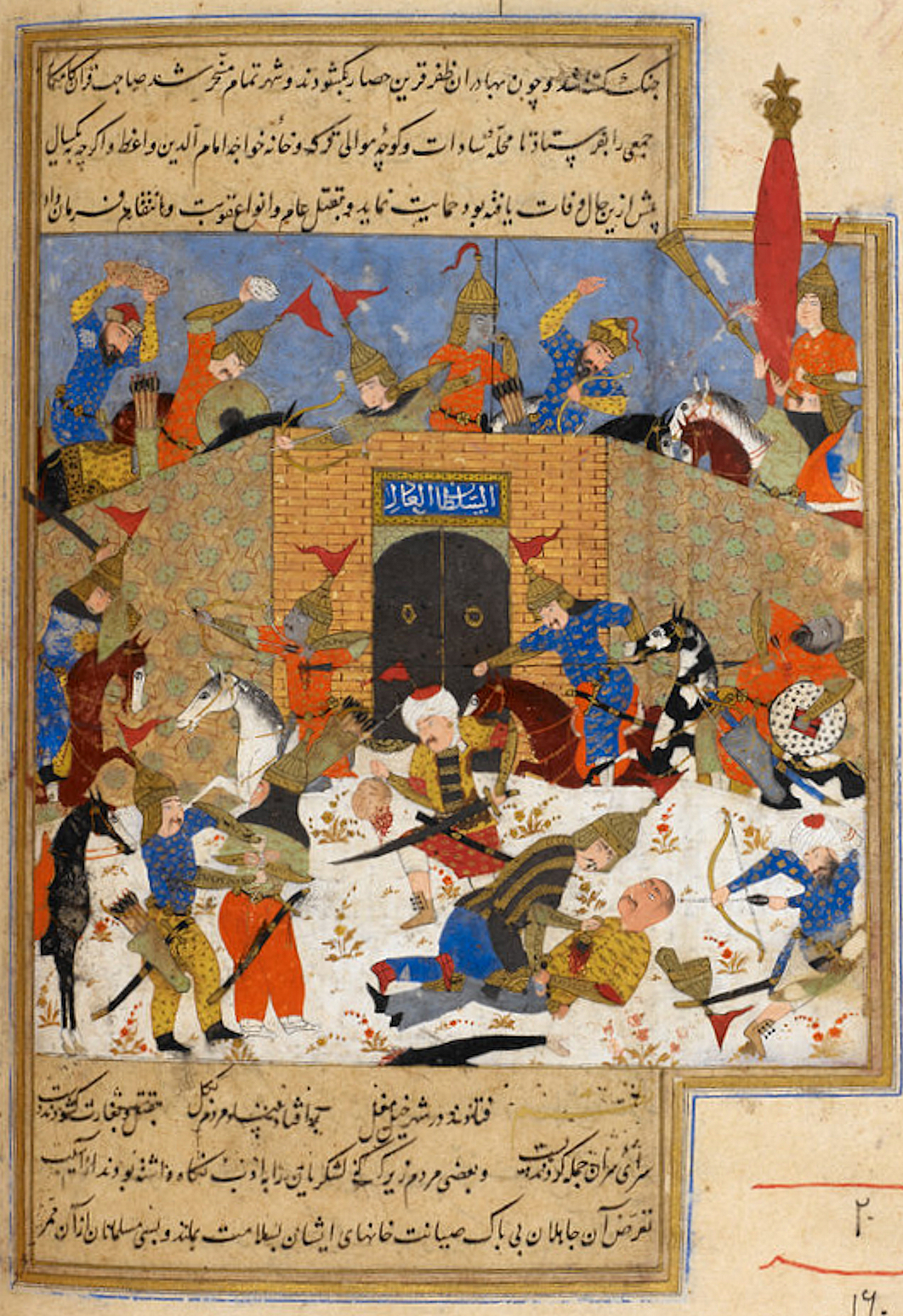
Timur conquered Iran in a series of campaigns between 1381 and 1393, sweeping away the local dynasties that had ruled since the fall of the Ilkhanate. Cities that surrendered were ransomed; those that resisted, such as Isfizar in 1383 and Isfahan in 1387, were massacred. By 1393 every part of Iran from Herat to Tabriz and Shiraz was in Timurid hands, governed by his sons and grandsons.

Iran before Timur
In 1380 Iran was divided among the dynasties described elsewhere in this section: the Kartids in Herat, the Sarbadars in Sabzevar, local lords in Mazandaran and Astarabad, the Muzaffarids in Fars, Kerman, Yazd and Isfahan, and the Jalayirids in Tabriz and Baghdad. None of them could match the army that Timur had built in Transoxiana during the 1370s (on his rise, see Timur (Tamerlane)).
Khorasan and the east, 1381–1384
Timur began with Herat. In 1381 the Kartid king Ghiyath al-Din Pir Ali surrendered after a short resistance; Timur took the city’s treasure, had its walls pulled down and sent leading families into exile. In the same year the Sarbadar ruler Ali Mu’ayyad came to him at Nishapur and submitted, saving Sabzevar.
In 1383 parts of Khorasan rebelled. The punishment showed what resistance would cost. At Isfizar, according to the Timurid historians, prisoners were piled up alive and built into towers with mortar and brick. The Kartid family was put to death. Timur then marched into Sistan, where the city of Zaranj was sacked and the dams and canals of the Helmand delta were damaged; the province never fully recovered its old prosperity. In 1384 he moved west along the Caspian, attacked Astarabad and Mazandaran, and took Rey and Soltaniyeh, the former Ilkhanid capital.
The three-year campaign, 1386–1388
Tabriz
In 1385 the Golden Horde khan Tokhtamysh, once Timur’s protégé and now his rival, raided Azerbaijan and sacked Tabriz. Timur followed in 1386. The Jalayirid Sultan Ahmad abandoned the city and Timur occupied it, taking its craftsmen east. He wintered in Karabakh and campaigned in Georgia.
Isfahan, 1387
In the autumn of 1387 Timur turned south to Isfahan, held for the Muzaffarids. The city surrendered without a fight and agreed to pay a ransom. Timur’s officers entered to collect it. During the night, a crowd in one quarter rose and killed the collectors and the soldiers stationed in the city; the Timurid histories say they numbered in the thousands. Timur retook Isfahan and ordered each unit of his army to bring in a fixed number of heads. The historian Hafiz-i Abru, writing for Timur’s son, gives a total of 70,000 heads, piled in towers outside the walls; later writers give higher figures. No count from the time can be checked, but there is no doubt that a large part of the population was killed.
Craftsmen, as usual, were kept alive and many were sent to Samarkand.
Shiraz and the poet
From Isfahan Timur marched to Shiraz. The Muzaffarid ruler Zayn al-Abidin fled, the city submitted, and the other Muzaffarid princes of Yazd and Kerman came to offer obedience. Timur left them in place as vassals. Hafez was living in Shiraz, an old man, and a much-told story says Timur summoned him to ask about a couplet in which the poet offers Samarkand and Bukhara for a beloved’s mole. The story first appears a century later and is best read as legend; it is discussed on our page on Hafez of Shiraz.
Timur did not stay. News came that Tokhtamysh had invaded Transoxiana, and at the end of 1387 he hurried back to Samarkand.
The five-year campaign, 1392–1396
Timur returned to Iran in 1392 with the aim of settling it for good. He first attacked the sayyid rulers of Amol and Sari in Mazandaran, then marched south through Luristan to Shushtar and Dezful. In Fars the Muzaffarid Shah Mansur had seized Shiraz and blinded his cousin Zayn al-Abidin. In the spring of 1393 Shah Mansur, with a small army weakened by desertion, attacked Timur’s much larger force outside Shiraz and, the histories say, nearly reached Timur himself before being driven back. He was caught and beheaded; Sharaf al-Din Yazdi says the young prince Shahrukh brought his head to his father.
The other Muzaffarid princes came in to submit. On 22 May 1393, at Qumisha (now Shahreza), south of Isfahan, Timur had them executed. Only Zayn al-Abidin and one brother were spared. The craftsmen and scholars of Fars were sent to Samarkand. Timur then crossed into Iraq and took Baghdad in August 1393.
Governing conquered Iran
Timur divided his conquests among his family. His son Umar Shaykh, and after Umar Shaykh’s death in 1394 his sons, governed Fars. Another son, Miranshah, was given the north-west, roughly the old Ilkhanid heartland with Tabriz and Soltaniyeh. By 1399 Miranshah’s behaviour had become erratic: the chronicles describe drinking, executions and the demolition of buildings in Tabriz, and some blame a head injury from a fall. Timur removed him, though he kept his life.
Iranian officials, many of them from the same families who had served the Ilkhans and the local dynasties, ran the tax system. Persian remained the language of government and of the dynasty’s histories. In this sense Timur’s conquest did not change how Iran was run so much as who sat at the top.
- 1381 Herat surrenders; the Sarbadars submit at Nishapur
- 1383 Revolt in Khorasan; massacre at Isfizar; Sistan devastated
- 1384 Astarabad, Rey and Soltaniyeh taken
- 1386 Tabriz occupied
- 1387 Isfahan massacre; Shiraz submits
- 1393 Shah Mansur killed outside Shiraz; Muzaffarid princes executed at Qumisha; Baghdad taken
- 1399 Miranshah removed from the government of the north-west
Counting the cost
The campaigns left deep marks. Contemporary writers from Iran, such as the poets of Shiraz, and later Iranian historians remember Timur above all for the towers of heads. Economic historians point also to the damage to irrigation in Sistan and Khorasan, and to the loss of skilled people taken east. Yet within a generation, Timur’s son Shahrukh was rebuilding in Herat and Mashhad, and many of the Persian craftsmen moved to Samarkand had built the monuments that defined Timurid architecture.
Persian words from this page
| اصفهان | Esfahân | Isfahan |
| هرات | Herât | Herat |
| سیستان | Sistân | Sistan |
| سلطانیه | Soltâniye | Soltaniyeh |
| قمشه | Qomshe | Qumisha, now Shahreza |
| کلهمنار | kalle-menâr | tower of skulls |
Sources and further reading
- Sharaf al-Din Ali Yazdi, Zafarnama (1424–25); Nizam al-Din Shami, Zafarnama (c. 1404).
- Hafiz-i Abru, histories written for Shahrukh, for the Isfahan figures.
- Beatrice Forbes Manz, The Rise and Rule of Tamerlane (Cambridge University Press, 1989).
- H. R. Roemer, “Timur in Iran”, in The Cambridge History of Iran, vol. 6 (1986).
- “Timur”, Encyclopaedia Iranica.
Want to learn Persian? Get the free Starter Pack
Get the 14-page printable Starter Pack (all 32 letters, a 7-day reading plan, 100 core words and 20 survival phrases) and a short 5-email course. Free.
More in Post-Mongol Dynasties, Timurids and Turkmens (1335–1501)
- The Chobanids and Jalayirids
- The Injuids and Muzaffarids of Shiraz
- The Sarbadars of Sabzevar
- Khwaju Kermani and Poets of the 14th Century
- Hafez of Shiraz
- Timur (Tamerlane)
- Timur’s Campaigns in Iran
- Timur and the Battle of Ankara (1402)
- Shahrukh and Herat
- Goharshad Begum
- Ulugh Beg and the Samarkand Observatory
- The Timurid Renaissance
- The Qara Qoyunlu (Black Sheep Turkmen)
- The Blue Mosque of Tabriz
- Sultan Husayn Bayqara
- Jami: The Last Great Classical Persian Poet
- Kamal al-Din Behzad and Persian Miniature Painting
- The Aq Qoyunlu (White Sheep Turkmen)
- The Safaviyya Sufi Order of Ardabil