The Blue Mosque of Tabriz (Masjed-e Kabud) was completed in 1465 for the Qara Qoyunlu ruler Jahan Shah and his wife Khatun Jan Begum, and was famous for the deep blue tile mosaic that covered it inside and out. An earthquake in 1780 brought down its domes, leaving little more than the entrance iwan; what visitors see today is largely a reconstruction begun in 1973 around the surviving walls and tiles.
| Persian name | Masjed-e Kabud (مسجد کبود), “the Blue Mosque”; originally part of the Mozaffariyye complex |
|---|---|
| Completed | 870 AH, 1465 CE (mausoleum work continued into the Aq Qoyunlu period) |
| Patrons | Khatun Jan Begum, wife of Jahan Shah; later their daughter Saleha Khatun |
| Calligrapher | Ne’matollah ibn Mohammad al-Bawwab |
| Plan | Fully covered mosque: domed central hall with ambulatories and a smaller domed sanctuary, T-shaped overall |
| Damage | Earthquake of 1780; only the entrance iwan stayed standing |
| Restoration | From 1973 under Reza Memaran Benam, still not complete in 2025 |

A foundation of the Qara Qoyunlu court
By the 1460s Jahan Shah ruled from Tabriz over an empire that reached from Iraq to Kerman (see the Qara Qoyunlu). His wife, Khatun Jan Begum, endowed a pious foundation in the city called the Mozaffariyye, probably after Jahan Shah’s title Mozaffar al-Din (“Victorious in the Faith”). Like other royal foundations of the time it was more than a mosque: the endowment was meant to support a complex of religious buildings with a family mausoleum at its heart.
The mosque was finished in 1465, the date 870 of the Islamic calendar in its inscriptions. Two years later Jahan Shah was killed by the Aq Qoyunlu leader Uzun Hasan, and Khatun Jan Begum died soon after. Their daughter Saleha Khatun saw the work on the mausoleum continue under the new Aq Qoyunlu rulers of Tabriz. Jahan Shah’s tomb lies in the southern part of the building. The mausoleum was probably never fully finished.
A covered mosque
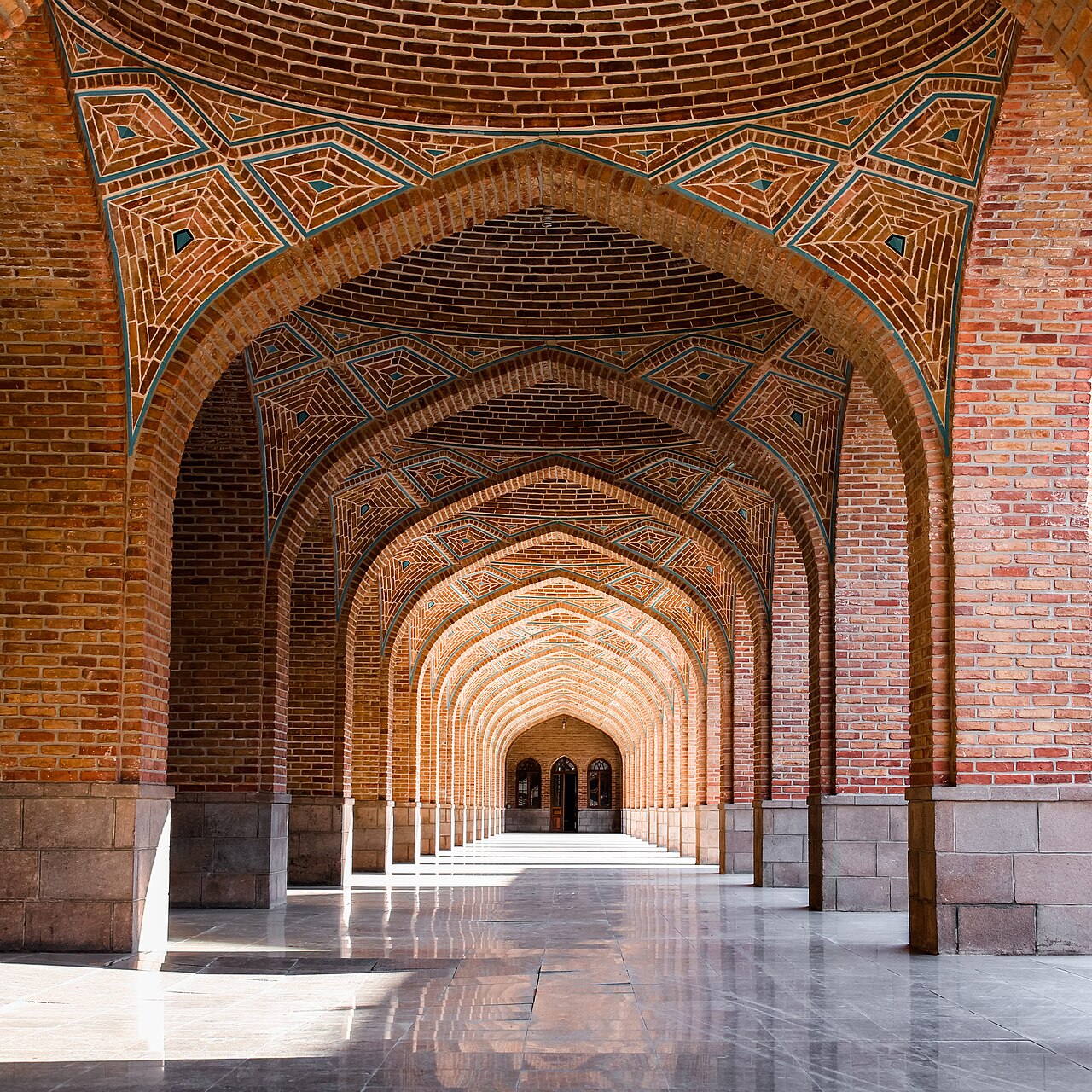
Most large Iranian mosques are built around an open courtyard with iwans on its sides. The Blue Mosque is unusual: it is almost entirely roofed. A monumental portal leads into a square central hall under a large dome, surrounded on three sides by domed passages, and beyond it a smaller domed chamber served as the sanctuary in front of the qibla wall. In front of the entrance an open forecourt took the place of the usual courtyard. Historians have explained the enclosed plan by the cold winters of Tabriz and have compared it with the domed mosques of Anatolia in the same century.
The building stood on a raised stone platform and was built of brick. It had two minarets flanking the portal; both have gone.
The tiles
The name “Blue Mosque” comes from the tilework, and it was the tiles that made the building famous. Three kinds were used together:
- Tile mosaic on the portal and outer walls: thousands of small pieces cut from glazed tiles of different colours and fitted together into arabesques, flowers and inscriptions. The entrance alone uses tiles of seven colours, with dark blue and turquoise dominant.
- Dark blue hexagonal tiles lining the sanctuary walls, painted with gold over the glaze. The effect, a room of deep blue and gold, had no equal in Iran until the Sheikh Lotfollah Mosque in Isfahan a century and a half later.
- Carved marble and alabaster for the dado panels and prayer niches.
The calligrapher Ne’matollah ibn Mohammad al-Bawwab designed the inscriptions in Kufic and thuluth scripts that run around the portal and walls. Fragments of the original mosaic still cover parts of the portal, and the gap between their density and the plain new brickwork shows how much was lost.
Earthquakes, decay and rebuilding
Tabriz lies on an active fault, and the city was shaken repeatedly. The great earthquake of 1780 brought down the domes and most of the walls, and for nearly two centuries the mosque stood as a ruin, with the portal and fragments of tiled wall rising from rubble.
Iran’s Ministry of Culture began reconstruction in 1973 under the architect Reza Memaran Benam. The main dome was rebuilt as a double shell, original tiles were kept in place wherever they survived, and new brick was made to match the old. Pieces of the old tiling are displayed in the southern prayer hall. The work was still going on in 2025.
The Blue Mosque and Tabriz
The mosque was one of several great buildings in Turkmen Tabriz. The Aq Qoyunlu later built a palace, the Hasht Behesht, and a large mosque and mausoleum of their own nearby, but almost nothing of these survives, which makes the Blue Mosque the main witness to the city’s fifteenth-century architecture. It stands in the historic centre, a short walk from the bazaar and close to Imam Khomeini Street; the Azerbaijan Museum is next to it. For the city as a whole, see our Tabriz city guide and the Tabriz Historic Bazaar. For opening hours and tickets, check current local information before you go.
Persian words from this page
| مسجد کبود | Masjed-e Kabud | the Blue Mosque |
| کبود | kabud | dark blue |
| کاشی | kâshi | glazed tile |
| گنبد | gonbad | dome |
| محراب | mehrâb | prayer niche |
| زلزله | zelzele | earthquake |
| جهانشاه | Jahânshâh | Jahan Shah |
Sources and further reading
- Sandra Aube, “Tabriz x. Monuments x(1). The Blue Mosque”, Encyclopaedia Iranica.
- Sandra Aube, La céramique dans l’architecture en Iran au XVe siècle, Paris: Presses de l’Université Paris-Sorbonne, 2017.
- Lisa Golombek and Donald Wilber, The Timurid Architecture of Iran and Turan, Princeton University Press, 1988.
- Sheila Blair and Jonathan Bloom, The Art and Architecture of Islam 1250–1800, Yale University Press, 1994.
Want to learn Persian? Get the free Starter Pack
Get the 14-page printable Starter Pack (all 32 letters, a 7-day reading plan, 100 core words and 20 survival phrases) and a short 5-email course. Free.
More in Post-Mongol Dynasties, Timurids and Turkmens (1335–1501)
- The Chobanids and Jalayirids
- The Injuids and Muzaffarids of Shiraz
- The Sarbadars of Sabzevar
- Khwaju Kermani and Poets of the 14th Century
- Hafez of Shiraz
- Timur (Tamerlane)
- Timur’s Campaigns in Iran
- Timur and the Battle of Ankara (1402)
- Shahrukh and Herat
- Goharshad Begum
- Ulugh Beg and the Samarkand Observatory
- The Timurid Renaissance
- The Qara Qoyunlu (Black Sheep Turkmen)
- The Blue Mosque of Tabriz
- Sultan Husayn Bayqara
- Jami: The Last Great Classical Persian Poet
- Kamal al-Din Behzad and Persian Miniature Painting
- The Aq Qoyunlu (White Sheep Turkmen)
- The Safaviyya Sufi Order of Ardabil