Sultan Husayn Bayqara (1438–1506) was the last Timurid ruler of Herat, holding the city and most of Khorasan from 1469 until his death in May 1506. His court, with the poet Jami, the statesman Ali-Shir Navai and the painter Behzad, made Herat the cultural capital of the Persian-speaking world; his quarrelling sons lost it to the Uzbeks within a year of his death.
| Born | June or July 1438, Herat |
|---|---|
| Died | 4 May 1506, at the start of a campaign against the Uzbeks |
| Reigned | 1469–1506 in Herat (briefly displaced in 1470) |
| Descent | Great-great-grandson of Timur through Umar Shaykh and Bayqara |
| Pen name | Husayni, for his poems in Chagatai Turkish |
| Buried | His madrasa and mausoleum at the Musalla, Herat |
| Successors | His sons Badi al-Zaman and Muzaffar Husayn, jointly; Herat fell to Muhammad Shaybani Khan in 1507 |
A prince without a throne
Husayn was born in Herat in 1438, in the last decade of Shahrukh‘s reign. His line went back to Timur’s eldest son Umar Shaykh, but it was a minor branch, with no claim to rule. After Shahrukh’s death in 1447 the empire broke into pieces held by competing princes, and Husayn grew up in that world. He served his cousin Abu’l-Qasim Babur in Herat from 1452; after Babur’s death in 1457 he became, in effect, a soldier of fortune, with a band of followers who raided across Khwarazm, the Qipchaq steppe and the Caspian provinces.
The chance came in 1469. The Timurid Abu Sa’id, who held Herat, invaded western Iran and was captured and executed after his defeat by the Aq Qoyunlu leader Uzun Hasan (see the Aq Qoyunlu). Husayn moved fast and entered Herat on 24 March 1469.
Holding Herat
Uzun Hasan backed a rival claimant, Yadgar Muhammad, a great-grandson of Shahrukh. Husayn beat him at Chenaran in September 1469, but on 7 July 1470 Yadgar Muhammad took Herat with Aq Qoyunlu support. Six weeks later Husayn surprised him in the city at night, captured him and had him executed. From then on Husayn’s hold on Herat was secure for over thirty years, a long reign by the standards of the Timurid house.
His wars after that were mostly with his own family. He had many sons (one source counts eighteen) and gave them provinces such as Balkh, Astarabad and Merv. In the 1490s several revolted, most seriously his eldest, Badi al-Zaman, who rebelled more than once and besieged Herat in 1499. Husayn reconciled with him in the end, but only after having Badi al-Zaman’s son Muhammad Mu’min put to death, an act Babur and other writers held against him.
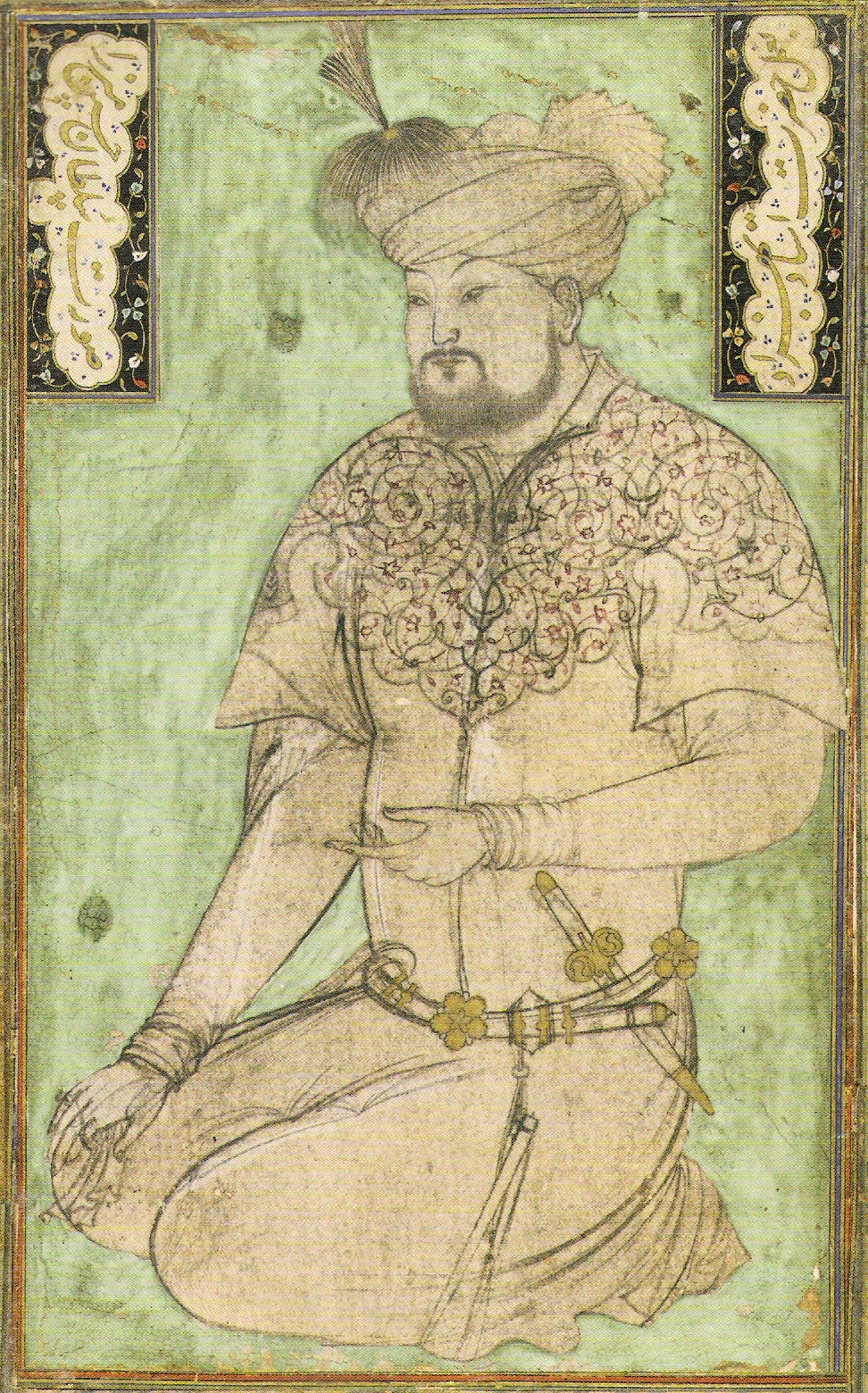

The court of Herat
The Herat of Husayn Bayqara is remembered less for its wars than for its people. His childhood friend Ali-Shir Navai served as keeper of the seal and adviser and used his own fortune to build schools, hospitals and Sufi lodges. The poet and Sufi Abd al-Rahman Jami was the senior figure of the city’s literary and religious life. In the royal library the painter Behzad and the calligrapher Sultan Ali Mashhadi did their finest work, and the historians Mirkhvand and his grandson Khvandamir wrote the chronicles from which much of our knowledge of the period comes.
The sultan took part himself. He wrote ghazals in Chagatai Turkish under the pen name Husayni, and a Persian prose work, the Majalis al-ushshaq (“Assemblies of Lovers”), a set of biographies of Sufis and lovers, circulated under his name, though many scholars think it was written for him by Kamal al-Din Gazurgahi. The broader picture of the period’s art is given in the Timurid Renaissance.
Building in Herat
Husayn built a madrasa and his own mausoleum near the Musalla, the great complex Goharshad had founded north of the city, and laid out the Bagh-e Jahanara (“World-adorning Garden”), a palace garden that was the setting of court life. He also paid for the redecoration of the Friday Mosque of Herat. Most of the Musalla was demolished in 1885, during fears of a Russian advance, and only a few minarets and Goharshad’s mausoleum still stand.
How Babur saw him
The best portrait of Husayn comes from a relative. Babur, the future founder of the Mughal empire, was a younger Timurid prince who came to Herat in late 1506, just after Husayn’s death. In his memoirs he devoted a long section to the late sultan: his ancestry, wives and children, emirs, poets and artists. He described Husayn as brave and well-read, fond of fine clothes and festivities, and so taken up with pleasure in his later years that his sons and nobles followed the same course. Babur admired the city’s culture but thought its elite unprepared for war.
Events proved him right. Husayn died on 4 May 1506 just after setting out against the Uzbek khan Muhammad Shaybani. His sons Badi al-Zaman and Muzaffar Husayn were proclaimed joint rulers and could not agree on a plan of defence. Babur, judging Herat impossible to hold, left. In May 1507 Shaybani Khan took the city, and Timurid rule in Khorasan ended. Three years later Shah Ismail I defeated and killed Shaybani at Marv, and Herat became a Safavid city.
How historians judge him
Historians weigh two sides of his reign. One is political: by the end, central power was weak, princes and emirs held their provinces as their own, and the treasury was strained by grants to the court’s many dependants. The other is cultural: few courts in Islamic history gathered so many first-rate writers, painters, calligraphers and musicians in one place, and the styles formed in his Herat were carried by artists who moved to Safavid Tabriz, Mughal India and Uzbek Bukhara.
Persian words from this page
| سلطان حسین بایقرا | Soltân Hoseyn-e Bâyqarâ | Sultan Husayn Bayqara |
| هرات | Herât | Herat |
| امیر علیشیر نوایی | Amir Alishir-e Navâyi | Ali-Shir Navai |
| مصلی | mosallâ | open prayer ground; the Musalla complex |
| باغ | bâgh | garden |
| مدرسه | madrese | religious college, school |
Sources and further reading
- Babur, The Baburnama: Memoirs of Babur, Prince and Emperor, trans. Wheeler M. Thackston, Oxford University Press, 1996.
- Khvandamir, Habib al-siyar, vol. 3, trans. W. M. Thackston, Harvard University, 1994.
- Maria Eva Subtelny, Timurids in Transition: Turko-Persian Politics and Acculturation in Medieval Iran, Brill, 2007.
- H. R. Roemer, “The successors of Timur”, in The Cambridge History of Iran, vol. 6, Cambridge University Press, 1986.
- Encyclopaedia Iranica, “Ḥosayn Bāyqarā”.
Want to learn Persian? Get the free Starter Pack
Get the 14-page printable Starter Pack (all 32 letters, a 7-day reading plan, 100 core words and 20 survival phrases) and a short 5-email course. Free.
More in Post-Mongol Dynasties, Timurids and Turkmens (1335–1501)
- The Chobanids and Jalayirids
- The Injuids and Muzaffarids of Shiraz
- The Sarbadars of Sabzevar
- Khwaju Kermani and Poets of the 14th Century
- Hafez of Shiraz
- Timur (Tamerlane)
- Timur’s Campaigns in Iran
- Timur and the Battle of Ankara (1402)
- Shahrukh and Herat
- Goharshad Begum
- Ulugh Beg and the Samarkand Observatory
- The Timurid Renaissance
- The Qara Qoyunlu (Black Sheep Turkmen)
- The Blue Mosque of Tabriz
- Sultan Husayn Bayqara
- Jami: The Last Great Classical Persian Poet
- Kamal al-Din Behzad and Persian Miniature Painting
- The Aq Qoyunlu (White Sheep Turkmen)
- The Safaviyya Sufi Order of Ardabil