Ulugh Beg (1394–1449), grandson of Timur and son of Shahrukh and Goharshad, governed Samarkand and Transoxiana for forty years and is remembered less as a ruler than as an astronomer. In the 1420s he built in Samarkand the largest observatory of its time, and with a team that included the Iranian mathematician Jamshid al-Kashi he produced the Zij-i Sultani, a set of astronomical tables written in Persian with a catalogue of about a thousand stars.

| Real name | Muhammad Taraghay; Ulugh Beg means “great prince” in Turkic |
|---|---|
| Born | 22 March 1394, Soltaniyeh, north-west Iran |
| Ruled | Samarkand and Transoxiana 1409–1447; Timurid sovereign 1447–1449 |
| Main works | Madrasa on the Registan, Samarkand (1417–1420); observatory (1420s); Zij-i Sultani |
| Died | 27 October 1449, killed on the orders of his son Abd al-Latif |
| Persian name | الغبیگ (Olugh Beyg) |
The Iranian connection
Ulugh Beg ruled from Samarkand, in modern Uzbekistan, and never governed Iran itself until the last two years of his life. But his story belongs in Iranian history in several ways. He was born at Soltaniyeh, the old Ilkhanid capital, while Timur’s army was campaigning in Iran. His mother Goharshad was the builder of the great mosque at Mashhad, and his father Shahrukh ruled Khorasan and much of Iran from Herat. His court wrote in Persian, the language of his tables. His leading scientist, al-Kashi, came from Kashan. And his observatory carried on the tradition of the Maragheh observatory in Azerbaijan, which Ulugh Beg is said to have visited as a boy, founded by Nasir al-Din Tusi in the 1250s.
Governor at fifteen
When Shahrukh won the succession war and took Samarkand in 1409, he gave the city and Transoxiana to Ulugh Beg, then fifteen, with experienced emirs to guide him. Ulugh Beg kept the post for the rest of his father’s long reign. He was a competent but not brilliant soldier: he defended the frontier against nomads, campaigned in Moghulistan, and suffered a heavy defeat on the northern steppe frontier in 1427. His real interests were scholarship and building. Samarkand under him remained a great city, and he added to Timur’s monuments rather than to Timur’s conquests.
A school and an observatory
Between 1417 and 1420 he built a madrasa on the Registan, the main square of Samarkand. Unusually, mathematics and astronomy were taught there alongside religious subjects. The leading teachers were Qadi-zada Rumi, a mathematician from Bursa in Anatolia, and Ghiyath al-Din Jamshid al-Kashi from Kashan.
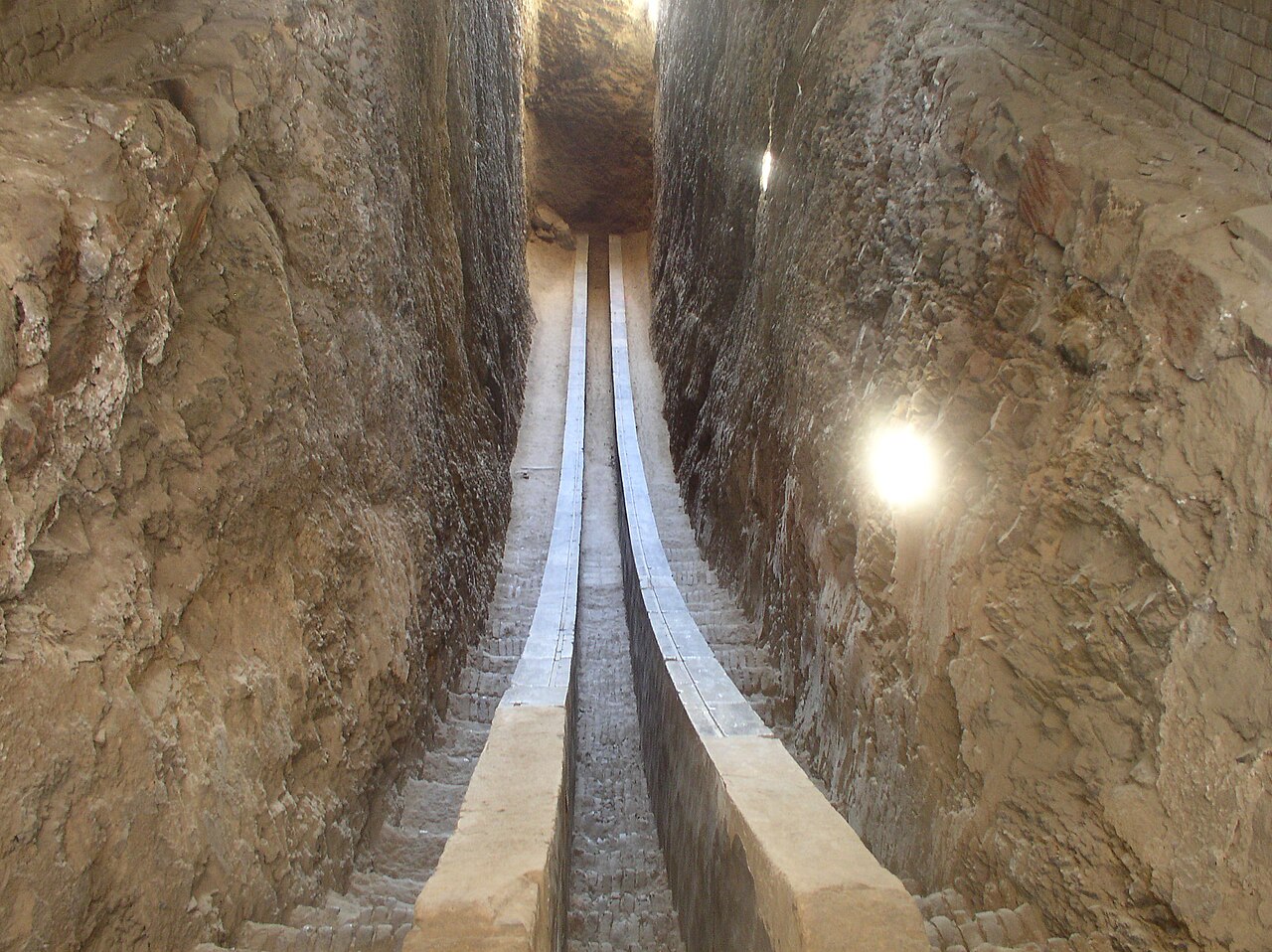
In the 1420s (the work is often dated to around 1424–1429) he built the observatory on a hill north-east of the city. It is described as a cylindrical building about three storeys high, decorated with tiles, and its main instrument was a gigantic meridian arc set into a trench in the rock. With a radius of more than 35 metres, it was used to measure the height of the Sun, Moon and stars as they crossed the meridian. The bigger the instrument, the finer the scale could be divided, and in the age before telescopes this gave remarkable precision.
After Ulugh Beg’s death the observatory was abandoned and its stone taken for other buildings. Its site was forgotten until the Russian archaeologist Vasily Vyatkin found the underground part of the arc in 1908. That curved track, pictured above, is what visitors see today.
The Zij-i Sultani
A zij is a handbook of astronomical tables: positions of the planets, calendars, eclipses, trigonometry. Ulugh Beg’s, finished around 1437 and written in Persian, opens with sections on chronology and on the calendars of different peoples and continues with tables for the Sun, Moon and planets. Its most famous part is a catalogue of fixed stars with their positions, about a thousand entries, the first major star catalogue based largely on new observations since Ptolemy’s.
Its figures were very accurate for their time. Ulugh Beg gave the length of the sidereal year as 365 days, 6 hours, 10 minutes and 8 seconds, within about a minute of the modern value. In 1665 the English orientalist Thomas Hyde published the star catalogue at Oxford with a Latin translation, and European astronomers used it.
Al-Kashi and the circle
Jamshid al-Kashi, who died at Samarkand in 1429, was one of the most gifted mathematicians of the medieval Islamic world. In a treatise of 1424 he computed the ratio of a circle’s circumference to its radius (2π) to sixteen decimal places, a record that stood for about 150 years. His letters to his father in Kashan describe life at Ulugh Beg’s observatory and the prince’s own skill at mental calculation. After Ulugh Beg’s death another member of the team, Ali Qushji, carried the school’s methods west, first to the Aq Qoyunlu court of Uzun Hasan in Tabriz and then to Ottoman Istanbul.
Two years on the throne
When Shahrukh died in 1447, Ulugh Beg claimed the empire. He had to fight his nephews and his own mother’s favourite grandson, and he quarrelled with his son Abd al-Latif, who held Balkh and felt cheated of his share. In 1449 Abd al-Latif defeated his father near Samarkand. Ulugh Beg surrendered and was allowed to set out on pilgrimage to Mecca, but on the way he was seized and beheaded, on 27 October 1449. Abd al-Latif himself was killed the following year. When Soviet scientists opened Ulugh Beg’s grave in the Gur-e Amir in 1941, they found the skeleton with the head severed, as the chronicles said.
Some later writers blamed Ulugh Beg’s fall partly on religious conservatives who disliked his tolerance and his interest in the stars. Most historians stress instead the ordinary family politics of the Timurid house (see Timur (Tamerlane) for the origins of the dynasty). For astronomy in Iran across the centuries, see science in Iranian history.
Persian words from this page
| رصدخانه | rasad-khâne | observatory |
| زیج | zij | astronomical tables |
| ستاره | setâre | star |
| سمرقند | Samarqand | Samarkand |
| کاشان | Kâshân | Kashan |
| سلطانیه | Soltâniye | Soltaniyeh |
Sources and further reading
- “Oloġ Beg”, Encyclopaedia Iranica.
- E. S. Kennedy, “A Survey of Islamic Astronomical Tables”, Transactions of the American Philosophical Society 46 (1956).
- Edward S. Kennedy, “A Letter of Jamshīd al-Kāshī to His Father”, Orientalia 29 (1960).
- Beatrice Forbes Manz, Power, Politics and Religion in Timurid Iran (Cambridge University Press, 2007).
- UNESCO World Heritage: Samarkand – Crossroad of Cultures.
Want to learn Persian? Get the free Starter Pack
Get the 14-page printable Starter Pack (all 32 letters, a 7-day reading plan, 100 core words and 20 survival phrases) and a short 5-email course. Free.
More in Post-Mongol Dynasties, Timurids and Turkmens (1335–1501)
- The Chobanids and Jalayirids
- The Injuids and Muzaffarids of Shiraz
- The Sarbadars of Sabzevar
- Khwaju Kermani and Poets of the 14th Century
- Hafez of Shiraz
- Timur (Tamerlane)
- Timur’s Campaigns in Iran
- Timur and the Battle of Ankara (1402)
- Shahrukh and Herat
- Goharshad Begum
- Ulugh Beg and the Samarkand Observatory
- The Timurid Renaissance
- The Qara Qoyunlu (Black Sheep Turkmen)
- The Blue Mosque of Tabriz
- Sultan Husayn Bayqara
- Jami: The Last Great Classical Persian Poet
- Kamal al-Din Behzad and Persian Miniature Painting
- The Aq Qoyunlu (White Sheep Turkmen)
- The Safaviyya Sufi Order of Ardabil