Nur al-Din Abd al-Rahman Jami (1414–1492) was a poet, Sufi master and scholar of Timurid Herat, often called the last great poet of the classical Persian tradition. His seven verse romances, the Haft Awrang, his prose Baharistan and his writings on Ibn Arabi’s mysticism were read and copied from Istanbul to Delhi for centuries.
| Born | 7 November 1414, at Kharjerd in the district of Jam, Khorasan |
|---|---|
| Died | November 1492, Herat |
| Persian name | عبدالرحمن جامی, Abd-or-Rahmân Jâmi |
| Sufi order | Naqshbandi, disciple of Sa’d al-Din Kashghari |
| Patrons and friends | Sultan Abu Sa’id; Sultan Husayn Bayqara; Ali-Shir Navai |
| Main works | Haft Awrang; Baharistan; Nafahat al-uns; Lawa’ih; three divans of lyrics |
From Jam to Herat
Jami took his pen name from his birthplace, the district of Jam in Khorasan, between Herat and Mashhad. He later added that it also suited him because he had “drunk from the cup” (jam) of the great Sufi Ahmad-e Jam, buried there. His father, Nezam al-Din Ahmad, came from Dasht near Isfahan and was his first teacher. The family moved to Herat when Jami was a boy.
He studied in Herat, at the Nezamiyye college, and then in Samarkand, where the astronomer-king Ulugh Beg had gathered scholars. Jami was known as a quick and sharp student of Arabic grammar, logic and law. Back in Herat he turned to Sufism. After a dream, the story goes, he sought out the Naqshbandi shaykh Sa’d al-Din Kashghari, became his disciple and later married his granddaughter. He was also devoted to the Naqshbandi leader of Samarkand, Khwaja Obeydollah Ahrar, to whom he dedicated the Tohfat al-ahrar. From the 1450s he taught as a Sufi master himself.
Pilgrimage and fame
In 1472 Jami set out on the pilgrimage to Mecca. The journey made his reputation across the Islamic world. In Baghdad he was drawn into a dispute when Shi’ite critics accused him of disrespect toward the family of the Prophet in one of his poems; he defended himself in a public session and wrote angrily about the city afterwards. On the way home he passed through Tabriz, where the Aq Qoyunlu ruler Uzun Hasan received him and invited him to stay. Like many other invitations, including one to India from the Bahmani vizier Mahmud Gavan, he declined and returned to Herat.
In Herat he stood at the centre of the court of Sultan Husayn Bayqara, though he held no office there. His closest friend was the statesman and poet Ali-Shir Navai, about thirty years younger, who regarded Jami as his master and wrote a memoir of him after his death. The circle is described more broadly in the Timurid Renaissance.

The Haft Awrang (Seven Thrones)
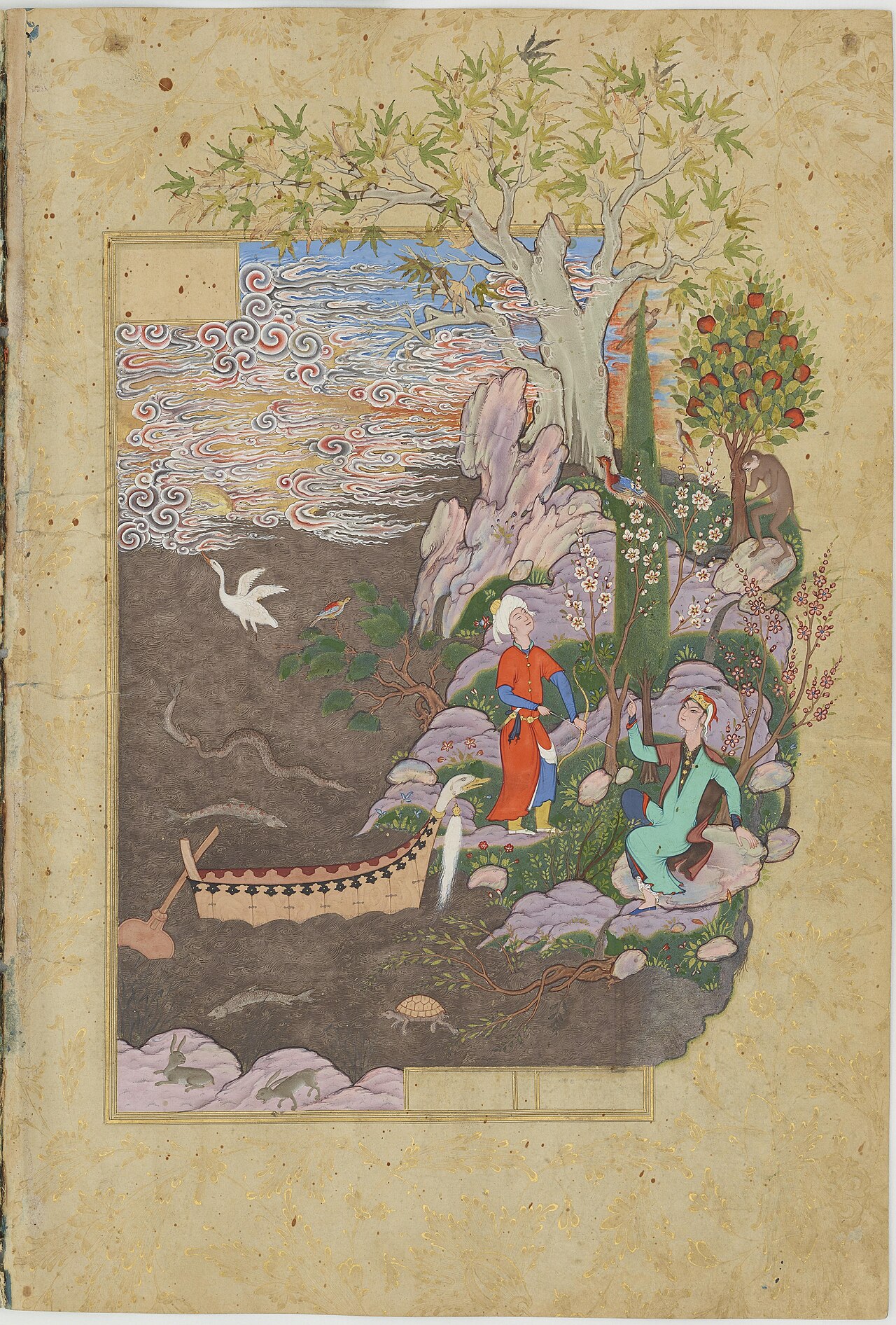
Jami’s seven long poems, written over about fifteen years from the late 1460s to the mid-1480s, were grouped together as the Haft Awrang, the “Seven Thrones”, which is also the Persian name for the seven stars of the Great Bear. Like Nezami’s Khamsa, which it answers, the collection mixes didactic and romantic poems:
- Selselat al-zahab (“Chain of Gold”), a long poem of Sufi teaching and anecdote
- Salaman o Absal, an allegory of a prince and his nurse that stands for the soul and the body
- Tohfat al-ahrar (“Gift of the Free”), moral discourses
- Sobhat al-abrar (“Rosary of the Pious”)
- Yusof o Zoleykha, the story of Joseph and Potiphar’s wife as a mystical romance, his best-loved work
- Leyli o Majnun, the Arabian lovers’ story retold after Nezami
- Kherad-name-ye Eskandari (“Alexander’s Book of Wisdom”)
In Yusof o Zoleykha Jami turns the Qur’anic story into an image of the soul’s love for divine beauty: Zoleykha, who first desires Yusof’s earthly beauty, comes through suffering to love what lies behind it. Painters loved the scene in which she locks Yusof in a palace of seven rooms; Behzad’s version of 1488, painted for a copy of Sa’di, is the most famous (see Kamal al-Din Behzad).
Prose, scholarship and Sufism
Jami wrote the Baharistan (“Spring Garden”) in 1487 for his young son, as a reading book in the manner of Sa’di’s Golestan: short stories and verses on kings, Sufis, poets, love and humour. The Nafahat al-uns (“Breaths of Intimacy”) is a collection of lives of more than six hundred Sufis and remains a basic source for the history of Sufism. The Lawa’ih (“Flashes of Light”) is a short, clear treatise on the unity of being in the tradition of Ibn Arabi, and Jami wrote several commentaries on Ibn Arabi’s works.
His learning reached far beyond poetry. A commentary he wrote on a famous Arabic grammar, Ibn al-Hajib’s al-Kafiya, became a standard schoolbook in Ottoman madrasas, where it was known simply as “Molla Jami”. He also arranged his lyric poems into three divans, which he named for youth, middle age and the end of life.
Why “the last classical poet”
The label is old and partly a judgment of taste. Persian critics saw Jami as the final master in a line that ran through Ferdowsi, Nezami, Rumi, Sa’di and Hafez, after whom poetry turned toward the more intricate “Indian style” of the Safavid and Mughal centuries. Modern scholars tend to see continuity instead, since the later poets learned from him. What is certain is the scale of his influence: Jami was copied, illustrated and taught as widely as almost any Persian author. The great illustrated Haft Awrang made for the Safavid prince Ebrahim Mirza in Mashhad between 1556 and 1565, now in the Freer Gallery in Washington, shows how prized he was within two generations of his death.
Jami died in Herat in November 1492. Husayn Bayqara and the city’s notables attended his funeral, and Navai and others wrote elegies. His grave is in the north of Herat.
Persian words from this page
| جامی | Jâmi | Jami |
| هفت اورنگ | Haft Owrang | Seven Thrones |
| بهارستان | Bahârestân | “Spring Garden” |
| یوسف و زلیخا | Yusof o Zoleykhâ | Joseph and Zulaikha |
| صوفی | sufi | Sufi, mystic |
| گلستان | Golestân | Sa’di’s “Rose Garden” |
| نقشبندی | Naqshbandi | the Naqshbandi Sufi order |
Sources and further reading
- Encyclopaedia Iranica, “Jāmi, ʿAbd-al-Raḥmān”.
- Jami, Yúsuf and Zulaikha, trans. Ralph T. H. Griffith, London, 1882; The Beharistan (Abode of Spring), trans. Edward Rehatsek, 1887.
- Marianna Shreve Simpson, Sultan Ibrahim Mirza’s Haft Awrang: A Princely Manuscript from Sixteenth-Century Iran, Freer Gallery of Art and Yale University Press, 1997.
- Jo-Ann Gross and Asom Urunbaev, The Letters of Khwāja ʿUbayd Allāh Aḥrār and his Associates, Brill, 2002.
- Jan Rypka (ed.), History of Iranian Literature, Reidel, 1968.
Want to learn Persian? Get the free Starter Pack
Get the 14-page printable Starter Pack (all 32 letters, a 7-day reading plan, 100 core words and 20 survival phrases) and a short 5-email course. Free.
More in Post-Mongol Dynasties, Timurids and Turkmens (1335–1501)
- The Chobanids and Jalayirids
- The Injuids and Muzaffarids of Shiraz
- The Sarbadars of Sabzevar
- Khwaju Kermani and Poets of the 14th Century
- Hafez of Shiraz
- Timur (Tamerlane)
- Timur’s Campaigns in Iran
- Timur and the Battle of Ankara (1402)
- Shahrukh and Herat
- Goharshad Begum
- Ulugh Beg and the Samarkand Observatory
- The Timurid Renaissance
- The Qara Qoyunlu (Black Sheep Turkmen)
- The Blue Mosque of Tabriz
- Sultan Husayn Bayqara
- Jami: The Last Great Classical Persian Poet
- Kamal al-Din Behzad and Persian Miniature Painting
- The Aq Qoyunlu (White Sheep Turkmen)
- The Safaviyya Sufi Order of Ardabil