The Injuids and the Muzaffarids were the two local dynasties that ruled Shiraz, Fars and much of central Iran between the collapse of the Ilkhanate in 1335 and Timur’s conquest in 1393. The easy-going Injuid prince Abu Ishaq lost Shiraz in 1353 to the stern Muzaffarid Mubariz al-Din, whose sons quarrelled over it for forty years. This is the world in which Hafez lived and wrote, and many of his poems glance at its rulers.

| Injuids | Governors of Fars from 1304; independent c. 1335–1357 |
|---|---|
| Muzaffarids | Rulers of Yazd and Kerman, then Shiraz, Isfahan and Fars, c. 1314–1393 |
| Capital | Shiraz (Muzaffarid princes also held Yazd, Kerman and Isfahan) |
| Best-known rulers | Abu Ishaq Inju (1343–1357); Mubariz al-Din Muhammad (d. 1363); Shah Shuja’ (1358–1384) |
| End | Muzaffarid princes executed by Timur at Qumisha, May 1393 |
The Injuids: stewards of the royal estates
The family took its name from the Mongol word inju, the crown lands of the Ilkhans. Around 1304 the Ilkhan Öljaitu put Sharaf al-Din Mahmud Shah in charge of these estates in Fars, and he turned the post into something close to a hereditary governorship. Abu Sa’id distrusted his growing power and tried to remove him, without much success. After Abu Sa’id’s death, the short-lived Ilkhan Arpa had Mahmud Shah executed, and his four sons spent the next years fighting each other and the Chobanids for Shiraz (see the Chobanids and Jalayirids).
Jamal al-Din Abu Ishaq, came out on top. He was given Isfahan by a Chobanid ally, then took Shiraz, and by 1343 ruled Fars in his own name. He was a generous patron, fond of poets and of pleasure, and remembered in Shiraz as a charming prince. The traveller Ibn Battuta, who visited Shiraz in these years, praised the city and its ruler. Abu Ishaq’s vizier Haji Qavam al-Din Hasan was another patron of poets, and the young Hafez wrote verses for both men.
The Muzaffarids: from Yazd to Shiraz
The Muzaffarids were a family of Arab descent who had settled in Khorasan and served the Ilkhans as local officers in the Yazd region. Mubariz al-Din Muhammad became governor of Yazd as a young man and, after the Ilkhanate collapsed, built his own state. In 1340 he took Kerman from its Mongol governor. He was a hard soldier, personally brave and, by the accounts of his own chroniclers, harsh and quick to kill.
Conflict with the Injuids came over Yazd and Kerman, which Abu Ishaq wanted. Abu Ishaq besieged Yazd in 1350–1351 and failed. Mubariz al-Din struck back, invaded Fars in 1352 and laid siege to Shiraz in 1353. Inside the city, Abu Ishaq grew suspicious of his own subjects and ordered whole quarters punished; the head of another quarter, fearing for his people, handed the key of his gate to Mubariz al-Din’s son Shah Shuja’. Abu Ishaq escaped to Isfahan, but Mubariz al-Din took that city too in 1357. Abu Ishaq was sent back to Shiraz and executed.
Hafez wrote the most famous epitaph for the Injuid years:
راستی خاتم فیروزه بواسحاقی / خوش درخشید ولی دولت مستعجل بود
Truly, the turquoise seal-ring of Abu Ishaq shone beautifully, but its fortune was fleeting.
A puritan in Shiraz
Mubariz al-Din ruled Shiraz very differently. He presented himself as a strict Sunni ruler, enforced religious law, and closed the wine-houses that had flourished under Abu Ishaq. He also gave allegiance to the Abbasid caliph then living under Mamluk protection in Cairo, a way of claiming legitimacy that did not depend on the Mongols. Shiraz tradition holds that Hafez’s many jibes at the mohtaseb, the market inspector who punished drinkers, and at hypocritical preachers were aimed at him. That reading cannot be proved, but it fits the dates.
His rule ended in a family coup. In 1358 his sons Shah Shuja’ and Shah Mahmud seized him and had him blinded. He died in prison in 1363.
Shah Shuja’ and the brothers’ wars
Shah Shuja’ ruled Shiraz from 1358 to 1384, the longest and most settled reign of the dynasty. He wrote poetry himself, and Hafez found in him a patron again, though stories of quarrels between them were already told in the fifteenth century. Peace inside the family did not last. His brother Shah Mahmud, who held Isfahan, married a daughter of the Jalayirid ruler Shaykh Uways and with Jalayirid help took Shiraz in 1364. Shah Shuja’ only won his capital back in 1366. Shah Mahmud later tried to seize Tabriz after Uways died in 1374, fell ill and died the following year.
These wars wore the dynasty down just as a far greater power appeared in the east. Shah Shuja’ died in 1384 and left Shiraz to his son Zayn al-Abidin, with other relatives ruling Kerman, Yazd and Isfahan.
The end under Timur
When Timur reached Fars in 1387, after the massacre at Isfahan, Zayn al-Abidin fled and the other Muzaffarid princes submitted. Timur left them as vassals and returned to Central Asia. One of them, Shah Mansur, then seized Shiraz, imprisoned and blinded his cousin Zayn al-Abidin, and tried to rule on his own. When Timur came back in 1393, Shah Mansur met him in battle outside Shiraz, fought hard and lost; he was caught and beheaded while trying to reach the city. The surviving princes came to swear allegiance and were received with honour, then executed together at Qumisha (modern Shahreza) on 22 May 1393. Only Zayn al-Abidin and one brother were spared and sent to Samarkand. The story of these campaigns is told in Timur’s campaigns in Iran.
What the period left
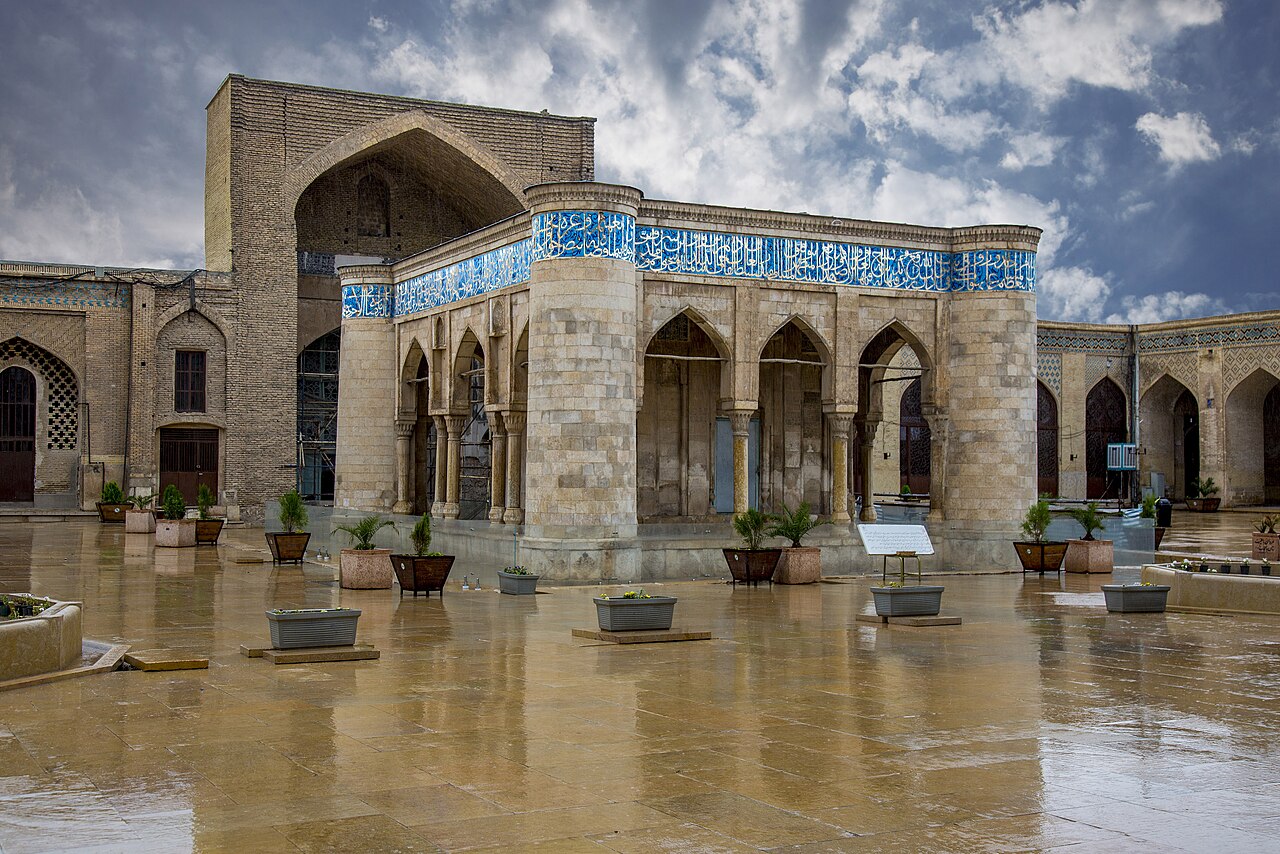
For all its violence, the Muzaffarid century was culturally rich. Shiraz was a city of poets: besides Hafez, Khwaju Kermani and ‘Obeyd Zakani wrote there, and ‘Obeyd’s satires mock the very hypocrisy Hafez complained of. The Muzaffarids built in Yazd and Kerman: the Jameh Mosque of Kerman was founded by Mubariz al-Din in 1349. Shiraz’s Atiq mosque kept its Khoda-khaneh, pictured above. For the poet’s own story see Hafez of Shiraz, and for the city today our Shiraz city guide.
Persian words from this page
| شیراز | Shirâz | Shiraz |
| آل مظفر | Âl-e Mozaffar | the Muzaffarids |
| شاه شجاع | Shâh Shojâ’ | Shah Shuja’ |
| محتسب | mohtaseb | market inspector, morals officer |
| فیروزه | firuze | turquoise |
| یزد | Yazd | Yazd |
| کرمان | Kermân | Kerman |
Sources and further reading
- “Injuids” and “Mozaffarids”, Encyclopaedia Iranica.
- H. R. Roemer, “The Jalayirids, Muzaffarids and Sarbadars”, in The Cambridge History of Iran, vol. 6 (1986).
- John Limbert, Shiraz in the Age of Hafez: The Glory of a Medieval Persian City (University of Washington Press, 2004).
- Ibn Battuta, Travels, the chapter on Shiraz.
- Hafez, Divan, ed. Mohammad Qazvini and Qasem Ghani (Tehran, 1941).
Want to learn Persian? Get the free Starter Pack
Get the 14-page printable Starter Pack (all 32 letters, a 7-day reading plan, 100 core words and 20 survival phrases) and a short 5-email course. Free.
More in Post-Mongol Dynasties, Timurids and Turkmens (1335–1501)
- The Chobanids and Jalayirids
- The Injuids and Muzaffarids of Shiraz
- The Sarbadars of Sabzevar
- Khwaju Kermani and Poets of the 14th Century
- Hafez of Shiraz
- Timur (Tamerlane)
- Timur’s Campaigns in Iran
- Timur and the Battle of Ankara (1402)
- Shahrukh and Herat
- Goharshad Begum
- Ulugh Beg and the Samarkand Observatory
- The Timurid Renaissance
- The Qara Qoyunlu (Black Sheep Turkmen)
- The Blue Mosque of Tabriz
- Sultan Husayn Bayqara
- Jami: The Last Great Classical Persian Poet
- Kamal al-Din Behzad and Persian Miniature Painting
- The Aq Qoyunlu (White Sheep Turkmen)
- The Safaviyya Sufi Order of Ardabil