Timur, known in Europe as Tamerlane, was a Turkic-speaking emir of the Barlas tribe from Transoxiana (in modern Uzbekistan) who seized power in Samarkand in 1370 and spent the next 35 years at war. His armies took all of Iran, Iraq and the Caucasus, crushed the Golden Horde, sacked Delhi and defeated the Ottoman sultan before he died on the way to invade China in 1405. He was one of the most destructive conquerors in history, and also the founder of the Timurid dynasty whose courts in Herat and Samarkand shaped Persian art for a century.
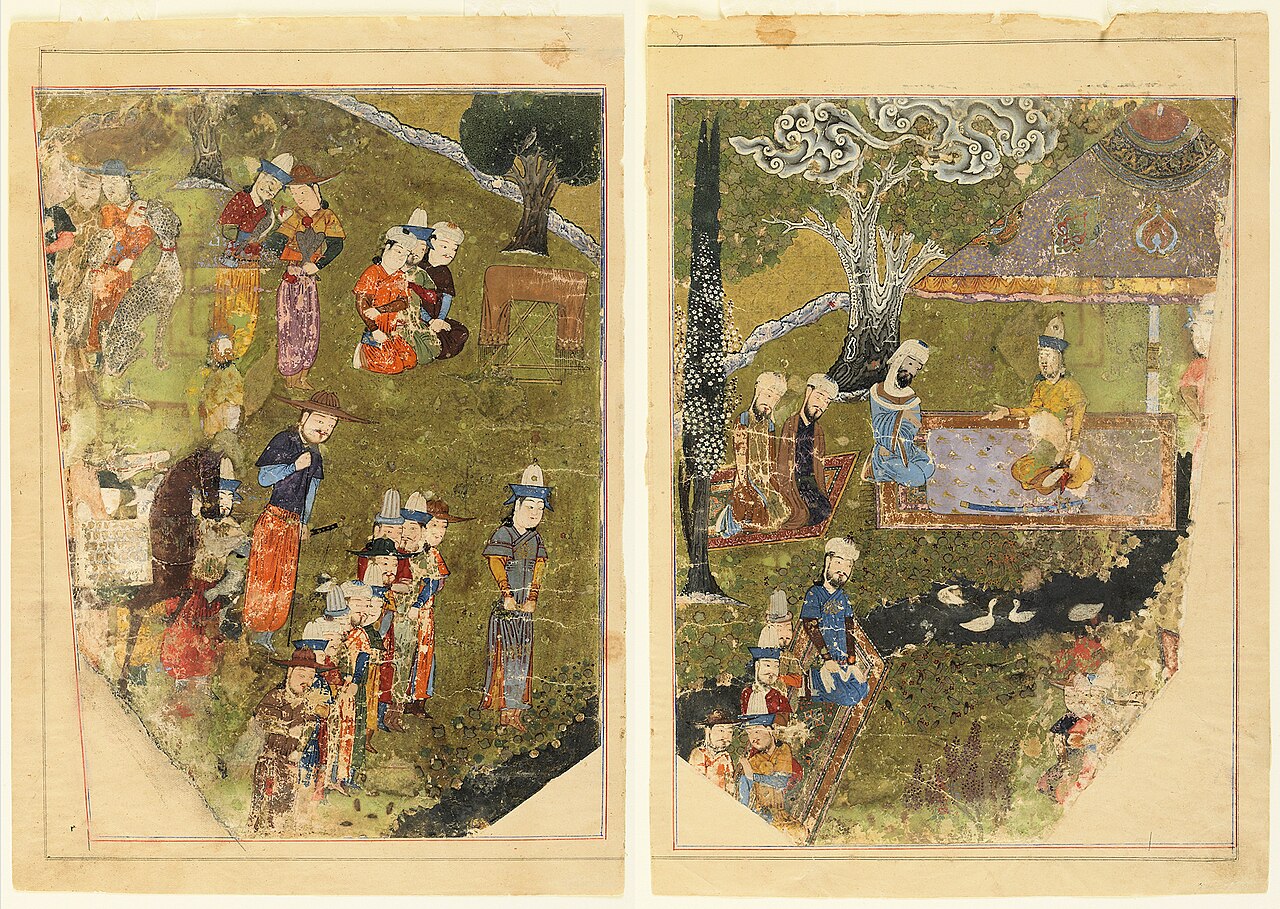

| Name | Temür (“iron” in Turkic); Persian تیمور لنگ Timur-e Lang, “Timur the Lame”, hence Tamerlane |
|---|---|
| Born | Near Kesh (Shahrisabz), Transoxiana; 8 April 1336 in Timurid histories, more likely the late 1320s |
| Ruled | 1370–1405, from Samarkand, with the title amir |
| Died | 17/18 February 1405 at Otrar, on the Syr Darya |
| Buried | Gur-e Amir, Samarkand |
| Successor | After a succession war, his son Shahrukh (1409–1447) |
A minor noble on the Chaghatai frontier
Timur was born into the Barlas, a Mongol tribe that had settled in the valley of Kesh south of Samarkand and become Turkic in speech and Muslim in faith. His family were of modest rank. The Chaghatai Khanate, the Mongol state of Central Asia, had split into a settled western half, where tribal emirs held real power, and a nomadic east (Moghulistan), whose khans repeatedly raided the west.
In the 1360s Timur rose as a raider and soldier of fortune, sometimes serving the khans of Moghulistan, sometimes fighting them. He was wounded in the right leg and right arm, probably in a fight in Sistan, and limped for the rest of his life. When Soviet scientists opened his tomb in 1941, they confirmed the injuries on his skeleton.
His main partner and rival was his brother-in-law, Amir Husayn, grandson of a former ruler of Transoxiana. In 1370 Timur besieged Husayn at Balkh; Husayn was killed, and Timur held an assembly of the emirs that recognised him as ruler.
Ruling without being khan
Timur was not a descendant of Genghis Khan, and in the Mongol world only Chinggisids could be khan. He solved the problem in two ways. He kept a Chinggisid puppet khan on the throne for the rest of his life, and he married Saray Mulk Khanum, a princess of the Chinggisid line, which let him take the title güregen, “royal son-in-law”. He called himself simply amir. At the same time he presented himself as a good Muslim ruler, patron of scholars and shrines, which let him justify wars against other Muslim kings as punishment of the unjust.
Thirty-five years of campaigns
Timur’s army was a tribal cavalry force held together by plunder. It needed constant war to keep it loyal, and Timur rarely stayed in Samarkand for long. The main campaigns were:
- 1370s Wars with Moghulistan and Khwarazm; Transoxiana secured
- 1381–1384 Herat and Khorasan taken; the Sarbadars submit; Sistan and Mazandaran attacked
- 1386–1388 The “three-year campaign”: Tabriz, Georgia, Isfahan (massacre, 1387) and Shiraz
- 1391, 1395 Victories over Tokhtamysh of the Golden Horde, at the Kunduzcha and the Terek; Sarai sacked
- 1392–1396 The “five-year campaign”: Mazandaran, Fars (end of the Muzaffarids, 1393), Baghdad
- 1398 Invasion of northern India; Delhi sacked in December
- 1399–1404 The “seven-year campaign”: Georgia, Syria (Aleppo and Damascus, 1400–1401), Baghdad (1401)
- 1402 Ottoman sultan Bayezid I defeated and captured at Ankara
- 1405 Dies at Otrar at the start of a winter campaign against Ming China
The Iranian campaigns are told in detail in Timur’s campaigns in Iran, and the Ottoman war in Timur and the Battle of Ankara.
Terror as policy
Timur’s cruelty was not random. Cities that opened their gates usually paid a heavy ransom and were spared; cities that resisted or rebelled were sacked, and their people killed in great numbers. Towers and pyramids of skulls, built at Isfahan, Delhi, Baghdad and elsewhere, were meant to be seen and talked about so that the next city would surrender. Craftsmen, scholars and artists were often spared and sent to Samarkand.
How many people died is unknown. Contemporary figures are very large and impossible to check; modern scholars agree that his wars killed millions in total, and that some regions, such as parts of Sistan, Iraq and northern India, took generations to recover from the damage to cities and irrigation.
Samarkand and the Persian court
The plunder of Asia paid for an imperial capital. Timur rebuilt Samarkand with great mosques, palaces and gardens, among them the Bibi Khanum mosque, and the Aq Saray palace in his home town of Kesh. Much of the work was done by craftsmen deported from Iran, Iraq, Syria and India. His court culture was Turkic and Mongol in its military customs but Persian in its writing, its bureaucracy and much of its art. His chroniclers wrote in Persian, and his grandsons became some of the greatest patrons of Persian literature and painting (see the Timurid renaissance).
Two famous meetings show how he appeared to outsiders. In 1401, outside Damascus, the North African historian Ibn Khaldun spent weeks in his camp and found him intelligent and curious about history. In 1404 the Castilian envoy Ruy González de Clavijo described feasts in the gardens of Samarkand and an old ruler whose eyesight was failing.
Death and succession
Timur died at Otrar in February 1405, aged about seventy or more, as his army marched east in winter towards China. He had named a grandson, Pir Muhammad, as heir, but his sons and grandsons fought each other for four years. The winner was his youngest son, Shahrukh, who ruled from Herat and gave Samarkand to his own son Ulugh Beg. Timur was buried in the Gur-e Amir in Samarkand, a domed tomb first built for his favourite grandson Muhammad Sultan. Its dark jade cenotaph is one of the best-known monuments of Central Asia.
Different pictures of Timur
The two Persian histories written for the dynasty, the Zafarnama (“Book of Victory”) of Nizam al-Din Shami (c. 1404) and the longer one by Sharaf al-Din Ali Yazdi (1420s), present him as a world-conqueror favoured by God. The Arab writer Ibn Arabshah, who had been carried off to Samarkand as a boy after the fall of Damascus, wrote a bitterly hostile biography. In Iran he is remembered mainly for the massacres; in modern Uzbekistan he has been made a national hero, with statues in Tashkent, Samarkand and Shahrisabz. Modern historians such as Beatrice Forbes Manz look past both images to the politics of the tribes and emirs who made his career possible.
Persian words from this page
| تیمور | Teymur | Timur |
| لنگ | lang | lame |
| سمرقند | Samarqand | Samarkand |
| ظفرنامه | Zafar-nâme | Book of Victory |
| گور امیر | Gur-e Amir | Tomb of the Amir |
| امیر | amir | emir, commander |
Sources and further reading
- Sharaf al-Din Ali Yazdi, Zafarnama (1424–25), and Nizam al-Din Shami, Zafarnama (c. 1404).
- Ahmad ibn Arabshah, Tamerlane, or Timur the Great Amir, trans. J. H. Sanders (1936).
- Ruy González de Clavijo, Embassy to Tamerlane, 1403–1406, trans. Guy Le Strange (1928).
- Beatrice Forbes Manz, The Rise and Rule of Tamerlane (Cambridge University Press, 1989).
- “Timur” and “Timurid dynasty”, Encyclopaedia Iranica; and The Cambridge History of Iran, vol. 6 (1986).
- UNESCO World Heritage: Samarkand – Crossroad of Cultures.
Want to learn Persian? Get the free Starter Pack
Get the 14-page printable Starter Pack (all 32 letters, a 7-day reading plan, 100 core words and 20 survival phrases) and a short 5-email course. Free.
More in Post-Mongol Dynasties, Timurids and Turkmens (1335–1501)
- The Chobanids and Jalayirids
- The Injuids and Muzaffarids of Shiraz
- The Sarbadars of Sabzevar
- Khwaju Kermani and Poets of the 14th Century
- Hafez of Shiraz
- Timur (Tamerlane)
- Timur’s Campaigns in Iran
- Timur and the Battle of Ankara (1402)
- Shahrukh and Herat
- Goharshad Begum
- Ulugh Beg and the Samarkand Observatory
- The Timurid Renaissance
- The Qara Qoyunlu (Black Sheep Turkmen)
- The Blue Mosque of Tabriz
- Sultan Husayn Bayqara
- Jami: The Last Great Classical Persian Poet
- Kamal al-Din Behzad and Persian Miniature Painting
- The Aq Qoyunlu (White Sheep Turkmen)
- The Safaviyya Sufi Order of Ardabil