Goharshad (died 1457) was the chief wife of the Timurid ruler Shahrukh, the mother of Ulugh Beg and Baysunghur, and the greatest woman patron of architecture in Iranian history. She founded the Goharshad Mosque at the shrine of Imam Reza in Mashhad, completed in 1418, and the mosque, madrasa and mausoleum of the musalla complex in Herat. In old age she was a political force in her own right, until a Timurid rival had her executed in 1457.

| Persian name | گوهرشاد (Gowharshâd), “joyful jewel” |
|---|---|
| Family | Daughter of the Timurid noble Ghiyath al-Din Tarkhan |
| Married | Shahrukh, probably c. 1388, certainly before 1394 |
| Children | Ulugh Beg (b. 1394), Baysunghur and others |
| Main buildings | Goharshad Mosque, Mashhad (1418); musalla complex, Herat (from 1417) |
| Died | Executed in Herat, 19 July 1457, aged over 80 |
A noble bride
Goharshad came from one of the most distinguished families of Timur’s state. Her father, Ghiyath al-Din, held the hereditary title tarkhan, which, according to family tradition, an ancestor had received from Genghis Khan himself. She married Timur’s youngest son Shahrukh in the late 1380s or early 1390s. When Shahrukh became governor of Khorasan in 1397 and then, from 1409, ruler of the whole empire from Herat, her brothers held senior posts at his court, and she became the most powerful woman of the dynasty. Her husband’s reign is described on our page on Shahrukh and Herat.
The mosque at Mashhad
Mashhad had grown up around the tomb of the eighth Shi’a imam, Ali al-Reza, who died at Tus in 818 (see Imam Reza and the origins of Mashhad). Shahrukh and Goharshad were Sunni, but the shrine was honoured by Sunnis and Shi’is alike, and the Timurids gave it lavish gifts. Goharshad’s contribution was a new congregational mosque on the south side of the shrine.
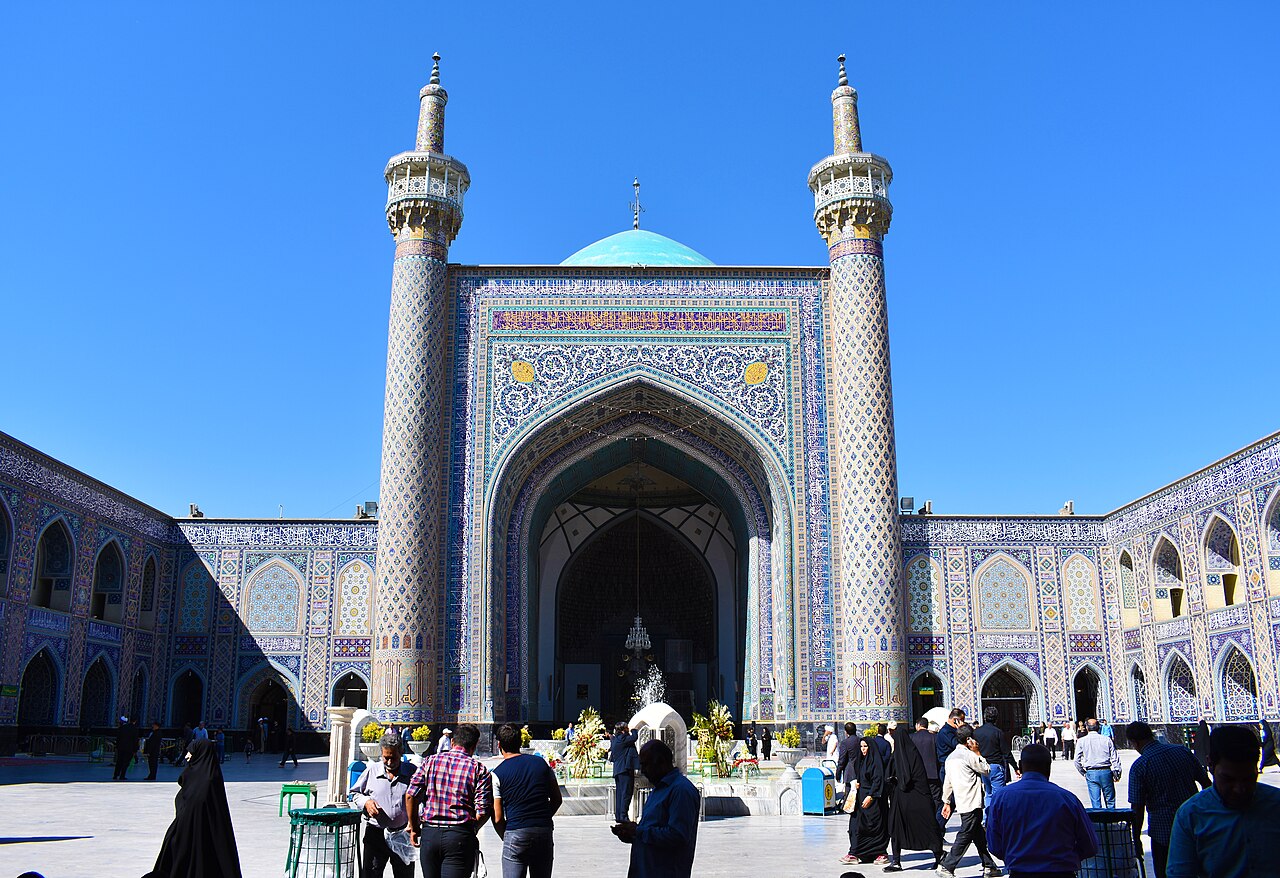
The architect was Qavam al-Din Shirazi, the leading builder of the age, and the mosque was completed in 1418. It follows the classic Iranian four-iwan plan: a large open courtyard with a great vaulted hall (iwan) in the middle of each side. The largest, the maqsura iwan on the qibla side, leads to the domed prayer hall and is framed by two minarets. Every surface is covered with glazed tile, mosaic faience and brick patterns. Around the courtyard runs a band of monumental inscription designed by her son Baysunghur, one of the finest calligraphers of his time.
The mosque became part of the shrine complex and remains in use. It was damaged when Russian troops shelled the shrine in 1912 and has been repaired several times, the dome most recently in the twentieth century. In July 1935 it was the scene of a protest against Reza Shah’s dress laws that was put down by force (see the unveiling decree and the Goharshad protest). For the city today, see our Mashhad city guide and the blog post on visiting Mashhad.
The musalla in Herat
In Herat Goharshad built on a still larger scale. From 1417 Qavam al-Din began for her a complex outside the city walls with a congregational mosque and a madrasa. The mosque was partly finished by 1437–38. A domed mausoleum in the madrasa was built for Baysunghur, who died in 1433, and became a family tomb; Goharshad herself was buried there. Later in the century Sultan Husayn Bayqara added his own madrasa to the site, and the whole area became known as the musalla.
Very little of it stands today. In 1885, during the crisis between Britain and Russia over the Afghan frontier, the Afghan ruler, advised by British officers, had most of the buildings blown up to clear a field of fire in case of a Russian attack on Herat. Of the minarets left standing, more fell over the following decades through earthquake and neglect, and only five survive, leaning and patched. The mausoleum with its ribbed dome also survives. Even in ruin, visitors still describe the scale and colour of the tilework.
A power in the dynasty
Chroniclers show Goharshad as a strong-willed figure at court with favourites among her grandsons. Her favourite was Ala al-Dawla, son of Baysunghur, whom she supported for the succession. When Shahrukh died in his camp near Rey in March 1447, she travelled with his body and the army, and in the struggle that followed she worked for Ala al-Dawla against her own son Ulugh Beg and his son Abd al-Latif. Her party lost: Ulugh Beg took the throne, and was himself killed in 1449.
In the wars of the 1450s Herat changed hands several times. In 1457 the Timurid prince Abu Sa’id, who had taken the city, had Goharshad put to death, accused of conspiring with his rivals. She was well over eighty.
Her place in history
Goharshad’s buildings set the style of the Timurid architecture of Khorasan: double domes, tall portal iwans, mosaic tile in deep blue, turquoise, white and yellow, and inscription bands of great size. Her patronage of Qavam al-Din helped shape what is often called the Timurid renaissance (see the Timurid renaissance). In Iran her name survives above all in the Goharshad Mosque, one of the most visited buildings in the country, and she is still remembered as a model of a queen who built for the public good.
Persian words from this page
| گوهرشاد | Gowharshâd | Goharshad |
| گوهر | gowhar | jewel |
| مسجد | masjed | mosque |
| ایوان | eyvân | iwan, vaulted hall |
| مدرسه | madrese | madrasa, school |
| مشهد | Mashhad | Mashhad |
| مصلی | mosallâ | musalla, place of prayer |
Sources and further reading
- “Gowharšād Āġā”, and the articles on Mashhad and its shrine, Encyclopaedia Iranica.
- Lisa Golombek and Donald Wilber, The Timurid Architecture of Iran and Turan (Princeton University Press, 1988).
- Robert Byron, The Road to Oxiana (1937), for descriptions of the Herat musalla before further losses.
- Beatrice Forbes Manz, Power, Politics and Religion in Timurid Iran (Cambridge University Press, 2007).
Want to learn Persian? Get the free Starter Pack
Get the 14-page printable Starter Pack (all 32 letters, a 7-day reading plan, 100 core words and 20 survival phrases) and a short 5-email course. Free.
More in Post-Mongol Dynasties, Timurids and Turkmens (1335–1501)
- The Chobanids and Jalayirids
- The Injuids and Muzaffarids of Shiraz
- The Sarbadars of Sabzevar
- Khwaju Kermani and Poets of the 14th Century
- Hafez of Shiraz
- Timur (Tamerlane)
- Timur’s Campaigns in Iran
- Timur and the Battle of Ankara (1402)
- Shahrukh and Herat
- Goharshad Begum
- Ulugh Beg and the Samarkand Observatory
- The Timurid Renaissance
- The Qara Qoyunlu (Black Sheep Turkmen)
- The Blue Mosque of Tabriz
- Sultan Husayn Bayqara
- Jami: The Last Great Classical Persian Poet
- Kamal al-Din Behzad and Persian Miniature Painting
- The Aq Qoyunlu (White Sheep Turkmen)
- The Safaviyya Sufi Order of Ardabil