The “Timurid renaissance” is the name historians give to the flowering of Persian art, literature and science at the courts of Timur’s descendants between about 1405 and 1507, above all in Herat. In this century the Persian illustrated book reached its classical form, nasta’liq became the great Persian script, Jami wrote the last major works of classical Persian poetry, Ali-Shir Navai made Turkic a literary language, and architects in Khorasan and Transoxiana perfected the tiled dome and portal.

From conquest to patronage
Timur had gathered craftsmen and scholars from every city he took and set them to work in Samarkand (see Timur (Tamerlane)). His successors had fewer conquests to boast of and competed instead in culture. Every Timurid prince with a city of his own kept a kitabkhana, a library that was also a workshop, with calligraphers, painters, illuminators, gilders and bookbinders. A Timurid ruler was expected to be a man of taste, and many princes were poets, calligraphers or scholars themselves.
The model was Persian. The dynasty was Turkic in origin and kept Turkic and Mongol customs in its army and court ceremony, but its secretaries wrote in Persian, its historians wrote in Persian, and its princes read the Shahnameh, Nizami and Saadi.
The courts
Shiraz
Timur’s grandsons in Fars were among the first great patrons. Iskandar Sultan, governor of Shiraz and Isfahan until his rebellion and death in 1415, commissioned anthologies with paintings of exceptional refinement. His successor Ibrahim Sultan, son of Shahrukh, ruled Shiraz until 1435, was a fine calligrapher, and had Sharaf al-Din Ali Yazdi write the classic history of Timur, the Zafarnama.
Herat under Shahrukh and Baysunghur
Herat became the cultural capital when Shahrukh made it the seat of the empire in 1409. His wife Goharshad built on a monumental scale there and at Mashhad. Their son Baysunghur (died 1433) ran the most famous of all the library-workshops. After a campaign to Tabriz in 1420–21 he brought artists who had worked for the Jalayirid Sultan Ahmad back to Herat, joining the Jalayirid tradition to that of Shiraz. A report from the head of his workshop to the prince, preserved in an album in Istanbul, lists the projects of more than twenty artists at a time.
The masterpiece of this workshop is the Shahnameh completed for Baysunghur in 1430, now in the Golestan Palace in Tehran (see our guide to the Golestan Palace) and listed by UNESCO in its Memory of the World register. Baysunghur also sponsored a new edition of the text of Ferdowsi’s poem with a preface that later copies often reproduced (on the poem itself, see the Shahnameh).
Samarkand under Ulugh Beg
In Samarkand the emphasis was on science. Ulugh Beg built a madrasa and an observatory and, with mathematicians such as Jamshid al-Kashi of Kashan, produced astronomical tables used for centuries.
Herat under Sultan Husayn Bayqara
After decades of wars between Timurid princes, Sultan Husayn Bayqara ruled Herat from 1469 to 1506, the last long and settled Timurid reign (see Sultan Husayn Bayqara). His court was the high point of the whole period. His boyhood friend Ali-Shir Navai (1441–1501), a minister and the greatest patron in the city after the sultan, wrote poetry mainly in Chagatai Turkic and argued in a treatise of 1499 that Turkic was as fit for literature as Persian. The poet and Sufi Abd al-Rahman Jami (1414–1492) wrote the Haft Awrang (“Seven Thrones”) and the Baharistan. The painter Kamal al-Din Behzad brought a new naturalism to the miniature: individual faces, crowded working scenes, and carefully built space. The historians Mirkhwand and his grandson Khwandamir wrote universal histories that later Iranian chroniclers used as models.
The arts that changed
The book
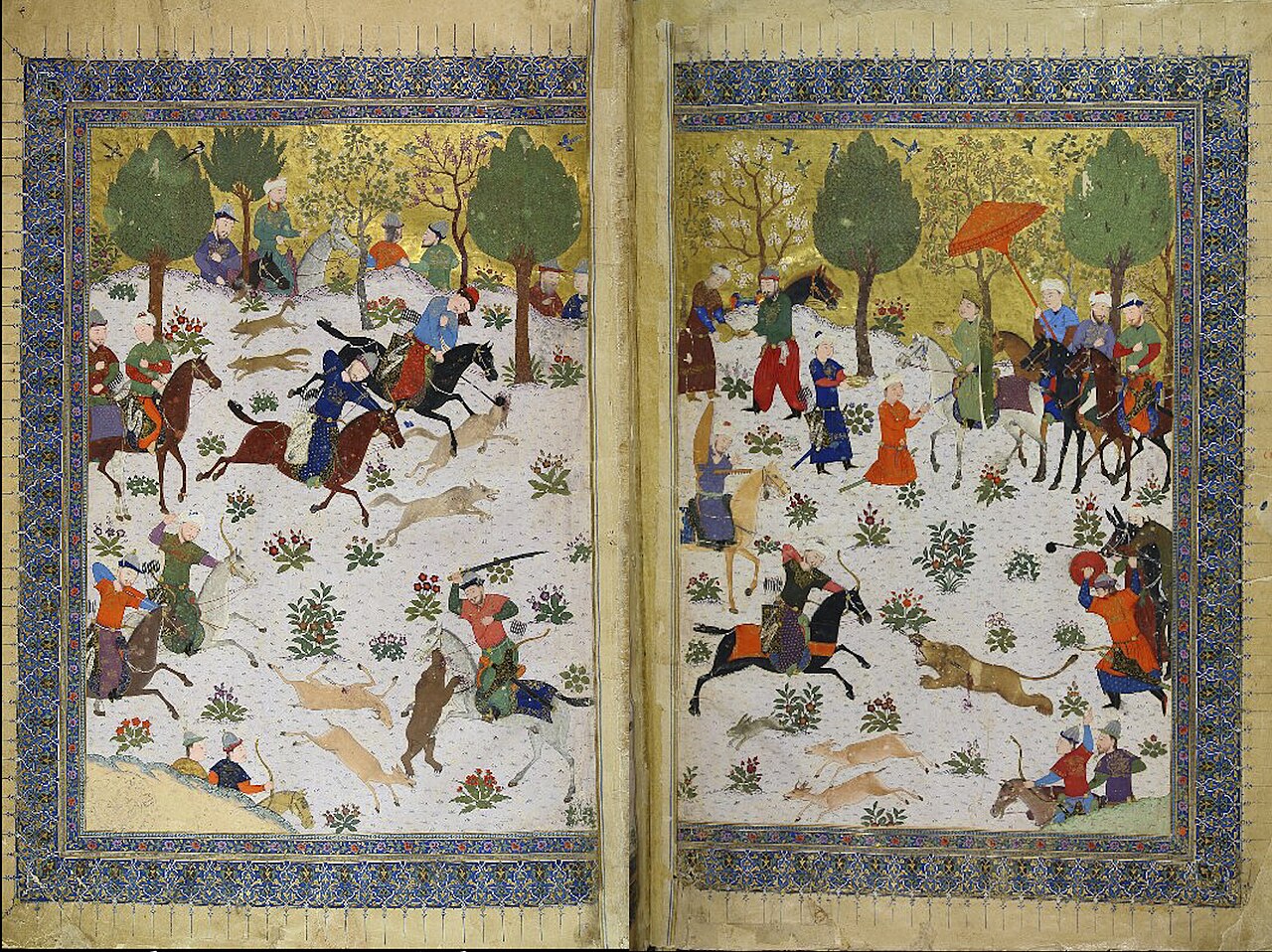
The Timurid illustrated manuscript set the standard for the next two centuries in Iran, India and the Ottoman empire: text and painting balanced on the page, rich mineral colours and gold, figures in landscapes of flowering trees and rock, and bindings of stamped and gilded leather or lacquer.
Calligraphy
The flowing nasta’liq script, traditionally said to have been created by Mir Ali Tabrizi in the late fourteenth century, was refined in Timurid Herat and became the standard script for Persian poetry. Its greatest Timurid master, Sultan Ali Mashhadi, worked for Husayn Bayqara. Most Persian books printed or written by hand today still use descendants of these forms.
Architecture
Timurid builders, many trained in Shiraz and Isfahan, developed the high double dome on a tall drum, the giant entrance iwan and the use of tile mosaic over whole façades. The leading architect was Qavam al-Din Shirazi, who built Goharshad’s mosque in Mashhad and began the madrasa at Khargerd in Khorasan for Shahrukh’s vizier. In Samarkand the Gur-e Amir and the Registan madrasa of Ulugh Beg are the best-known examples.
The end in Herat, and what followed
Husayn Bayqara died in 1506. The young Babur, a Timurid prince who would found the Mughal empire in India, visited Herat that year and left a vivid portrait of its poets, musicians and pleasures in his memoirs, and of the late sultan’s sons, whom he judged unfit to rule. In 1507 the Uzbek leader Muhammad Shaybani Khan took the city. Three years later Shah Ismail I defeated Shaybani, and Herat passed to the Safavids (see Shah Ismail I).
Timurid culture did not end with the dynasty. Behzad moved to Tabriz and in 1522 was made head of the Safavid royal library. Timurid artists and books passed to the Mughal court through Babur’s heirs, and to the Ottomans through gifts and war booty. Meanwhile the Turkmen courts of Tabriz, the Qara Qoyunlu and Aq Qoyunlu, had built their own parallel style (see the Aq Qoyunlu), and the Safavid art of the sixteenth century grew from the meeting of the two.
Is “renaissance” the right word
The term borrows from European history and was made popular by exhibitions and studies of the 1980s, such as Thomas Lentz and Glenn Lowry’s Timur and the Princely Vision (1989). Critics point out that nothing classical was being reborn: Timurid culture continued an unbroken Persian tradition that had flourished under the Ilkhans, the Jalayirids and the Muzaffarids. Others defend it as shorthand for a real burst of court patronage. Most scholars use it with that caution in mind.
Persian words from this page
| کتابخانه | ketâb-khâne | library, royal book workshop |
| نستعلیق | nasta’liq | nasta’liq script |
| نگارگری | negârgari | Persian miniature painting |
| خوشنویسی | khoshnevisi | calligraphy |
| شاهنامه | Shâhnâme | the Shahnameh |
| هفت اورنگ | Haft Owrang | Seven Thrones, Jami’s cycle of poems |
Sources and further reading
- Thomas W. Lentz and Glenn D. Lowry, Timur and the Princely Vision: Persian Art and Culture in the Fifteenth Century (Los Angeles County Museum of Art and Smithsonian, 1989).
- Lisa Golombek and Donald Wilber, The Timurid Architecture of Iran and Turan (Princeton University Press, 1988).
- Maria Eva Subtelny, Timurids in Transition: Turko-Persian Politics and Acculturation in Medieval Iran (Brill, 2007).
- The Baburnama: Memoirs of Babur, Prince and Emperor, trans. Wheeler M. Thackston (1996).
- “Timurid dynasty”, Encyclopaedia Iranica, and The Cambridge History of Iran, vol. 6 (1986).
Want to learn Persian? Get the free Starter Pack
Get the 14-page printable Starter Pack (all 32 letters, a 7-day reading plan, 100 core words and 20 survival phrases) and a short 5-email course. Free.
More in Post-Mongol Dynasties, Timurids and Turkmens (1335–1501)
- The Chobanids and Jalayirids
- The Injuids and Muzaffarids of Shiraz
- The Sarbadars of Sabzevar
- Khwaju Kermani and Poets of the 14th Century
- Hafez of Shiraz
- Timur (Tamerlane)
- Timur’s Campaigns in Iran
- Timur and the Battle of Ankara (1402)
- Shahrukh and Herat
- Goharshad Begum
- Ulugh Beg and the Samarkand Observatory
- The Timurid Renaissance
- The Qara Qoyunlu (Black Sheep Turkmen)
- The Blue Mosque of Tabriz
- Sultan Husayn Bayqara
- Jami: The Last Great Classical Persian Poet
- Kamal al-Din Behzad and Persian Miniature Painting
- The Aq Qoyunlu (White Sheep Turkmen)
- The Safaviyya Sufi Order of Ardabil