Kamal al-Din Behzad (c. 1455/60–c. 1535) was the most celebrated painter of Persian miniatures, head of the royal library-workshop of Sultan Husayn Bayqara in Herat and later of Shah Ismail’s in Tabriz. He gave the Persian book painting crowded, lively scenes of ordinary work, individual faces and carefully built space, and for later generations his name became a byword for mastery itself.
| Persian name | کمالالدین بهزاد, Kamâl-od-Din Behzâd |
|---|---|
| Born | Herat, c. 1455–1460 |
| Died | c. 1535 (some sources give 1536) |
| Teacher | Mirak Naqqash, head of the Timurid royal library |
| Patrons | Ali-Shir Navai and Sultan Husayn Bayqara in Herat; Shah Ismail I and Shah Tahmasp I in Tabriz |
| Key works | Bustan of Sa’di, Herat 1488 (Dar al-Kutub, Cairo); paintings in a Khamsa of Nezami, 1494–1495 (British Library) |
| Office | Head of the Safavid royal library from 1522 |
An orphan in the royal library
Almost everything known about Behzad’s early life comes from later writers. According to the Safavid author Qazi Ahmad, he lost his parents young and was brought up by Mirak Naqqash, a painter and illuminator who directed the royal library in Herat. That library, the ketabkhane, was both a collection and a workshop where calligraphers, painters, gilders and binders worked together on a single book for months or years. It was the place where Persian painting had been shaped since Prince Baysunghur’s day.
Behzad’s career rose with the court of Sultan Husayn Bayqara (r. 1469–1506). His first patron was the sultan’s friend Ali-Shir Navai, and by 1486 he had succeeded Mirak as head of the library. Most of the paintings that can be firmly attributed to him date from about 1488 to 1495.

What was new in his painting
Earlier Persian painting, from the Jalayirid courts of Baghdad and Tabriz to Baysunghur’s Herat, had already developed graceful figures set in jewel-like landscapes and palaces. Behzad kept that frame and changed what happened inside it.
People at work
His most famous scenes are full of labour. In “The Building of the Castle of Khawarnaq”, from the 1494–1495 Khamsa of Nezami in the British Library, masons climb ladders, carry bricks on their backs and mix mortar while an overseer watches. Other scenes show men washing in a bathhouse, a beggar at a mosque door, or camels and drivers at rest. The story is often small and off to the side; the life around it is what holds the eye.
Faces and gestures
His figures are individual. They turn, argue, point, bend and stare, and their faces show age, surprise or concentration. Writers since the sixteenth century have praised this. Babur, who saw his work in Herat, called him a very fine painter but remarked that he drew beardless faces less well than bearded ones.
Space and colour
Behzad organised his pictures with geometric architecture and large areas of plain colour, and used stronger contrasts of light and dark than his predecessors. He used colour symbolically too, and many scholars read Sufi meanings in his compositions, a reading that fits the Naqshbandi piety of Herat in Jami’s time.
Yusuf and Zulaikha, 1488
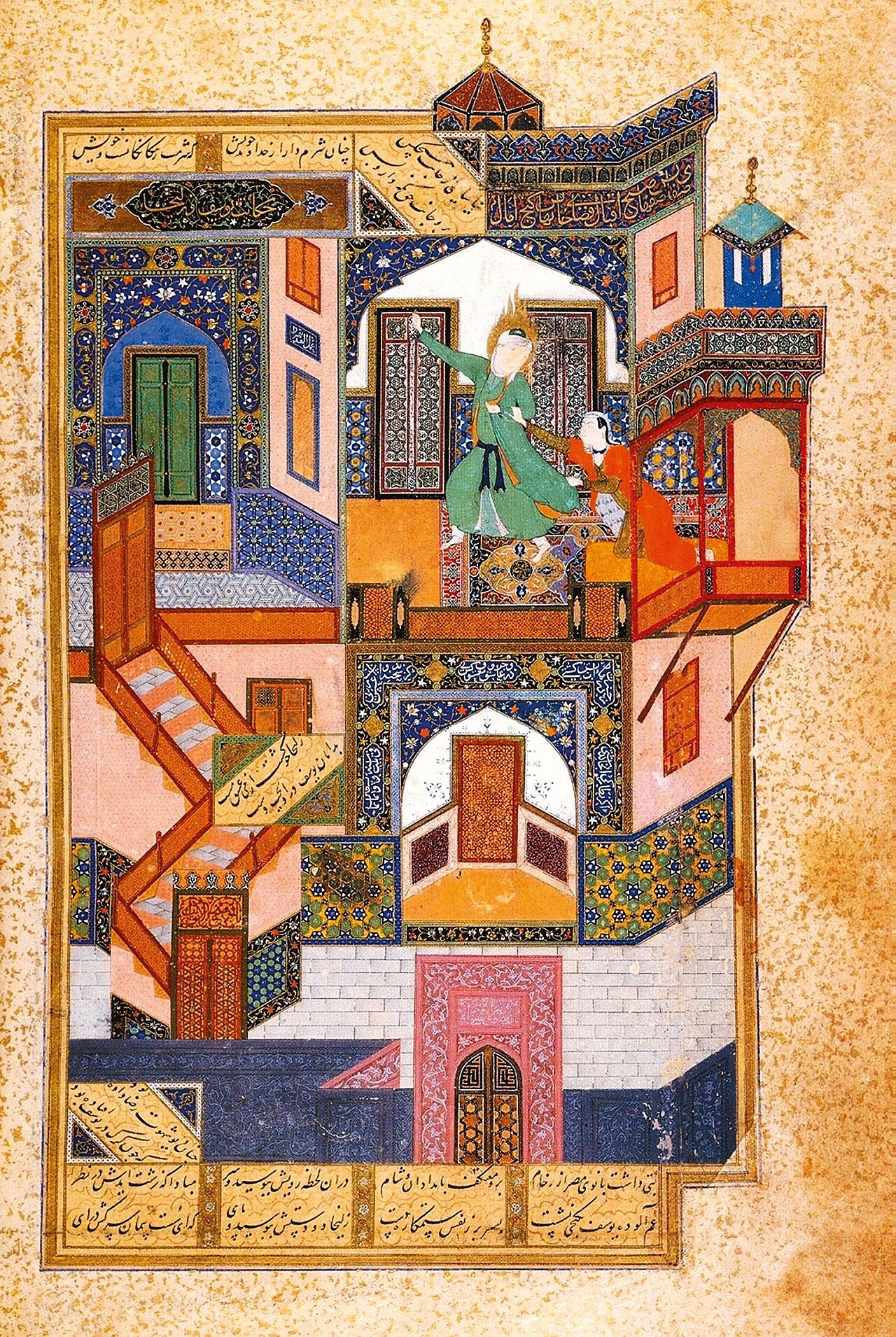
The painting shown above comes from a copy of Sa’di’s Bustan made in Herat in 1488 for Husayn Bayqara’s library, now in the Egyptian National Library (Dar al-Kutub) in Cairo, and is signed by Behzad. It illustrates the story of Yusuf (Joseph) and Zulaikha, wife of the Egyptian official, which Jami turned into a mystical romance in Herat in the same decade. Zulaikha has led Yusuf through seven rooms and locked the doors behind them; at the moment of her embrace, the doors fly open and Yusuf escapes. Behzad builds the palace as a maze of zigzag stairs, tiled walls and doorways, so that the eye has to climb and turn through it as Yusuf does.
Tabriz and the Safavids
After Husayn Bayqara’s death in 1506 and the Uzbek conquest of Herat in 1507, Behzad seems to have stayed in the city. When Shah Ismail I took Herat in 1510, the city’s artists came under Safavid rule. In 1522 Ismail issued a decree, preserved by the historian Khvandamir, appointing Behzad head of the royal library in Tabriz and calling him the wonder of the age. He remained in charge under Shah Tahmasp I, during the years when the great Safavid Shahnameh of Tahmasp was being painted, though by then the leading hands were younger artists such as Soltan Mohammad.
The place of his burial is disputed. Some sources put his grave in Herat; a long tradition in Tabriz holds that he lies near the poet Kamal Khujandi, in the tomb known as the “Tomb of the Two Kamals”.
The problem of attribution
Behzad’s fame created a problem for historians. Within a generation, collectors and dealers were adding his name to paintings he could not have made, and copyists imitated his manner. Only a small number of works carry signatures in positions and forms that scholars accept, mostly in the 1488 Bustan and the 1494–1495 Khamsa. Others are attributed on grounds of style, and specialists disagree about many of them. The portrait of Husayn Bayqara reproduced on his page, for instance, is a copy after a Behzad original rather than the master’s own work.
Behzad’s legacy
His pupils and followers carried his manner to Tabriz, to Bukhara under the Uzbeks and, through Safavid artists who went to India with the Mughal emperor Humayun, to the Mughal workshops. In Iran his name has stayed a symbol of painting itself: Iranian miniaturists of the twentieth century looked back to him as the classic model. For the wider setting, see the Timurid Renaissance.
Persian words from this page
| بهزاد | Behzâd | Behzad |
| نگارگری | negârgari | Persian miniature painting |
| کتابخانه | ketâbkhâne | library; royal book workshop |
| بوستان | Bustân | Sa’di’s “Orchard” |
| نقاش | naqqâsh | painter |
| خمسه | Khamse | Nezami’s “Quintet” |
Sources and further reading
- Encyclopaedia Iranica, “Behzād, Kamāl-al-Dīn”.
- Qazi Ahmad, Calligraphers and Painters, trans. V. Minorsky, Freer Gallery of Art, 1959.
- Ebadollah Bahari, Bihzad: Master of Persian Painting, I. B. Tauris, 1996.
- Thomas W. Lentz and Glenn D. Lowry, Timur and the Princely Vision: Persian Art and Culture in the Fifteenth Century, Los Angeles County Museum of Art, 1989.
- Michael Barry, Figurative Art in Medieval Islam and the Riddle of Bihzâd of Herât, Flammarion, 2004.
Want to learn Persian? Get the free Starter Pack
Get the 14-page printable Starter Pack (all 32 letters, a 7-day reading plan, 100 core words and 20 survival phrases) and a short 5-email course. Free.
More in Post-Mongol Dynasties, Timurids and Turkmens (1335–1501)
- The Chobanids and Jalayirids
- The Injuids and Muzaffarids of Shiraz
- The Sarbadars of Sabzevar
- Khwaju Kermani and Poets of the 14th Century
- Hafez of Shiraz
- Timur (Tamerlane)
- Timur’s Campaigns in Iran
- Timur and the Battle of Ankara (1402)
- Shahrukh and Herat
- Goharshad Begum
- Ulugh Beg and the Samarkand Observatory
- The Timurid Renaissance
- The Qara Qoyunlu (Black Sheep Turkmen)
- The Blue Mosque of Tabriz
- Sultan Husayn Bayqara
- Jami: The Last Great Classical Persian Poet
- Kamal al-Din Behzad and Persian Miniature Painting
- The Aq Qoyunlu (White Sheep Turkmen)
- The Safaviyya Sufi Order of Ardabil