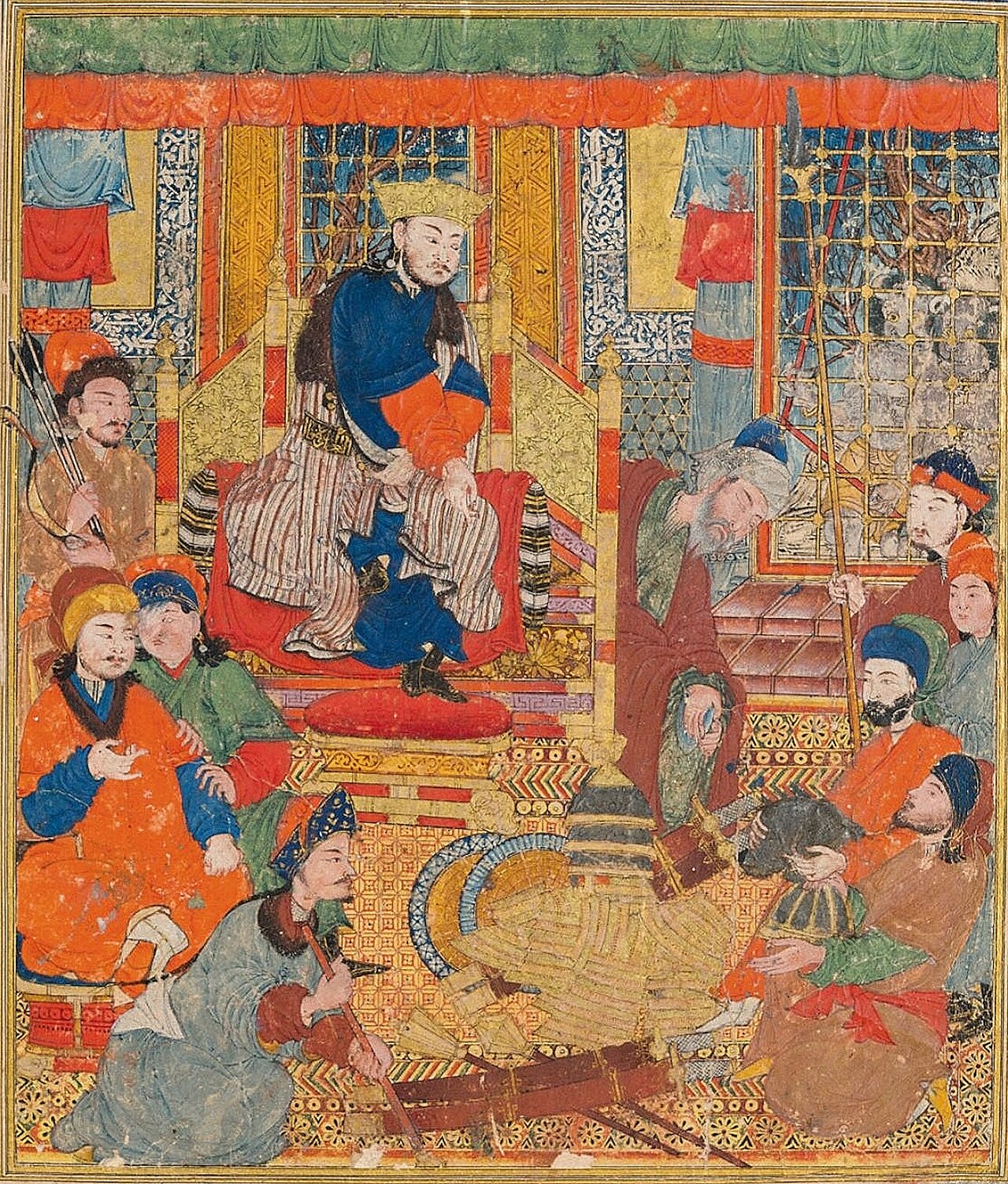
The Chobanids and the Jalayirids were the two great military families that divided north-western Iran and Iraq after the death of the last strong Ilkhan, Abu Sa’id, in 1335. The Chobanids ruled Azerbaijan from Tabriz until 1357; the Jalayirids held Baghdad from the late 1330s, took Tabriz in 1360 and survived Timur’s invasions, only to fall to the Qara Qoyunlu Turkmens in the early fifteenth century. Their courts kept Persian painting and poetry alive in the gap between the Mongols and the Timurids.

| Chobanids | c. 1335–1357, centred on Tabriz and Azerbaijan |
|---|---|
| Jalayirids | c. 1336–1432, centred on Baghdad, with Tabriz 1360–1386 and again 1406–1410 |
| Origins | Both families descended from Mongol emirs who served the Ilkhans |
| Key rulers | Hasan Kuchak, Malik Ashraf (Chobanid); Hasan Buzurg, Shaykh Uways, Sultan Ahmad (Jalayirid) |
| End | Chobanids destroyed by the Golden Horde, 1357; Jalayirids by the Qara Qoyunlu, 1410 and 1432 |
Two emirs’ families
Both dynasties grew out of the Ilkhanid court. Amir Chupan of the Suldus tribe had been the most powerful man in the state during Abu Sa’id’s minority, until the young Ilkhan turned on him in 1327 and had him killed. Hasan Buzurg (“Hasan the Elder”) of the Jalayir tribe was another senior emir, and the two families were tied together by marriage and rivalry. Chupan’s daughter Baghdad Khatun had been Hasan Buzurg’s wife before Abu Sa’id forced a divorce and married her himself.
When Abu Sa’id died without an heir (the background is told on our page on Abu Sa’id and the end of the Ilkhanate), neither family could claim the throne for itself, because only descendants of Genghis Khan were thought fit to be khan. Instead each raised its own puppet Ilkhans and fought in their names.
The Chobanids in Tabriz
In 1338 Chupan’s grandson Hasan Kuchak (“Hasan the Younger”) rallied his relatives, defeated the Jalayirids and took Tabriz. He governed through nominal rulers, first Sati Beg, Abu Sa’id’s sister and Chupan’s widow, then other princes. For a few years the Chobanids reached as far as Isfahan, until the Injuid prince Abu Ishaq took that city in 1342. Hasan Kuchak died in 1343; the chronicles say he was murdered by his own wife.
His brother Malik Ashraf won the struggle that followed and by the end of 1344 controlled the family’s lands. He too ruled behind a puppet khan, Anushirvan. His attempts to take Baghdad (1347) and Fars (1350) failed, and the sources remember him as greedy and cruel: merchants and scholars left Tabriz, and some of them appealed for help to the Golden Horde, the Mongol state north of the Caucasus. In 1357 its khan Jani Beg crossed the mountains, took Tabriz and had Malik Ashraf executed. The Chobanids never recovered.
The Jalayirids of Baghdad
Hasan Buzurg withdrew to Baghdad after his defeat in 1338 and built a state in Iraq. He continued for a time to recognise puppet Ilkhans, then ruled in his own name until his death in 1356. His son Shaykh Uways (ruled 1356–1374) is usually seen as the high point of the dynasty. When the Golden Horde army withdrew from Azerbaijan, Uways moved in and took Tabriz in 1360. For the next quarter of a century the Jalayirids ruled both the old Ilkhanid capital and Baghdad, the two richest cities of the region.
Uways also fought his neighbours to the south. He backed his son-in-law Shah Mahmud, a Muzaffarid prince, against Shah Shuja’ of Shiraz, and Shiraz politics in these years cannot be understood without the Jalayirids (see the Injuids and Muzaffarids of Shiraz).
Sultan Ahmad, poet and survivor
After Uways’s death his sons quarrelled. Sultan Husayn (1374–1382) was killed by his brother Ahmad, who ruled from 1382 to 1410. Ahmad’s reign was a long flight. In 1385 a Golden Horde army under Tokhtamysh sacked Tabriz, and in 1386 Timur arrived and took the city. Ahmad lost Baghdad to Timur in 1393, took refuge with the Mamluks in Egypt, returned, and lost it again in 1401. He shared his exile for a time with Qara Yusuf, leader of the Qara Qoyunlu Turkmens. After Timur’s death in 1405 Ahmad regained Tabriz, but in 1410 his former ally Qara Yusuf defeated him near the city and had him put to death. Jalayirid princes held on in southern Iraq until the Qara Qoyunlu removed the last of them in 1432.
Patrons of painting and verse
The Jalayirids matter more to art history than their politics might suggest. Their workshops in Baghdad and Tabriz continued the Ilkhanid tradition of illustrated books and changed it. Paintings from their time, many now in albums in the Topkapi Palace Library, show slimmer figures, lyrical landscapes and a new interest in everyday scenes. A manuscript of the poems of Khwaju Kermani copied in Baghdad in 1396, now in the British Library, carries the signature of the painter Junayd and is one of the earliest securely dated works of the style that the Timurids later inherited.
Shaykh Uways was a patron of the poet Salman Savaji, and Sultan Ahmad wrote poetry himself and is said to have practised painting. When Baysunghur, the Timurid prince, took artists from Tabriz to Herat in the 1420s, he was in effect collecting the Jalayirid workshop. On the poets of the period see Khwaju Kermani and the poets of the fourteenth century.
How historians see them
Older histories treated the decades after 1335 as an interregnum of petty dynasties between two empires. More recent work, such as Charles Melville’s studies and Patrick Wing’s book on the Jalayirids, sees continuity instead. The Jalayirids presented themselves as heirs of the Ilkhans, kept Mongol titles and court forms, and used Persian bureaucrats and Persian culture to rule a mixed Turkic, Mongol, Persian and Arab population. Their fall did not end that model: the Qara Qoyunlu and then the Aq Qoyunlu ruled Tabriz in much the same way (see the Qara Qoyunlu).
- 1327 Amir Chupan killed on Abu Sa’id’s orders
- 1335 Death of Abu Sa’id; the Ilkhanate splits
- 1338 Hasan Kuchak defeats the Jalayirids and takes Tabriz
- 1343 Death of Hasan Kuchak; Malik Ashraf takes over by 1344
- 1356 Death of Hasan Buzurg; Shaykh Uways succeeds
- 1357 Jani Beg of the Golden Horde takes Tabriz and executes Malik Ashraf
- 1360 Shaykh Uways takes Tabriz
- 1386 Timur takes Tabriz from Sultan Ahmad
- 1410 Qara Yusuf defeats and executes Sultan Ahmad
- 1432 Last Jalayirid ruler removed by the Qara Qoyunlu
Persian words from this page
| چوپانیان | Chupâniyân | the Chobanids |
| جلایریان | Jalâyeriyân | the Jalayirids |
| تبریز | Tabriz | Tabriz |
| بغداد | Baghdâd | Baghdad |
| سلطان احمد | Soltân Ahmad | Sultan Ahmad |
| امیر | amir | emir, commander |
Read next: how Tabriz became the Mongol capital in Tabriz under the Ilkhans, the plague that struck in these same years in the Black Death and Iran, and the modern city in our Tabriz city guide.
Sources and further reading
- Charles Melville and ‘Abbas Zaryab, “Chobanids”, Encyclopaedia Iranica, vol. V.
- “Jalayerids”, Encyclopaedia Iranica.
- Patrick Wing, The Jalayirids: Dynastic State Formation in the Mongol Middle East (Edinburgh University Press, 2016).
- Charles Melville, The Fall of Amir Chupan and the Decline of the Ilkhanate, 1327–37 (Indiana University, 1999).
- The Cambridge History of Iran, vol. 6: The Timurid and Safavid Periods (1986), chapter on the Jalayirids, Muzaffarids and Sarbadars by H. R. Roemer.
Want to learn Persian? Get the free Starter Pack
Get the 14-page printable Starter Pack (all 32 letters, a 7-day reading plan, 100 core words and 20 survival phrases) and a short 5-email course. Free.
More in Post-Mongol Dynasties, Timurids and Turkmens (1335–1501)
- The Chobanids and Jalayirids
- The Injuids and Muzaffarids of Shiraz
- The Sarbadars of Sabzevar
- Khwaju Kermani and Poets of the 14th Century
- Hafez of Shiraz
- Timur (Tamerlane)
- Timur’s Campaigns in Iran
- Timur and the Battle of Ankara (1402)
- Shahrukh and Herat
- Goharshad Begum
- Ulugh Beg and the Samarkand Observatory
- The Timurid Renaissance
- The Qara Qoyunlu (Black Sheep Turkmen)
- The Blue Mosque of Tabriz
- Sultan Husayn Bayqara
- Jami: The Last Great Classical Persian Poet
- Kamal al-Din Behzad and Persian Miniature Painting
- The Aq Qoyunlu (White Sheep Turkmen)
- The Safaviyya Sufi Order of Ardabil