The Safaviyya was a Sufi order founded at Ardabil in north-western Iran by Sheikh Safi al-Din (1252/53–1334). Over the fifteenth century its leaders changed it from a respected, largely Sunni mystical brotherhood into a militant movement of Turkmen devotees, the Qizilbash, and in 1501 its young head Ismail made himself shah and founded the Safavid dynasty.
| Founded | 1301, when Safi al-Din succeeded his master Zahed Gilani |
|---|---|
| Centre | The shrine and lodge (khanqah) of Sheikh Safi, Ardabil |
| Leaders | Safi al-Din (d. 1334); Sadr al-Din Musa (d. 1391/92); Khwaja Ali (d. c. 1429); Ebrahim (d. 1447); Joneyd (d. 1460); Heydar (d. 1488); Soltan Ali (d. 1494); Ismail |
| Main early source | Ibn Bazzaz, Safvat al-safa, written in the 1350s |
| Followers | Iranian townspeople and villagers at first; later Turkmen tribes of Anatolia, Syria and Azerbaijan |
| Emblem | The red twelve-gored cap (taj-e Heydari), from which the name Qizilbash (“Red Heads”) |
Sheikh Safi al-Din of Ardabil
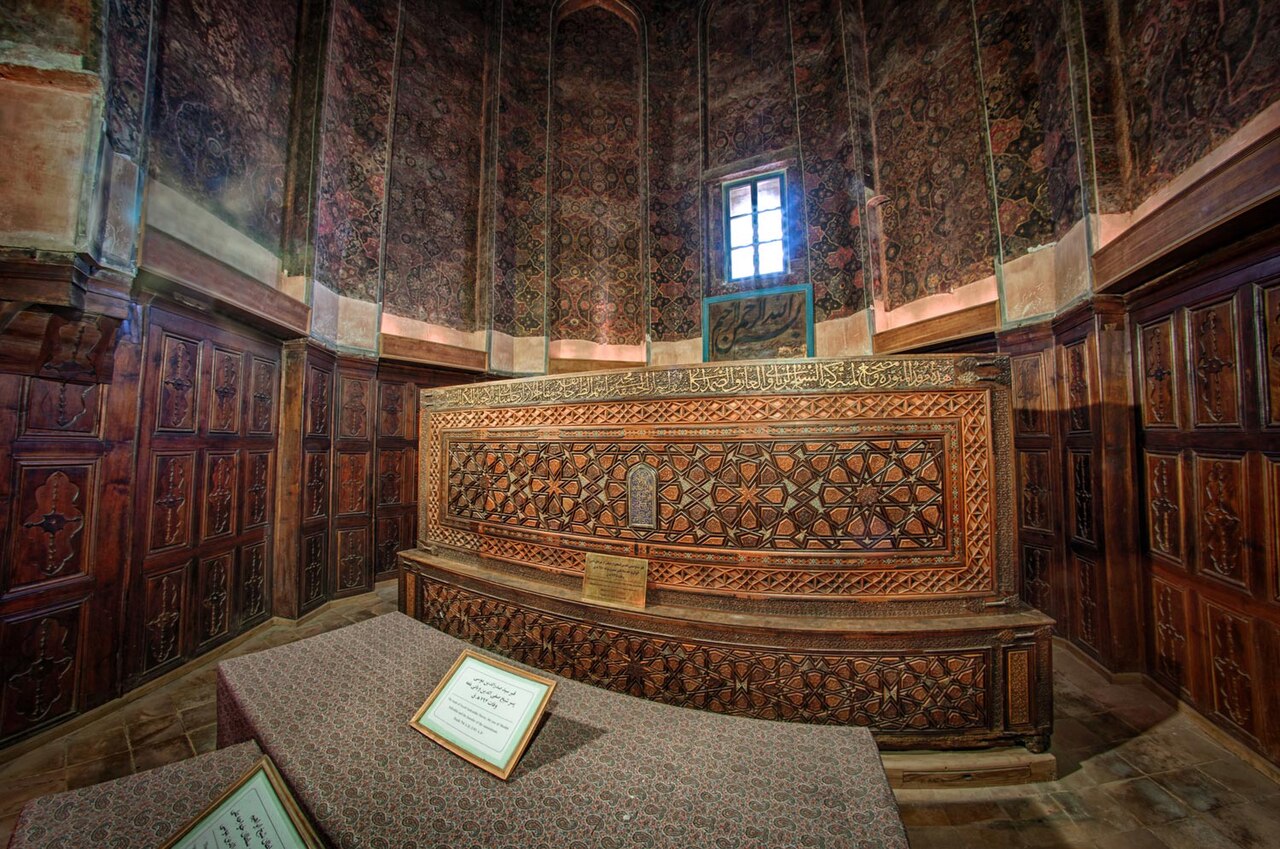
Safi al-Din Ardabili was born in Ardabil in 1252 or 1253, under Mongol rule. As a young man he went looking for a spiritual guide and found one in Sheikh Zahed Gilani, who taught at a village in the Caspian lowlands near Lankaran. Safi became his chief disciple, married his daughter, and in 1301, on Zahed’s death, took over his followers, who from then on were known after him as the Safaviyya.
Safi was famous in his lifetime. The order spread from Ardabil across Azerbaijan, Gilan, Iraq and Anatolia, and the Ilkhanid vizier and historian Rashid al-Din treated him with great respect. Gifts and endowments poured into Ardabil. The Safvat al-safa, a book of his sayings and miracles written by Ibn Bazzaz, a disciple of Safi’s son, about twenty years after his death, is the oldest and most important source on the order. It shows a Sufi master of the Shafi’i Sunni community, preaching piety, obedience to the sheikh and the remembrance of God, with nothing of the later militancy.
Safi also wrote a few short poems in Old Azari, the Iranian language spoken in Azerbaijan before Turkish replaced it there, and they are among the few surviving texts in that language. He died in September 1334 and was buried in Ardabil.

Origins and the rewritten genealogy
Where did the family come from? The earliest manuscripts of the Safvat al-safa trace Safi’s ancestry to Firuz Shah Zarrin-Kolah, “of the golden cap”, a Kurd from the region of Sanjan, and many historians, following the Turkish scholar Zeki Velidi Togan, accept a Kurdish origin for the family, which by Safi’s time spoke Persian and Azari. After the Safavids came to power, court historians rewrote the genealogy to make Safi a descendant of the seventh Shi’ite imam, Musa al-Kazim, and so of the Prophet, and later copies of the Safvat were edited to match. Most modern scholars regard this sayyid descent as a later invention.
A century of quiet growth
Safi’s son Sadr al-Din Musa led the order for nearly sixty years and built much of the shrine complex at Ardabil around his father’s tomb. Under Khwaja Ali, a famous story says, Timur visited Ardabil and released Turkish prisoners of war into the sheikh’s keeping; they and their descendants became devotees of the order. The story first appears in Safavid sources and may be a legend, but it reflects something real: by the fifteenth century many of the order’s most devoted followers were Turkmen tribesmen in eastern Anatolia and northern Syria. Their religion mixed Sufism, reverence for Ali and the twelve imams, and older beliefs, and it was very far from the scholarly Sunnism of Safi’s time.
Joneyd: the sheikh becomes a warrior
The change came with Joneyd, who became head of the order in 1447. He claimed temporal as well as spiritual authority, and that alarmed the Qara Qoyunlu ruler Jahan Shah, who drove him out of Ardabil. Joneyd spent years in Anatolia and Syria preaching to the Turkmen tribes and gathering armed followers. He led them in raids against Christian Trebizond and Circassia, presenting these as holy war.
He found an ally in Uzun Hasan of the Aq Qoyunlu, the rising rival of Jahan Shah, and married his sister Khadija Begum in Diyarbakr in the late 1450s. Barred from returning to Ardabil, he raided into the Caucasus and was killed in 1460 in a clash with the forces of the Shirvanshah near the Samur river. That death began a feud between the Safavids and the Sunni Shirvanshahs that lasted until Ismail took his revenge in 1500.
Heydar and the red cap
Joneyd’s son Heydar was born in Diyarbakr in 1459/60, shortly before his father’s death. He grew up at the court of his uncle Uzun Hasan, who later gave him his daughter Halima (Alamshah Begum), whose mother was the Trebizond princess Despina Khatun. Heydar returned to Ardabil with Aq Qoyunlu support and gave his followers the sign that made them a distinct body: a red cap with twelve gores, for the twelve imams, wound around with a turban. The Turks called its wearers qizilbash, “red heads”.
Like his father, Heydar led his disciples on raids into Circassia and Daghestan. In 1488, on his way north through Shirvan, he was attacked by the Shirvanshah Farrukh Yasar, who had help from the Aq Qoyunlu sultan Ya’qub, married to the Shirvanshah’s daughter. Heydar was killed at Tabasaran on 9 July 1488. His relationship with his Aq Qoyunlu cousins had turned from alliance to enmity (see the Aq Qoyunlu).
Soltan Ali and the boy in hiding
Ya’qub imprisoned Heydar’s three young sons and their mother in the fortress of Estakhr in Fars. After his death in 1490 the Aq Qoyunlu princes, fighting each other, released them and used the Qizilbash as allies. The eldest son, Soltan Ali, was soon seen as a threat, and in 1494 he was killed in battle near Ardabil fighting Aq Qoyunlu troops. Before he died he named his younger brother Ismail, then about seven, as his successor. Ismail’s followers smuggled him to Lahijan in Gilan, where a local ruler protected him for five years.
In 1499 Ismail left Gilan, gathered the Qizilbash tribes at Erzincan, and in 1501, after defeating the Shirvanshah and then the Aq Qoyunlu at Sharur, was crowned in Tabriz. That story, and how the head of a Sufi order became shah of Iran and made Twelver Shi’ism its official religion, is told on the page on Shah Ismail I. The Turkmen tribes who carried him to power have their own page: the Qizilbash.
Why the Safaviyya matters
Historians still debate how a Sunni Sufi order became the vehicle of a Shi’ite messianic movement. Some stress the changing audience: once the order’s main followers were Turkmen tribesmen, it took on their beliefs and their way of war. Others point to the ambitions of Joneyd and Heydar, and to the political vacuum left by the Timurids and the feuds of the Turkmen dynasties. What is clear is the result: the Safavid shahs kept the title of morshed-e kamel, “perfect guide” of the order, and Ardabil remained a dynastic shrine. Today the shrine of Sheikh Safi is a UNESCO World Heritage Site (see Sheikh Safi al-Din Shrine and our guide to Ardabil).
- 1252/53 Safi al-Din born in Ardabil
- 1301 Safi succeeds Zahed Gilani; the Safaviyya order begins
- 1334 Death of Safi; Sadr al-Din Musa succeeds
- 1447 Joneyd becomes head of the order
- 1460 Joneyd killed fighting the Shirvanshah
- 1488 Heydar killed at Tabasaran
- 1494 Soltan Ali killed; Ismail hidden in Gilan
- 1501 Ismail crowned in Tabriz
Persian words from this page
| شیخ صفیالدین اردبیلی | Sheykh Safi-od-Din-e Ardabili | Sheikh Safi al-Din of Ardabil |
| صفویه | Safaviye | the Safaviyya order; the Safavids |
| خانقاه | khânqâh | Sufi lodge |
| مرشد | morshed | spiritual guide |
| قزلباش | qezelbâsh | Qizilbash, “red head” |
| تاج | tâj | crown; the Safavid cap |
| اردبیل | Ardabil | Ardabil |
Sources and further reading
- Ibn Bazzaz, Safvat al-safa (c. 1358), the earliest life of Sheikh Safi.
- Encyclopaedia Iranica, “Ardabīlī, Shaikh Ṣafī-al-Dīn” and “Safavid dynasty”.
- Andrew J. Newman, Safavid Iran: Rebirth of a Persian Empire, I. B. Tauris, 2006.
- Roger Savory, Iran under the Safavids, Cambridge University Press, 1980.
- Kathryn Babayan, Mystics, Monarchs, and Messiahs: Cultural Landscapes of Early Modern Iran, Harvard University Press, 2002.
- UNESCO World Heritage Centre, “Sheikh Safi al-din Khānegāh and Shrine Ensemble in Ardabil” (whc.unesco.org/en/list/1345).
Want to learn Persian? Get the free Starter Pack
Get the 14-page printable Starter Pack (all 32 letters, a 7-day reading plan, 100 core words and 20 survival phrases) and a short 5-email course. Free.
More in Post-Mongol Dynasties, Timurids and Turkmens (1335–1501)
- The Chobanids and Jalayirids
- The Injuids and Muzaffarids of Shiraz
- The Sarbadars of Sabzevar
- Khwaju Kermani and Poets of the 14th Century
- Hafez of Shiraz
- Timur (Tamerlane)
- Timur’s Campaigns in Iran
- Timur and the Battle of Ankara (1402)
- Shahrukh and Herat
- Goharshad Begum
- Ulugh Beg and the Samarkand Observatory
- The Timurid Renaissance
- The Qara Qoyunlu (Black Sheep Turkmen)
- The Blue Mosque of Tabriz
- Sultan Husayn Bayqara
- Jami: The Last Great Classical Persian Poet
- Kamal al-Din Behzad and Persian Miniature Painting
- The Aq Qoyunlu (White Sheep Turkmen)
- The Safaviyya Sufi Order of Ardabil