Khwaju Kermani (1290–c. 1349) was the leading Persian poet of the generation before Hafez: a Sufi from Kerman who wrote five verse romances and a large divan of ghazals, and whose lyrics Hafez knew well and often answered. He belongs to a crowded fourteenth century in which Obeyd Zakani, Salman Savoji, Ibn Yamin and Kamal Khujandi also wrote, while the Ilkhanate broke up into rival courts that each wanted poets of their own.
| Born | 24 December 1290, Kerman |
|---|---|
| Died | c. 1349 (some sources give the early 1350s), Shiraz |
| Pen name | Khwaju, a diminutive of khwaja, “master” |
| Sufi link | The Morshedi (Kazeruni) order, named after Shaykh Abu Eshaq Kazeruni |
| Patrons | The Ilkhans Abu Sa’id and Arpa Ke’un, the Injuid Abu Eshaq, the Muzaffarid Mobarez al-Din |
| Main works | Divan; the romances Homay o Homayun and Gol o Nowruz; Rowzat al-anvar and other didactic poems |
| Tomb | Tang-e Allah-o Akbar gorge, at the northern entrance to Shiraz |
A poet between the Ilkhans and the Injuids
Khwaju was born in Kerman in 1290, when the city was ruled by the Qutlugh-khanid dynasty under Mongol overlordship. He spent his young years travelling: he visited Egypt, Syria, Jerusalem and Iraq and made the pilgrimage to Mecca. In Baghdad, then the winter capital of the Ilkhans, he wrote his first romance, Homay o Homayun, and dedicated poems to the last strong Ilkhan, Abu Sa’id.
Abu Sa’id died in 1335, the year Khwaju returned to the Iranian plateau. The poet’s career after that mirrors the politics of the time. He praised the short-lived Ilkhan Arpa Ke’un, then settled in Shiraz under Abu Eshaq Inju, the cultured and pleasure-loving ruler whom the young Hafez also served. When the Muzaffarid Mobarez al-Din took Shiraz in 1353 and closed its taverns, the old order of the city ended; Khwaju had probably already died, though some sources place his death a few years later. The story of those rival Shiraz courts is told in the Injuids and Muzaffarids of Shiraz.
Patronage was not the whole story. Khwaju’s nisba, Morshedi, ties him to the Sufi order of Shaykh Abu Eshaq Kazeruni, whose lodges were spread across Fars and along the trade routes to the Persian Gulf. Much of his poetry is mystical, and his longer didactic poems treat the Sufi path and the ethics of kingship side by side.

The romances
Khwaju consciously followed Nezami, the twelfth-century master of the verse romance, and his long poems are often grouped as a Khamsa (“Quintet”) in Nezami’s manner. Two are love stories:
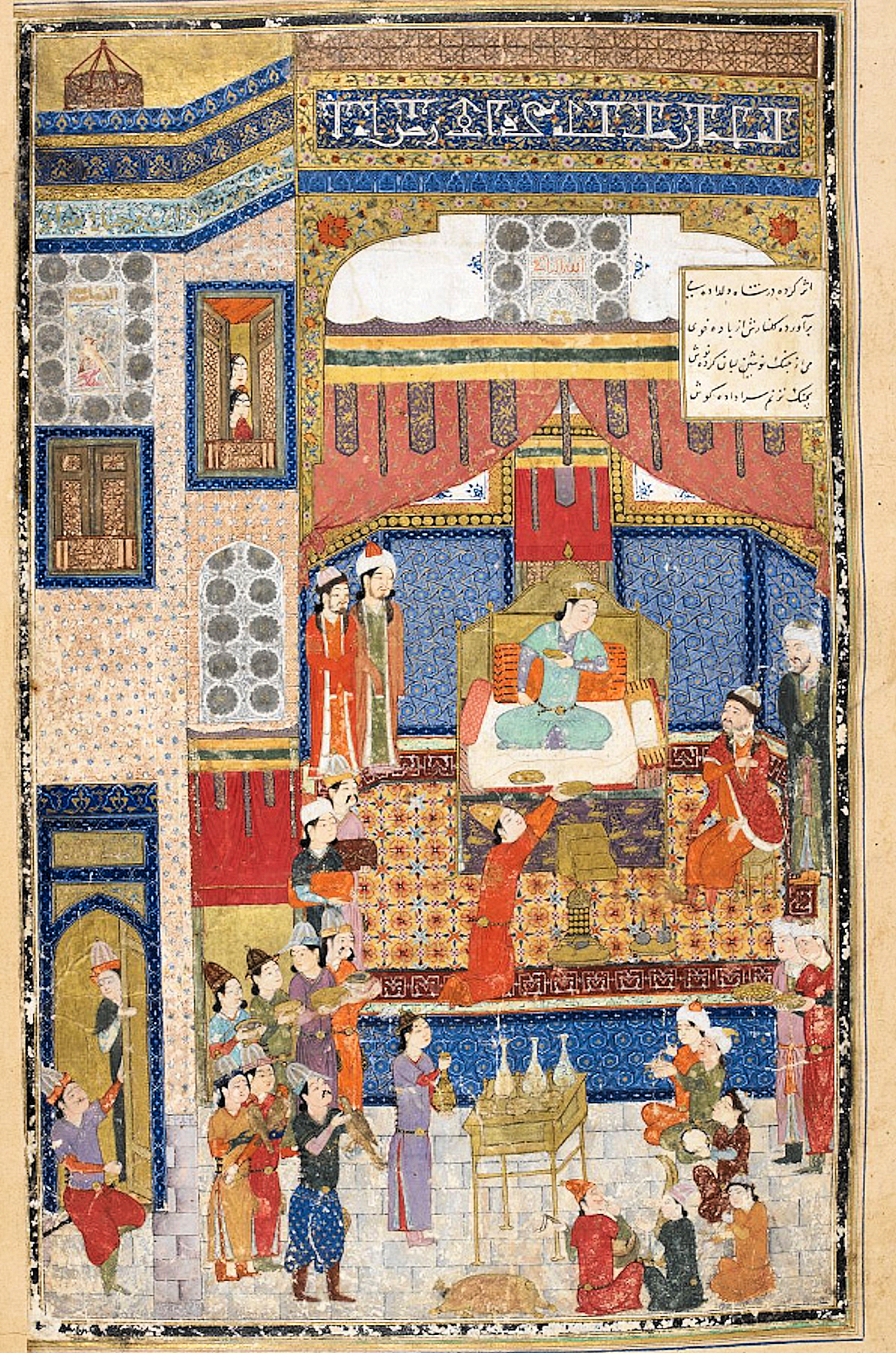
- Homay o Homayun: the Persian prince Homay sees a picture of the Chinese princess Homayun, falls in love and travels east through adventures with demons and rivals to win her. It was the poem that made Khwaju’s name.
- Gol o Nowruz: a romance set shortly before the coming of Islam, between Nowruz, a prince of Khorasan, and Gol, a princess of Byzantium.
The others are didactic or mystical: Rowzat al-anvar (“Garden of Lights”), twenty discourses on the spiritual path and on just rule; the Kamal-name; and the Gowhar-name. A heroic epic, the Sam-name, about Rostam’s grandfather Sam, has also been attributed to him, but scholars doubt whether it is his.
The romances lived on in painting. In 1396 a copy of Khwaju’s poems was illustrated in Baghdad for the Jalayirid court, and its paintings, now in the British Library, are among the first in which Persian painters set slender figures inside large, detailed gardens and palaces. One of them is signed by the painter Jonayd. That manuscript links Khwaju to the court art that later flowered in Herat (see the Chobanids and Jalayirids).
Khwaju and Hafez
Khwaju was about thirty years older than Hafez, and the two lived in the same city under the same patron. Readers have long noticed that many of Hafez’s ghazals use the same metre, rhyme and refrain as poems in Khwaju’s divan, which in the Persian tradition is a way of answering, competing with and honouring a predecessor. Scholars disagree on how much Hafez owed him: some see Khwaju as the poet who prepared the language Hafez perfected, others stress that Hafez’s compression and ambiguity are his own. Either way, a reader who knows Khwaju hears Hafez differently. See our page on Hafez of Shiraz.
Other poets of the fourteenth century
The collapse of the Ilkhanate after 1335 did not silence Persian poetry. It multiplied the courts that paid for it.
Obeyd Zakani (d. c. 1370)
Obeyd, from a family of Qazvin, lived in Shiraz in the same years and wrote the sharpest satire of the age. His Akhlaq al-ashraf (“Ethics of the Aristocrats”) turns moral treatises inside out, setting out the “old” virtues and then the “new” ones the great men of his day actually practise. The fable Mush o gorbe (“Mouse and Cat”), long attributed to him, mocks a cat who repents of eating mice and then eats more of them.
Salman Savoji (c. 1300–1376)
Salman was the court poet of the Jalayirids in Baghdad and Tabriz, writing polished qasidas for Shaykh Uways and his family. He was the most admired panegyrist of his day.
Ibn Yamin (1286–1368)
From Faryumad near Sabzevar, Ibn Yamin served the Sarbadars and is remembered for his qet’e, short occasional poems full of plain, practical wisdom about money, pride and contentment.
Kamal Khujandi (d. c. 1400)
Born in Khujand in Central Asia, Kamal settled in Tabriz, where the Jalayirid sultan built him a lodge. His ghazals were compared with those of Hafez in his own lifetime. He was carried off to Central Asia after the armies of Toqtamish sacked Tabriz in 1385 and later returned to the city, where he is buried.
Visiting Khwaju’s tomb
Khwaju’s tomb stands in the rocky gorge of Tang-e Allah-o Akbar, just outside the Qur’an Gate at the northern entrance to Shiraz, on the old road to Isfahan. The modern tomb is set into the hillside above the road and is a short walk from the gate. Most visitors to Shiraz go to the tomb of Hafez in the Musalla garden; Khwaju’s is quieter.
Persian words from this page
| خواجوی کرمانی | Khâju-ye Kermâni | Khwaju Kermani |
| غزل | ghazal | lyric poem |
| دیوان | divân | collected poems of one poet |
| همای و همایون | Homây o Homâyun | Khwaju’s best-known romance |
| گل و نوروز | Gol o Nowruz | “Rose and New Year”, his second romance |
| عبید زاکانی | Obeyd-e Zâkâni | Obeyd Zakani |
| موش و گربه | mush o gorbe | mouse and cat |
Sources and further reading
- Encyclopaedia Iranica, “Kᵛāju Kermāni”.
- Encyclopaedia Iranica, “ʿObayd Zākāni”.
- Jan Rypka (ed.), History of Iranian Literature, Dordrecht: Reidel, 1968.
- The Cambridge History of Iran, vol. 6, chapter on Persian literature in the Timurid and Turkmen periods, Cambridge University Press, 1986.
- The 1396 Baghdad manuscript of Khwaju’s poems: British Library, Add. 18113. On its paintings see Sheila Blair and Jonathan Bloom, The Art and Architecture of Islam 1250–1800, Yale University Press, 1994.
Want to learn Persian? Get the free Starter Pack
Get the 14-page printable Starter Pack (all 32 letters, a 7-day reading plan, 100 core words and 20 survival phrases) and a short 5-email course. Free.
More in Post-Mongol Dynasties, Timurids and Turkmens (1335–1501)
- The Chobanids and Jalayirids
- The Injuids and Muzaffarids of Shiraz
- The Sarbadars of Sabzevar
- Khwaju Kermani and Poets of the 14th Century
- Hafez of Shiraz
- Timur (Tamerlane)
- Timur’s Campaigns in Iran
- Timur and the Battle of Ankara (1402)
- Shahrukh and Herat
- Goharshad Begum
- Ulugh Beg and the Samarkand Observatory
- The Timurid Renaissance
- The Qara Qoyunlu (Black Sheep Turkmen)
- The Blue Mosque of Tabriz
- Sultan Husayn Bayqara
- Jami: The Last Great Classical Persian Poet
- Kamal al-Din Behzad and Persian Miniature Painting
- The Aq Qoyunlu (White Sheep Turkmen)
- The Safaviyya Sufi Order of Ardabil