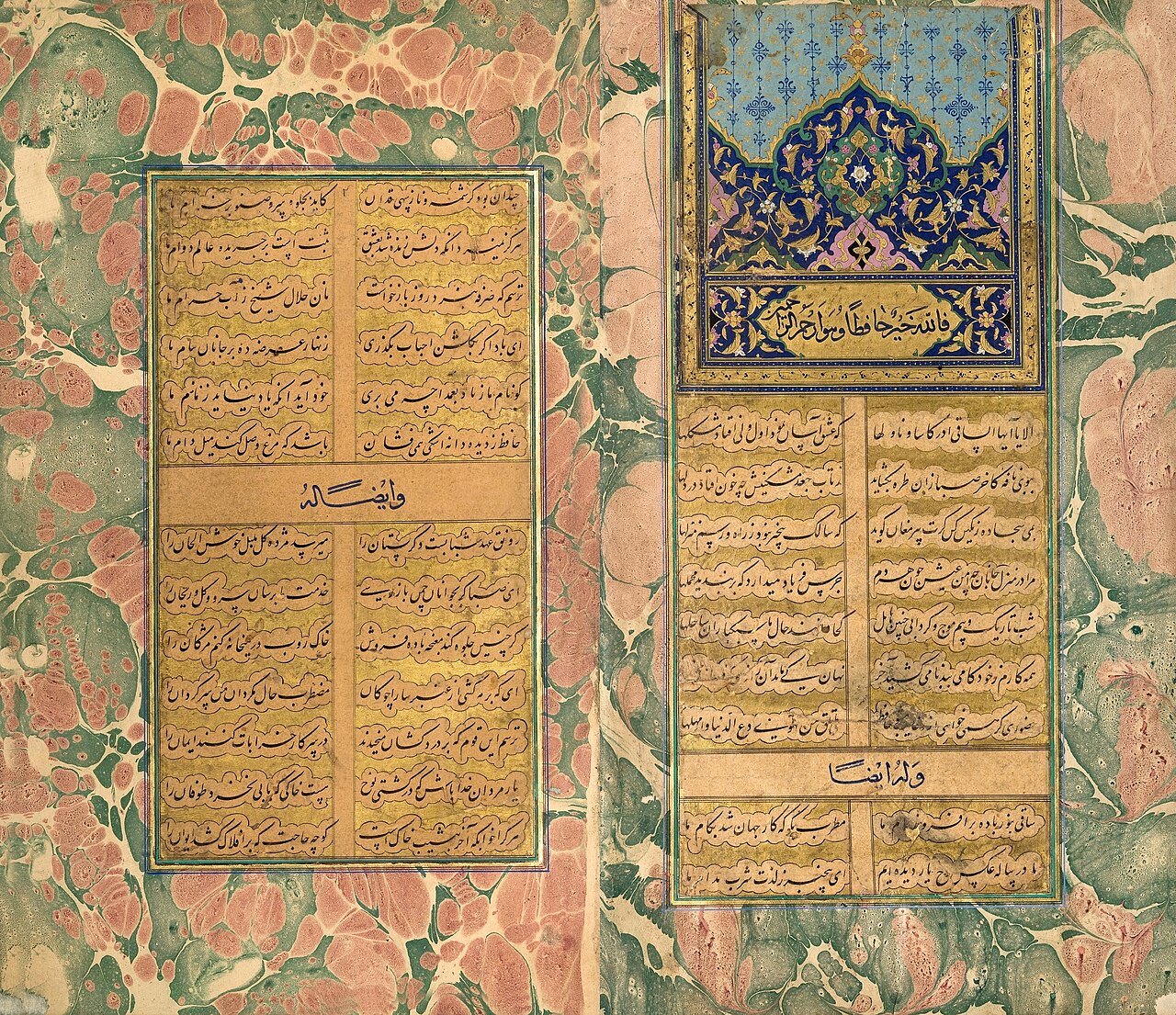
Hafez (Khwaja Shams al-Din Muhammad Hafez-e Shirazi, c. 1315/1325 – 1389/90) was a lyric poet of Shiraz and the greatest master of the Persian ghazal. He spent almost his whole life in one city while it changed hands between the Injuids, the Muzaffarids and finally Timur, and his roughly 500 ghazals, collected after his death as the Divan, are still the most widely read and quoted book of Persian poetry in Iran.

| Full name | Khwaja Shams al-Din Muhammad, pen name Hafez |
|---|---|
| Born | Shiraz, c. 1315–1325 (no contemporary record) |
| Died | Shiraz, 791 AH (1389/90); some sources give 792 |
| Rulers in his lifetime | Injuids, Muzaffarids, then Timur (1387 and 1393) |
| Main work | Divan: about 500 ghazals, with qasidas, short poems, quatrains and the Saqi-nameh |
| Persian name | حافظ شیرازی (Hâfez-e Shirâzi) |
What is known and what is legend
Very little about Hafez’s life is documented. No court chronicle of the time records him, and the biographies written in the fifteenth century and later mix a few facts with many good stories. Scholars build his life mainly from his own poems, which name rulers and ministers and can sometimes be dated by them.
Later writers say his father, Baha al-Din, was a merchant who had moved to Shiraz from Isfahan, and that he died when Hafez was young, leaving the family poor. A popular story makes the young Hafez a baker’s apprentice who fell in love at first sight with a beautiful girl called Shakh-e Nabat. Both stories are traditional, not proven. What is certain is his pen name: a hafez is someone who knows the Qur’an by heart, and in one ghazal he claims to recite it in fourteen readings. He was well trained in Arabic, theology and the earlier Persian poets, especially Saadi, his predecessor in Shiraz.
A poet and his patrons
Poets of the time lived by patronage, and Hafez wrote for a series of rulers and ministers whose politics are traced on our page on the Injuids and Muzaffarids of Shiraz.
Abu Ishaq Inju (ruled 1343–1357)
His first great patron was the pleasure-loving Injuid ruler Abu Ishaq and his vizier Haji Qavam al-Din Hasan. Hafez praised both, and when Abu Ishaq lost Shiraz in 1353 and was executed in 1357, he looked back on the reign as a brief, bright moment: “the turquoise seal-ring of Abu Ishaq shone beautifully, but its fortune was fleeting”.
Mubariz al-Din (1353–1358)
The Muzaffarid conqueror closed the wine-houses and enforced religious law. Many of Hafez’s sharpest lines attack the mohtaseb (morals officer), the self-righteous preacher and the hypocritical ascetic. Shiraz tradition, recorded later, says the city nicknamed Mubariz al-Din himself the mohtaseb. The poems do not name him, so the link is likely but not certain.
Shah Shuja’ (1358–1384)
Under Mubariz al-Din’s son Shah Shuja’, a poet himself, Hafez reached his greatest fame. Their relationship seems to have had cold periods. A story told by later biographers says the shah criticised his ghazals for jumping between subjects, and Hafez replied that they were nonetheless known far beyond Shiraz while other poets’ verses never left the city gates. Whether or not the exchange happened, Hafez’s fame did spread: rulers in Baghdad and India knew his work in his lifetime.
Invitations he did not accept
Hafez praised the Jalayirid Sultan Ahmad of Baghdad in a ghazal, and according to later sources was invited there. The Indian historian Firishta tells how the Bahmani sultan of the Deccan sent for him; Hafez travelled to Hormuz, boarded the ship, and turned back when a storm frightened him, sending a ghazal instead. He seems to have spent a short, unhappy time in Yazd, and complained of it in verse. Otherwise he stayed in Shiraz, whose gardens and stream of Roknabad he praised all his life.
The meeting with Timur: a legend
Timur took Shiraz in 1387, when Hafez was an old man, and returned in 1393, after his death. A famous story connects them through the opening couplet of one of Hafez’s best-known ghazals:
اگر آن ترک شیرازی به دست آرد دل ما را / به خال هندویش بخشم سمرقند و بخارا را
If that Shirazi Turk would take my heart in hand, for the dark mole on his cheek I would give away Samarkand and Bukhara.
In the version told by Dawlatshah of Samarkand in his collection of poets’ lives (1487), Timur summoned the poet and asked how he dared give away Samarkand, his capital, which he had spent his life adorning, for a mole. Hafez, dressed in rags, bowed and said: “It is through such generosity that I have come to this poverty.” Timur laughed and rewarded him.
Historians treat this as a literary anecdote. It was first written down about a century after the events, no Timurid chronicle mentions a meeting, and similar witty-poet stories are told about other conquerors. It survives because it captures how Iranians like to see Hafez: poor, fearless and quicker than the most powerful man of his age. On Timur’s actual conduct in Fars, see Timur’s campaigns in Iran.
The Divan
Hafez did not, as far as we know, publish his own collection. A preface attributed to his friend Muhammad Golandam says the poems were gathered after his death. Because they circulated widely and were copied many times, manuscripts disagree on the number of poems, their order and many words. The standard modern edition, by Mohammad Qazvini and Qasem Ghani (1941), contains 495 ghazals; later editors, such as Parviz Natel-Khanlari, used older manuscripts to refine the text.
A Hafez ghazal moves through images of wine, the beloved, the rose and nightingale, the tavern and the Sufi lodge. Readers have argued for centuries whether the wine is literal or mystical. Most modern critics think the ambiguity is the point: the same couplet can be read as a love poem, a mystical poem and a jibe at hypocrites. For favourite lines in Persian and English, see our collection of Hafez quotes.
Death, tomb and afterlife
Hafez died in Shiraz in 791 AH (1389/90) and was buried in the Musalla garden outside the city. Karim Khan Zand built a structure over the tomb in the eighteenth century, and the present pavilion, designed by the French architect André Godard, was completed in the 1930s. It is described in our guide to the Tomb of Hafez (Hafezieh).
Hafez also became a book people consult. In fal-e Hafez, a reader makes a wish, opens the Divan at random and reads the ghazal as an answer; families do it on Yalda night and at Nowruz. Our guide to fal-e Hafez explains how it works. In Europe, Joseph von Hammer-Purgstall’s German translation (1812–13) inspired Goethe’s West-östlicher Divan (1819), and Hafez has been translated into English many times since the eighteenth century.
Persian words from this page
| حافظ | hâfez | one who knows the Qur’an by heart; the poet’s pen name |
| دیوان | divân | collected poems |
| غزل | ghazal | lyric poem |
| فال | fâl | omen, fortune-reading |
| ترک | tork | Turk; in poetry, a beautiful beloved |
| خال | khâl | beauty mark, mole |
| سمرقند | Samarqand | Samarkand |
Sources and further reading
- Hafez, Divan, ed. Mohammad Qazvini and Qasem Ghani (Tehran, 1941).
- “Hafez”, Encyclopaedia Iranica (multi-part article on his life and poetry).
- John Limbert, Shiraz in the Age of Hafez (University of Washington Press, 2004).
- Dawlatshah Samarqandi, Tazkirat al-Shu’ara (1487), the life of Hafez.
- Leonard Lewisohn (ed.), Hafiz and the Religion of Love in Classical Persian Poetry (I. B. Tauris, 2010).
Love Persian poetry? Learn to read it: free Starter Pack
Get the 14-page printable Starter Pack (all 32 letters, a 7-day reading plan, 100 core words and 20 survival phrases) and a short 5-email course. Free.
More in Post-Mongol Dynasties, Timurids and Turkmens (1335–1501)
- The Chobanids and Jalayirids
- The Injuids and Muzaffarids of Shiraz
- The Sarbadars of Sabzevar
- Khwaju Kermani and Poets of the 14th Century
- Hafez of Shiraz
- Timur (Tamerlane)
- Timur’s Campaigns in Iran
- Timur and the Battle of Ankara (1402)
- Shahrukh and Herat
- Goharshad Begum
- Ulugh Beg and the Samarkand Observatory
- The Timurid Renaissance
- The Qara Qoyunlu (Black Sheep Turkmen)
- The Blue Mosque of Tabriz
- Sultan Husayn Bayqara
- Jami: The Last Great Classical Persian Poet
- Kamal al-Din Behzad and Persian Miniature Painting
- The Aq Qoyunlu (White Sheep Turkmen)
- The Safaviyya Sufi Order of Ardabil