Yazdegerd III was the last king of the Sasanian Empire. Crowned as a boy at Istakhr in 632, he spent almost his entire reign retreating before the Arab armies, from Ctesiphon to the Iranian plateau and finally to Khorasan. In 651 he was killed near Merv, by tradition at the hands of a miller, and with his death four centuries of Sasanian rule came to an end.
| Reign | 632–651 CE |
|---|---|
| Father | Shahriyar, a son of Khosrow II |
| Crowned | At Istakhr in Fars, 632; his age is uncertain, most sources making him a boy or young teenager |
| Death | Near Merv (in modern Turkmenistan), 651 |
| Children | Sons Peroz and Bahram; daughters named in later tradition |
| Legacy | The Zoroastrian “Yazdegerdi” era counts years from his accession in 632 |
A survivor of the massacre
Yazdegerd was a grandson of Khosrow II. His father Shahriyar was one of the princes killed by Kavad II in 628, and the boy is said to have been hidden in Istakhr, the old Sasanian homeland in Fars, to keep him from the same fate. After four years of civil war, in which at least eight rulers came and went, the leading nobles, Rostam Farrokhzad of the Parthian families and Piruz Khosrow of the Persian faction, agreed to put him on the throne in 632. The background is told on civil war and the queens Boran and Azarmidokht.
The young king had little power of his own. In his early years the empire was in practice run by Rostam and other great nobles, whose rivalries continued under the surface.
The Arab invasions, 633–642
In 633 the armies of the new Islamic state, under Khalid ibn al-Walid, began attacking the Sasanian territories on the lower Euphrates. The Persians won a notable victory at the Battle of the Bridge in 634, but they could not hold the frontier. The decisive battles are covered in detail on their own pages:
- The Battle of the Bridge (634), a Persian victory.
- The Battle of al-Qadisiyyah (c. 636), where Rostam was killed and the Persian army in Iraq destroyed.
- The fall of Ctesiphon (637). Yazdegerd left the capital with his court and treasure before it fell.
- The Battle of Jalula (637), fought as the king withdrew to the Zagros.
- The Battle of Nahavand (642), after which no royal army could take the field again.
Yazdegerd himself did not command in these battles. After the loss of Mesopotamia, the rich lowland province that provided much of the state’s revenue, the king became a ruler without a capital.

The long retreat
After Nahavand, Yazdegerd moved from city to city across the plateau: to Rey and Isfahan, south to Istakhr, then to Kerman and Sistan, and finally north-east to Khorasan. Arabic accounts describe a king travelling with a vast household of cooks, servants, falconers and treasure, a burden on every governor he visited. He hoped that the eastern provinces and the princes of Central Asia would give him a new army. He also sent envoys to the Tang emperor of China asking for help; the Chinese court received them but sent no army.
Many local lords now saw the king as a danger rather than a protector. Some made terms with the Arab commanders in return for keeping their lands. In Fars, Istakhr resisted fiercely and was taken only after heavy fighting. The progress of the conquest through the east is told in the conquest of Fars, Khorasan and the East.
Death at Merv, 651
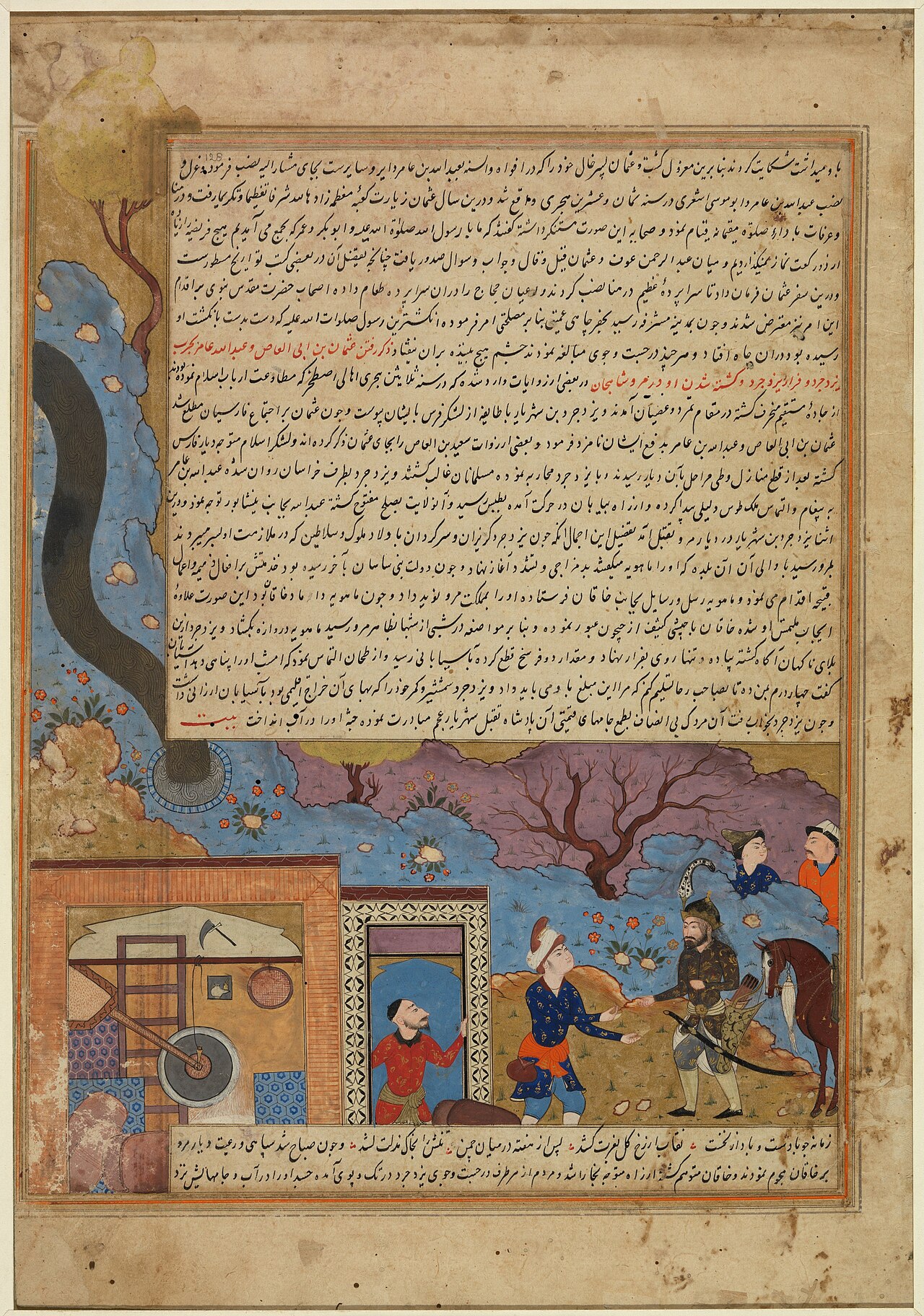
Yazdegerd reached Merv, the great oasis city of Khorasan, around 650. Its governor, the marzban Mahoy Suri, had no wish to support a king who demanded money and obedience but could not protect him. The sources tell several versions of what followed. In the best known, Mahoy turned against the king and called in a Hephthalite or Turkish prince, Nizak, whose forces attacked Yazdegerd’s followers. The king escaped alone on foot and hid in a mill on the Murghab river. The miller, seeing his rich clothes and jewels, killed him in his sleep, or killed him on Mahoy’s orders. His body was thrown into the river.
According to Tabari, the Christian bishop of Merv recovered the body and buried it in a tomb, out of respect for the king’s ancestors, who had treated Christians well. The legend of the miller became one of the most famous scenes in the Shahnameh, where Ferdowsi gives the dying king long lament and makes the miller the instrument of fate. Ferdowsi’s account of Yazdegerd also includes Rostam’s prophetic letter about the end of the Persian kingdom.
After Yazdegerd
His son Peroz fled east and reached the court of the Tang dynasty, where he was given an honorary title and spent the rest of his life trying to win back his kingdom; see Peroz III and the Sasanian exiles in China. In Iran, resistance continued in the mountains of Tabaristan and elsewhere, but the empire as a state was gone.
A later Shi’a tradition holds that a daughter of Yazdegerd, Shahrbanu, married Husayn ibn Ali and was the mother of the fourth imam. Historians regard the story as legend, although it shows how Iranians later linked their Persian and Islamic heritage.
The year of his accession lived on in the calendar. Zoroastrians in Iran and India still number their years from 632, the start of the Yazdegerdi era. For more on this see the history of the Iranian calendar and Zoroastrians after the Arab conquest.
A king judged by his fate
Yazdegerd has often been described as weak or unlucky, a figure of pity rather than blame. Historians point out that he came to the throne as a child in an empire already broken by war, plague and civil conflict, and that the real decisions in the 630s were made by nobles such as Rostam. His long flight also kept the idea of Sasanian kingship alive for nineteen years. The deeper reasons for the fall are explored in why the Sasanian Empire fell.
Persian words from this page
| یزدگرد سوم | Yazdgerd-e sevvom | Yazdegerd III |
| مرو | Marv | Merv |
| آسیاب | âsiyâb | mill |
| آسیابان | âsiyâbân | miller |
| استخر | Estakhr | Istakhr |
| مرزبان | marzbân | governor of a frontier province |
| پیروز | Piruz | Peroz; also “victorious” |
Sources and further reading
- al-Tabari, The History of al-Tabari, vols. 11–15 (SUNY Press), for the conquest years.
- Ferdowsi, Shahnameh, reign of Yazdegerd; trans. Dick Davis (Penguin, 2006).
- “Yazdegerd III”, Encyclopaedia Iranica.
- Parvaneh Pourshariati, Decline and Fall of the Sasanian Empire (I.B. Tauris, 2008).
- Hugh Kennedy, The Great Arab Conquests (Weidenfeld & Nicolson, 2007).
Want to learn Persian? Get the free Starter Pack
Get the 14-page printable Starter Pack (all 32 letters, a 7-day reading plan, 100 core words and 20 survival phrases) and a short 5-email course. Free.
More in The Sasanian Empire (224–651 CE)
- The Origins of the Sasanian Family
- Ardashir I, Founder of the Sasanian Empire
- Firuzabad: Ardashir’s Round City
- Shapur I, King of Kings of Iran and Non-Iran
- Bishapur: Shapur’s City
- The Battle of Edessa and the Capture of Valerian
- The Ka’ba-ye Zartosht Inscription of Shapur I
- Mani and Manichaeism
- Hormizd I and Bahram I
- Kartir and the Zoroastrian Church
- Bahram II
- Narseh and the Peace of Nisibis
- Shapur II the Great
- Julian’s Invasion of Persia (363)
- Christians in the Sasanian Empire
- Shapur III and the Partition of Armenia
- Yazdegerd I
- Bahram V Gur
- Yazdegerd II
- The Battle of Avarayr (451)
- The Hephthalites and Iran’s Eastern Frontier
- Peroz I and the Hephthalite Disaster
- Kavad I
- Zamasp and Kavad’s Return
- Mazdak and the Mazdakite Movement
- Khosrow I Anushirvan the Just
- The Sasanian–Byzantine Wars of the 6th Century
- The Battle of Dara (530)
- Khosrow I Sacks Antioch (540)
- The Lazic War (541–562)
- The Reforms of Khosrow I
- The Academy of Gondishapur: History and Legend
- Borzuya, Chess and Kalila wa Dimna
- Taq Kasra: The Arch of Ctesiphon
- The Sasanian Conquest of Yemen
- The Sasanians and the Western Turks
- Hormizd IV
- Bahram Chobin’s Rebellion
- Khosrow II Parviz
- The Last Great War: Byzantium and Persia, 602–628
- The Siege of Constantinople (626)
- Heraclius Strikes Back
- Shirin: Queen and Legend
- Shahrbaraz, the General Who Became King
- Civil War and the Queens Boran and Azarmidokht
- Yazdegerd III, the Last Sasanian King
- The Sasanian Army
- Sasanian Society and the Class System
- Zoroastrianism under the Sasanians
- Sasanian Art: Silver, Reliefs and Silk
- The Sasanian Reliefs of Naqsh-e Rostam
- Taq-e Bostan
- Sasanian Cities, Palaces and Bridges
- Middle Persian (Pahlavi) Language and Literature
- Sasanian Coins and Silverwork
- Women in the Sasanian Empire
- Polo, Hunting and Games at the Sasanian Court
- The Sasanian Legacy