After the overthrow of Khosrow II in February 628, the Sasanian Empire went through four years of civil war in which as many as ten rulers held the throne, among them Khosrow’s daughters Boran and Azarmidokht, the only women to rule the Sasanian Empire in their own name. Rival noble factions made and murdered kings until Yazdegerd III was crowned in 632. The chaos left the empire divided and weakened just as the first Arab armies reached Mesopotamia.
| Dates | February 628 to 632 CE |
|---|---|
| Main rulers | Kavad II, Ardashir III, Shahrbaraz, Boran (twice), Azarmidokht, and several short-lived claimants |
| Main factions | The Parsig (“Persian”) nobility of the south-west; the Pahlav (“Parthian”) families of the north and east |
| Key nobles | Piruz Khosrow (Parsig); Farrukh Hormizd and his son Rostam Farrokhzad (Pahlav); the general Shahrbaraz |
| Ended | Accession of Yazdegerd III, 632 |
Kavad II and the killing of the princes
The coup of 25 February 628 that removed Khosrow II was carried out by nobles from several great families, who freed his son Shiroe and proclaimed him king as Kavad II. Kavad had his father executed, made peace with the Byzantine emperor Heraclius and, to remove any rival, had his brothers killed. The sources speak of seventeen or eighteen princes put to death, among them Mardanshah, son of Shirin. Arabic historians say that Kavad’s sisters Boran and Azarmidokht reproached him for the murders.
The massacre left the dynasty with almost no adult males. Kavad himself died in September 628, after a reign of a few months, of a plague that struck Mesopotamia that year and killed, the sources say, a large part of the population. Later writers remembered it as the plague of Shiroe.
A child king and a general on the throne
Kavad’s son Ardashir III was about seven or eight years old. A regent, Mah-Adhur Gushnasp, governed for him. But the general Shahrbaraz, who had conquered Jerusalem and Egypt for Khosrow and still commanded the largest army in the empire, had his own ambitions. After negotiating the evacuation of the Byzantine provinces with Heraclius, he marched on Ctesiphon with Byzantine backing and the support of nobles from the Nimruz (south-eastern) command. In April 630 he took the capital and executed the boy king and his regent.
Shahrbaraz was the second man outside the house of Sasan to take the throne in forty years, after Bahram Chobin. He lasted about forty days before he was killed by nobles loyal to the Sasanian line. His career has its own page: Shahrbaraz, the general who became king.

Queen Boran
With no suitable prince available, the nobles turned to Khosrow’s daughter Boran (Middle Persian Bōrān, Persian Purandokht). Her accession in 630 was a break with custom, but it kept the crown in the royal family. Her chief minister was Farrukh Hormizd, head of the Pahlav nobility and governor in the north.
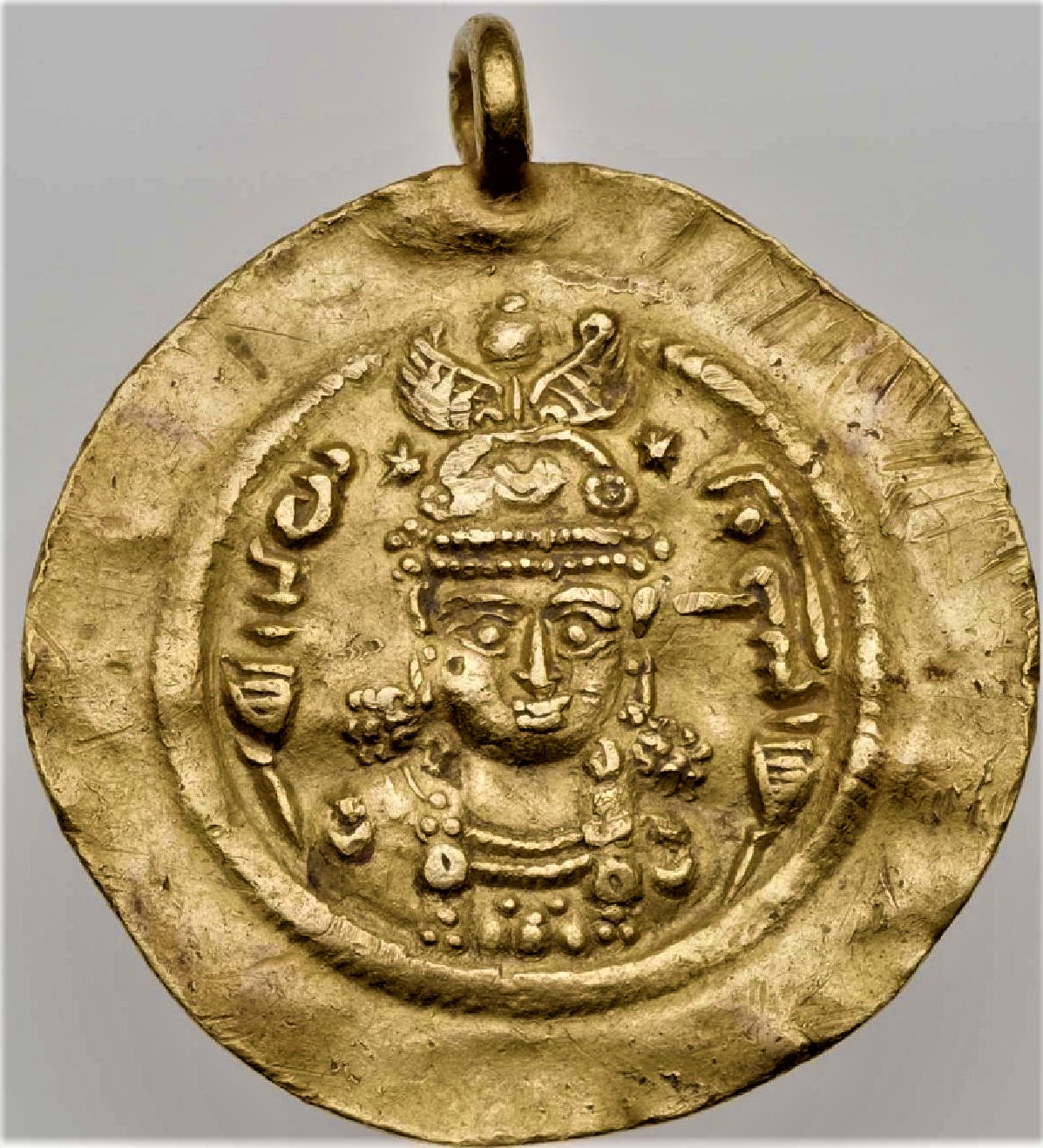
The Arabic histories present her short reign kindly. Tabari says that she ruled justly, rebuilt bridges, remitted taxes still owed and wrote to the nobles promising to govern well. She sent an embassy to Heraclius and confirmed the peace. Her coins, which show her crowned portrait, are among the very few Sasanian coins with a woman’s face; some carry the legend that she restored the race of the gods. Within about a year she was deposed.
Queen Azarmidokht and the vengeance of Rostam
For a short time Boran was followed by Shapur, a son of Shahrbaraz, and then by her sister Azarmidokht, who was put on the throne by Piruz Khosrow and the Parsig faction. Farrukh Hormizd, hoping to rule through her, asked to marry the new queen. According to the story preserved by Tabari, she pretended to agree, invited him to the palace at night and had him killed.
His son Rostam Farrokhzad, commander in Khorasan, marched on Ctesiphon to avenge him, took the city and had Azarmidokht blinded and killed. Rostam restored Boran as queen and became her chief minister. Her second reign ended in 632, when she was killed in a revolt, probably at the instigation of Piruz Khosrow. Rostam later commanded the Persian army against the Arabs; see Rostam Farrokhzad.
Too many kings
Between these better-known reigns, coins and king-lists name other rulers: Peroz II, Hormizd VI, Khosrow III, Khosrow IV and Farrukhzad Khosrow, some reigning for weeks, some only in one province. Arabic and Persian sources disagree on their order and even their existence. Some were probably local claimants backed by one faction while a rival ruled in Ctesiphon. Coins struck in different mints show that the empire was in places split between rival kings at the same moment.
Parsig and Pahlav
Why did the empire tear itself apart? Older historians blamed the exhaustion of the Byzantine war and the weakness of the surviving princes. The historian Parvaneh Pourshariati has argued that the deeper cause was a struggle between two noble blocs: the Parsig, families based in Fars and the south-west who were closely tied to the crown, and the Pahlav, the great Parthian-descended houses of the north and east, such as the family of Farrukh Hormizd and Rostam. In her view, the Sasanian state had always depended on an alliance between the crown and these Parthian families, and the alliance broke down after 628. Not all historians accept every part of this argument, but most agree that factional conflict, not only foreign war, made the Sasanian collapse so quick.
The crowning of Yazdegerd III
In 632 Rostam and Piruz Khosrow settled their differences long enough to agree on a new king: Yazdegerd, a young grandson of Khosrow II, who had been kept hidden at Istakhr in Fars. His accession ended the civil war. It came too late. Arab forces had already begun raiding the lower Euphrates in 633, and the empire that faced them was short of money, troops and trust. The story continues with Yazdegerd III, the last Sasanian king, and with why the Sasanian Empire fell.
- Feb 628 Coup against Khosrow II; Kavad II king
- Sept 628 Kavad II dies of plague; Ardashir III king
- Apr 630 Shahrbaraz seizes Ctesiphon, rules about forty days
- 630 Boran queen, first reign
- c. 630–631 Azarmidokht queen; Farrukh Hormizd killed
- 631 Rostam takes Ctesiphon; Boran restored
- 632 Boran killed; Yazdegerd III crowned
Persian words from this page
| پوراندخت | Purândokht | Boran |
| آزرمیدخت | Âzarmidokht | Azarmidokht |
| دخت | dokht | daughter (in names) |
| رستم فرخزاد | Rostam Farrokhzâd | Rostam Farrokhzad |
| ملکه | malake | queen |
| طاعون | tâ’un | plague |
Sources and further reading
- al-Tabari, The History of al-Tabari, vol. 5, trans. C. E. Bosworth (SUNY Press, 1999).
- Parvaneh Pourshariati, Decline and Fall of the Sasanian Empire: The Sasanian-Parthian Confederacy and the Arab Conquest of Iran (I.B. Tauris, 2008).
- Touraj Daryaee, Sasanian Persia: The Rise and Fall of an Empire (I.B. Tauris, 2009).
- “Boran”, Encyclopaedia Iranica.
- “Sasanian Dynasty”, Encyclopaedia Iranica, iranicaonline.org.
Want to learn Persian? Get the free Starter Pack
Get the 14-page printable Starter Pack (all 32 letters, a 7-day reading plan, 100 core words and 20 survival phrases) and a short 5-email course. Free.
More in The Sasanian Empire (224–651 CE)
- The Origins of the Sasanian Family
- Ardashir I, Founder of the Sasanian Empire
- Firuzabad: Ardashir’s Round City
- Shapur I, King of Kings of Iran and Non-Iran
- Bishapur: Shapur’s City
- The Battle of Edessa and the Capture of Valerian
- The Ka’ba-ye Zartosht Inscription of Shapur I
- Mani and Manichaeism
- Hormizd I and Bahram I
- Kartir and the Zoroastrian Church
- Bahram II
- Narseh and the Peace of Nisibis
- Shapur II the Great
- Julian’s Invasion of Persia (363)
- Christians in the Sasanian Empire
- Shapur III and the Partition of Armenia
- Yazdegerd I
- Bahram V Gur
- Yazdegerd II
- The Battle of Avarayr (451)
- The Hephthalites and Iran’s Eastern Frontier
- Peroz I and the Hephthalite Disaster
- Kavad I
- Zamasp and Kavad’s Return
- Mazdak and the Mazdakite Movement
- Khosrow I Anushirvan the Just
- The Sasanian–Byzantine Wars of the 6th Century
- The Battle of Dara (530)
- Khosrow I Sacks Antioch (540)
- The Lazic War (541–562)
- The Reforms of Khosrow I
- The Academy of Gondishapur: History and Legend
- Borzuya, Chess and Kalila wa Dimna
- Taq Kasra: The Arch of Ctesiphon
- The Sasanian Conquest of Yemen
- The Sasanians and the Western Turks
- Hormizd IV
- Bahram Chobin’s Rebellion
- Khosrow II Parviz
- The Last Great War: Byzantium and Persia, 602–628
- The Siege of Constantinople (626)
- Heraclius Strikes Back
- Shirin: Queen and Legend
- Shahrbaraz, the General Who Became King
- Civil War and the Queens Boran and Azarmidokht
- Yazdegerd III, the Last Sasanian King
- The Sasanian Army
- Sasanian Society and the Class System
- Zoroastrianism under the Sasanians
- Sasanian Art: Silver, Reliefs and Silk
- The Sasanian Reliefs of Naqsh-e Rostam
- Taq-e Bostan
- Sasanian Cities, Palaces and Bridges
- Middle Persian (Pahlavi) Language and Literature
- Sasanian Coins and Silverwork
- Women in the Sasanian Empire
- Polo, Hunting and Games at the Sasanian Court
- The Sasanian Legacy