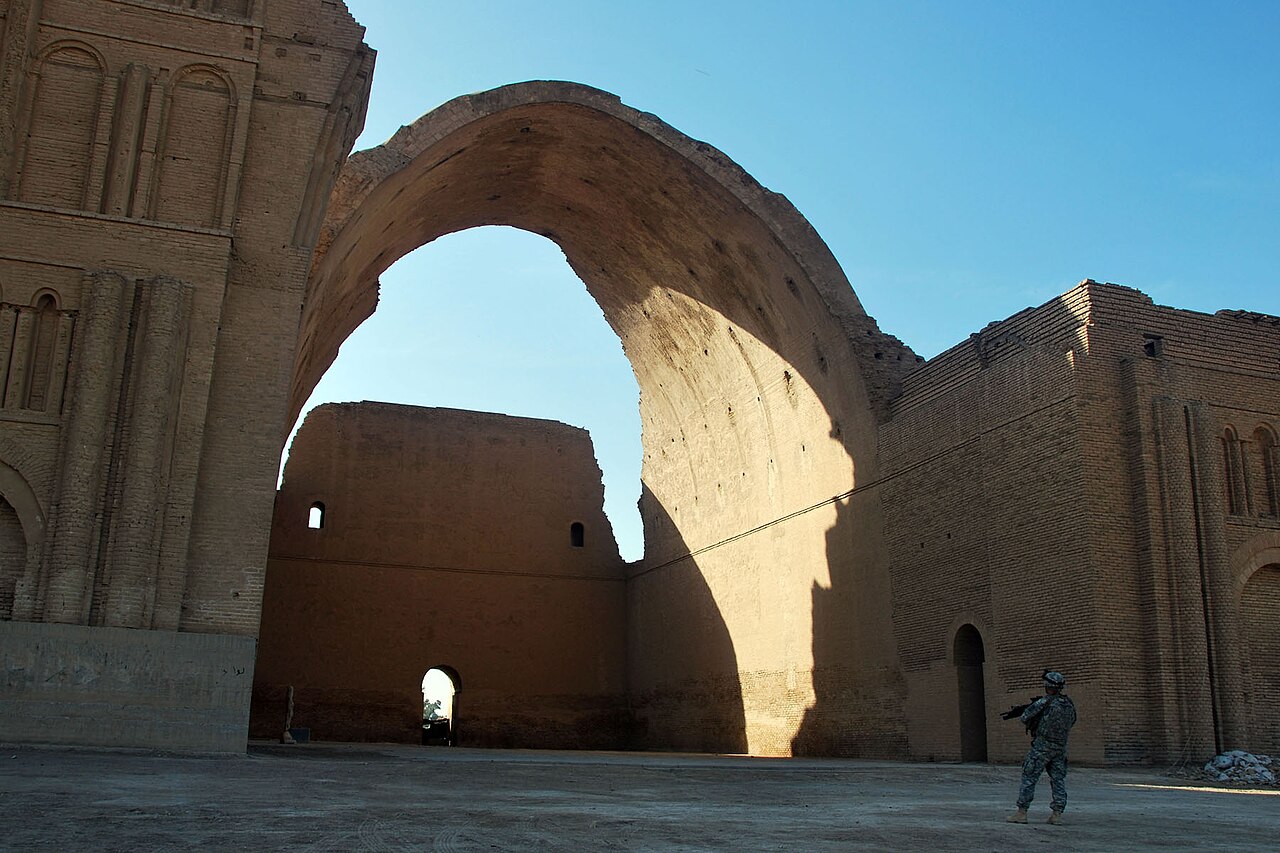
Taq Kasra, “the Arch of Khosrow”, is the ruined throne hall of the Sasanian kings at Ctesiphon, on the Tigris south of modern Baghdad. Its great brick vault, about 25 metres wide and some 35 metres high, is the largest surviving vault of its kind from the ancient world. It is usually dated to the reign of Khosrow I in the 6th century CE, although the date is still debated, and it became the most famous symbol of fallen Persian power in Arabic and Persian poetry.
| Persian names | Taq-e Kasra; Ayvan-e Kasra, “the Iwan of Khosrow”; Ayvan-e Mada’en |
|---|---|
| Location | Ctesiphon, near Salman Pak, Iraq, on the east bank of the Tigris |
| Date | Most often attributed to Khosrow I (531–579); Shapur I (3rd century) and Khosrow II have also been proposed |
| Size | Hall about 25.5 m wide and 43.5 m deep (Encyclopaedia Iranica); vault roughly 35–37 m high |
| Material | Fired brick laid in gypsum mortar |
| Condition | About a third of the ruin fell in a flood in 1888; further collapse in 2019 |

The capital on the Tigris
Ctesiphon was the winter capital of the Parthian kings and became the main seat of the Sasanians. By late Sasanian times it was a cluster of towns on both banks of the Tigris, which the Arabs later called al-Mada’in, “the cities”. Here stood the royal palaces, the treasury, and the hall in which the king of kings received ambassadors, nobles and subjects. The great iwan, a vaulted hall closed on three sides and open at the front, faced east across a courtyard. Behind it lay further halls and rooms, now mostly reduced to mounds.
Who built it, and when
The building carries no inscription, and the written sources disagree. The 10th-century historian Hamza al-Isfahani reported that it was built by Shapur I, a view the archaeologist Ernst Herzfeld favoured, but himself preferred Khosrow II. Other sources name Khosrow I, and the Arabic name, the Arch of Kisra, links it to a Khosrow without saying which. Most recent scholars, including the excavators Oscar Reuther and Giorgio Gullini, have argued for the 6th century on the style of the façade. Edward Keall, in the Encyclopaedia Iranica, concludes that the evidence is largely circumstantial and that the date remains uncertain.
A popular story says the hall was built with the labour or the booty from Khosrow I’s sack of Antioch in 540. It fits the attribution to Khosrow I but rests on no direct evidence.
How the vault was built
The hall is roofed by a single parabolic vault of fired brick. Its side walls are about 7 metres thick at the base and narrow as they rise. The Sasanian builders reduced the span a little by stepping the brick courses inward below the springing of the vault. In the upper part they laid the bricks on edge and leaning slightly backwards against the courses already set, so that each ring of brick held itself up while the mortar dried. This technique, long known in Mesopotamia and Iran, meant that the vault could be built without wooden centring, a great advantage in a country with little timber. The arch itself is about 1.8 metres thick at the base and 1.3 metres at the crown.
The façade, which once stretched for some 46 metres on either side of the arch, was covered with six tiers of blind arcades, engaged columns and niches. It may have been plastered and painted. The design has roots in earlier Parthian architecture, for example at Ashur on the Tigris.
The hall in its glory
Arabic and Persian writers describe the hall as it was in the 7th century: a throne beneath a crown so heavy that it hung from the vault on a chain, curtains closing off the king from his audience, and a great garden carpet woven with gold, silver and jewels that showed the spring in flower even in winter. After the Arab armies took Ctesiphon in 637, the carpet was cut up and divided among the victors (see The Fall of Ctesiphon). Al-Tabari says that the Arab commander Sa’d ibn Abi Waqqas prayed in the iwan, which served for a time as a mosque.
A ruin that would not fall
The caliphs who built Baghdad nearby looked at the ruins as a source of building material. Al-Tabari tells that the caliph al-Mansur, in the 760s, considered pulling the hall down to reuse its bricks, and that his minister Khalid ibn Barmak, of the Persian Barmakid family, advised against it. The ruins around the hall were quarried for centuries, but the arch survived.
A mirror of warning
For poets the arch became a lesson in the passing of power. The 9th-century Arab poet al-Buhturi wrote a celebrated ode on his visit to the ruins. In the 12th century the Persian poet Khaqani stood before it on his way to Mecca and wrote his qasida on the “Iwan of Mada’in”, which every educated Iranian knows. It opens:
هان ای دل عبرتبین از دیده عبر کن هان / ایوان مدائن را آیینه عبرت دان
“Look, O heart that learns from warnings, look with your eyes and learn: know the Iwan of Mada’in as a mirror of warning.”
Collapse and restoration
Travellers’ drawings and photographs from the 19th century show the arch with both wings of the façade standing. In 1888 a flood brought down about a third of the ruin, including the northern wing; the French archaeologist Marcel Dieulafoy’s photographs, published shortly before, record its earlier state. A German expedition excavated at Ctesiphon in 1928–1929, and an Italian mission made studies in the 1960s. Iraqi authorities restored the southern wing in the 1970s and began rebuilding the northern wing, work that stopped with the wars after 1980 and 1991.
In recent decades the arch has suffered from neglect, weather and the conflicts in Iraq. Part of the structure collapsed in 2019, prompting new conservation work. It remains one of the most visited monuments of pre-Islamic Iraq, and a place of special meaning for Iranian visitors. The nearby town takes its name from Salman Pak, the shrine of Salman the Persian.
For other Sasanian buildings, see Sasanian Cities, Palaces and Bridges and A History of Persian Architecture.
Persian words from this page
| طاق کسری | Tâgh-e Kasrâ | Arch of Khosrow |
| ایوان | eyvân | iwan, vaulted hall |
| مدائن | Madâen | al-Mada’in, Ctesiphon |
| تیسفون | Tisfun | Ctesiphon |
| آجر | âjor | fired brick |
| عبرت | ebrat | warning, lesson |
| خاقانی | Khâghâni | Khaqani |
Sources and further reading
- Edward J. Keall, “Ayvān-e Kesrā”, Encyclopaedia Iranica (1987).
- Al-Tabari, The History of al-Tabari, vol. XIII: The Conquest of Iraq, Southwestern Persia, and Egypt, trans. G. H. A. Juynboll (SUNY Press, 1989).
- Oscar Reuther, “The German Excavations at Ctesiphon”, Antiquity 3 (1929).
- Khaqani Shervani, Divan, the qasida “Ayvan-e Mada’en”.
- Matthew P. Canepa, The Iranian Expanse: Transforming Royal Identity through Architecture, Landscape, and the Built Environment, 550 BCE–642 CE (University of California Press, 2018).
Want to learn Persian? Get the free Starter Pack
Get the 14-page printable Starter Pack (all 32 letters, a 7-day reading plan, 100 core words and 20 survival phrases) and a short 5-email course. Free.
More in The Sasanian Empire (224–651 CE)
- The Origins of the Sasanian Family
- Ardashir I, Founder of the Sasanian Empire
- Firuzabad: Ardashir’s Round City
- Shapur I, King of Kings of Iran and Non-Iran
- Bishapur: Shapur’s City
- The Battle of Edessa and the Capture of Valerian
- The Ka’ba-ye Zartosht Inscription of Shapur I
- Mani and Manichaeism
- Hormizd I and Bahram I
- Kartir and the Zoroastrian Church
- Bahram II
- Narseh and the Peace of Nisibis
- Shapur II the Great
- Julian’s Invasion of Persia (363)
- Christians in the Sasanian Empire
- Shapur III and the Partition of Armenia
- Yazdegerd I
- Bahram V Gur
- Yazdegerd II
- The Battle of Avarayr (451)
- The Hephthalites and Iran’s Eastern Frontier
- Peroz I and the Hephthalite Disaster
- Kavad I
- Zamasp and Kavad’s Return
- Mazdak and the Mazdakite Movement
- Khosrow I Anushirvan the Just
- The Sasanian–Byzantine Wars of the 6th Century
- The Battle of Dara (530)
- Khosrow I Sacks Antioch (540)
- The Lazic War (541–562)
- The Reforms of Khosrow I
- The Academy of Gondishapur: History and Legend
- Borzuya, Chess and Kalila wa Dimna
- Taq Kasra: The Arch of Ctesiphon
- The Sasanian Conquest of Yemen
- The Sasanians and the Western Turks
- Hormizd IV
- Bahram Chobin’s Rebellion
- Khosrow II Parviz
- The Last Great War: Byzantium and Persia, 602–628
- The Siege of Constantinople (626)
- Heraclius Strikes Back
- Shirin: Queen and Legend
- Shahrbaraz, the General Who Became King
- Civil War and the Queens Boran and Azarmidokht
- Yazdegerd III, the Last Sasanian King
- The Sasanian Army
- Sasanian Society and the Class System
- Zoroastrianism under the Sasanians
- Sasanian Art: Silver, Reliefs and Silk
- The Sasanian Reliefs of Naqsh-e Rostam
- Taq-e Bostan
- Sasanian Cities, Palaces and Bridges
- Middle Persian (Pahlavi) Language and Literature
- Sasanian Coins and Silverwork
- Women in the Sasanian Empire
- Polo, Hunting and Games at the Sasanian Court
- The Sasanian Legacy