Iran and India share a linguistic ancestry, a long land frontier in the east and more than two thousand years of conquest, trade and migration. Persian was the language of government and high culture across much of the Indian subcontinent for about six centuries, until the British replaced it in 1837, and India gave Iran chess, the fables of Kalila wa Dimna and a home for the Zoroastrian Parsis.
| Shared roots | Avestan and Vedic Sanskrit, sister languages of the Indo-Iranian branch |
|---|---|
| First political link | Achaemenid satrapy of Hindush in the Indus valley, late 6th century BCE |
| Persian in India | Court and administrative language from the Ghaznavids to 1837 |
| Migrant communities | Parsis (from c. 8th to 10th century), later Iranis (19th to 20th century) |
| Modern project | Chabahar port on the Gulf of Oman |
Cousins in language and religion
The oldest layer of the relationship is kinship rather than contact. The language of the Avesta and the Sanskrit of the Rigveda are so close that whole verses can be converted from one to the other by sound rules, and both peoples called themselves Arya. Gods and ideas overlap, sometimes inverted: the Indian devas are gods, while in Zoroastrian texts the daevas are demons. How and when the two groups separated is discussed in the arrival of the Iranian peoples and Zoroaster and the Avesta.
Empires on the Indus
Darius I added the Indus lands to the Achaemenid empire around 518 BCE, and Hindush appears in his inscriptions as a subject land; Herodotus says the Indians paid the largest tribute of any people, 360 talents of gold dust (Book 3). The episode is told in the Achaemenid conquest of the Indus. The Kharosthi script used in north-west India for centuries was derived from Aramaic, the chancery script of the Persian empire.
In the following centuries the border zone of Afghanistan and the Punjab was ruled by peoples with strong Iranian ties, among them the Indo-Parthian king Gondophares, whom Christian legend links with the apostle Thomas, and the Kushans, whose coins carry Iranian gods. See the Kushans and Indo-Parthians.

What India gave Sasanian Iran
Under Khosrow I in the 6th century, Indian learning arrived at the Persian court. The physician Burzoe is said to have brought back the Panchatantra, translated into Middle Persian as Kalila wa Dimna; it later passed through Arabic into dozens of languages (see Burzoe and Kalila wa Dimna). A Middle Persian text describes how an Indian king sent the game of chess to Khosrow as a challenge, and how the Persian sage Wuzurgmihr answered by inventing backgammon. Indian astronomy and medicine also reached Gondishapur.
The Parsis
After the Arab conquest some Zoroastrians left Iran by sea. According to the Qissa-i Sanjan, a Persian poem written in 1599, a group landed at Sanjan in Gujarat and was allowed to settle by a local Hindu ruler. The date of the landing is uncertain, with estimates from the 8th to the 10th century. Their descendants, the Parsis, became prominent in Bombay under British rule as shipbuilders, merchants and industrialists. A second wave of Zoroastrian migrants from Yazd and Kerman in the 19th and early 20th centuries are called Iranis. Their story is part of Zoroastrians after the conquest and Zoroastrianism through the ages.
Persian becomes India’s language of power
The Turkic dynasties that ruled eastern Iran carried Persian into India. Mahmud of Ghazni raided northern India repeatedly in the early 11th century, sacking the temple at Somnath in 1025, and his scholar al-Biruni learned Sanskrit and wrote a famous description of Indian religion, science and society. The Delhi Sultanate, founded in 1206, ran its affairs in Persian, and the poet Amir Khusrau (1253 to 1325) of Delhi wrote Persian verse admired in Iran itself.
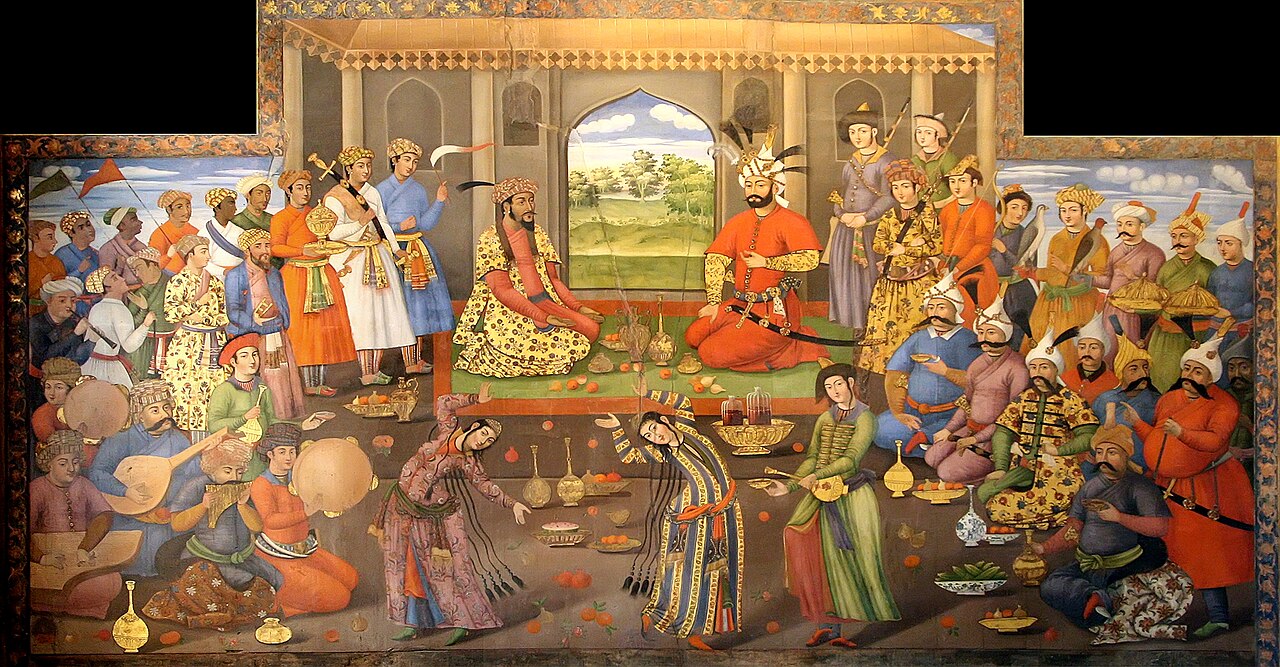
The Mughals made the link closest. When the emperor Humayun lost his throne, he took refuge with Shah Tahmasp I in 1544 and returned to India with Persian troops and Persian painters, who helped found Mughal painting (see Humayun in Persia). Under Akbar, Persian became the language of the whole administration. Iranian poets, officials, physicians and soldiers sought careers at the richer Mughal and Deccan courts, and the style of Persian poetry written in India, the “Indian style” (سبک هندی), became the dominant fashion in Persian literature for two centuries. The two empires also fought over Kandahar, which changed hands several times (see the Safavid-Mughal contest for Kandahar).
The balance turned violent in 1739, when Nader Shah defeated the Mughal army at Karnal and sacked Delhi, carrying off the Peacock Throne and the Koh-i-Noor diamond (see the sack of Delhi).
British India and the end of Persian as an official language
The East India Company at first kept Persian for its courts and diplomacy. In 1837 it replaced Persian with English and local languages, and the long official career of Persian in India ended. It survived in literature: Mirza Ghalib wrote much of his poetry in Persian, and Muhammad Iqbal of Lahore (1877 to 1938) wrote most of his in Persian and is honoured in Iran as Iqbal-e Lahouri. Hindi and Urdu still carry thousands of Persian words, from dost (friend) to bazaar.
British India also shaped Iran’s eastern frontier: the boundary with Baluchistan and the arbitration over Sistan were drawn by officers from India (see how Iran’s borders changed).
Since independence
Iran and India signed a treaty of friendship in 1950. Relations were cool during the Cold War, when Iran leaned towards the United States and Pakistan, and warmer after the 1990s, when both opposed the Taliban in Afghanistan. India became a major buyer of Iranian oil, though it cut purchases in 2019 under US sanctions. The main joint project is the port of Chabahar, which India has helped develop as a route to Afghanistan and Central Asia that avoids Pakistan; a ten-year operating contract was signed in May 2024. India also has one of the world’s largest Shi’a populations, with old religious ties to Qom and Mashhad.
Persian words from this page
| هند | Hend | India |
| پارسی | Pârsi | Persian; Parsi |
| شطرنج | shatranj | chess |
| کلیله و دمنه | Kelile va Demne | Kalila wa Dimna |
| سبک هندی | sabk-e hendi | the “Indian style” of poetry |
| دوست | dust | friend |
Sources and further reading
- Herodotus, Histories, Book 3 (the tribute list).
- Encyclopaedia Iranica, “India: Relations with Persia” and “Parsi communities”.
- Muzaffar Alam, “The Pursuit of Persian: Language in Mughal Politics”, Modern Asian Studies 32 (1998).
- Nile Green (ed.), The Persianate World: The Frontiers of a Eurasian Lingua Franca (2019).
- Al-Biruni, Kitab fi tahqiq ma li-l-Hind (India), trans. E. Sachau.
- Mary Boyce, Zoroastrians: Their Religious Beliefs and Practices.
Want to learn Persian? Get the free Starter Pack
Get the 14-page printable Starter Pack (all 32 letters, a 7-day reading plan, 100 core words and 20 survival phrases) and a short 5-email course. Free.
More in Themes Across Iranian History (3000 BCE–today)
- A History of the Persian Language
- Zoroastrianism through the Ages
- Shi’a Islam in Iranian History
- The Jews of Iran
- The Armenians of Iran
- Christians of Iran
- The Baha’i Faith in Iran
- The Kurds in Iranian History
- Azerbaijanis in Iranian History
- The History of the Iranian Calendar
- Nowruz through History
- The Persian Garden (Pardis) through History
- Qanats: Iran’s Ancient Water Tunnels
- A History of Persian Carpets
- A History of Persian Architecture
- A History of Persian Painting
- A History of Persian Music
- Science in Iranian History
- Women in Iranian History
- Iran and the Silk Road
- Iran and China through History
- Iran and India through History
- Iran and Greece: Perceptions and Exchanges
- Persia and Rome: Seven Centuries of Rivalry
- Iran and the Ottoman Empire
- Iran and Russia through History
- Iran and Britain through History
- Iran and the United States
- How Iran’s Borders Changed
- The Capitals of Iran through History
- Coins of Iran through History: From the Daric to the Rial
- Flags and Symbols of Iran through History
- Myth and History in the Shahnameh: The Epic’s Kings and the Real Past
- Timeline of Iranian History: Key Dates from Elam to Today
- A History of Persian Cuisine: From Royal Banquets to Chelow Kabab
- A History of Persian Poetry: From Rudaki to Forough
- Wine in Iranian History: From Hajji Firuz to Hafez and Prohibition
- Sports in Iranian History: Polo, the Zurkhaneh and Wrestling
- List of Iranian Dynasties and Rulers