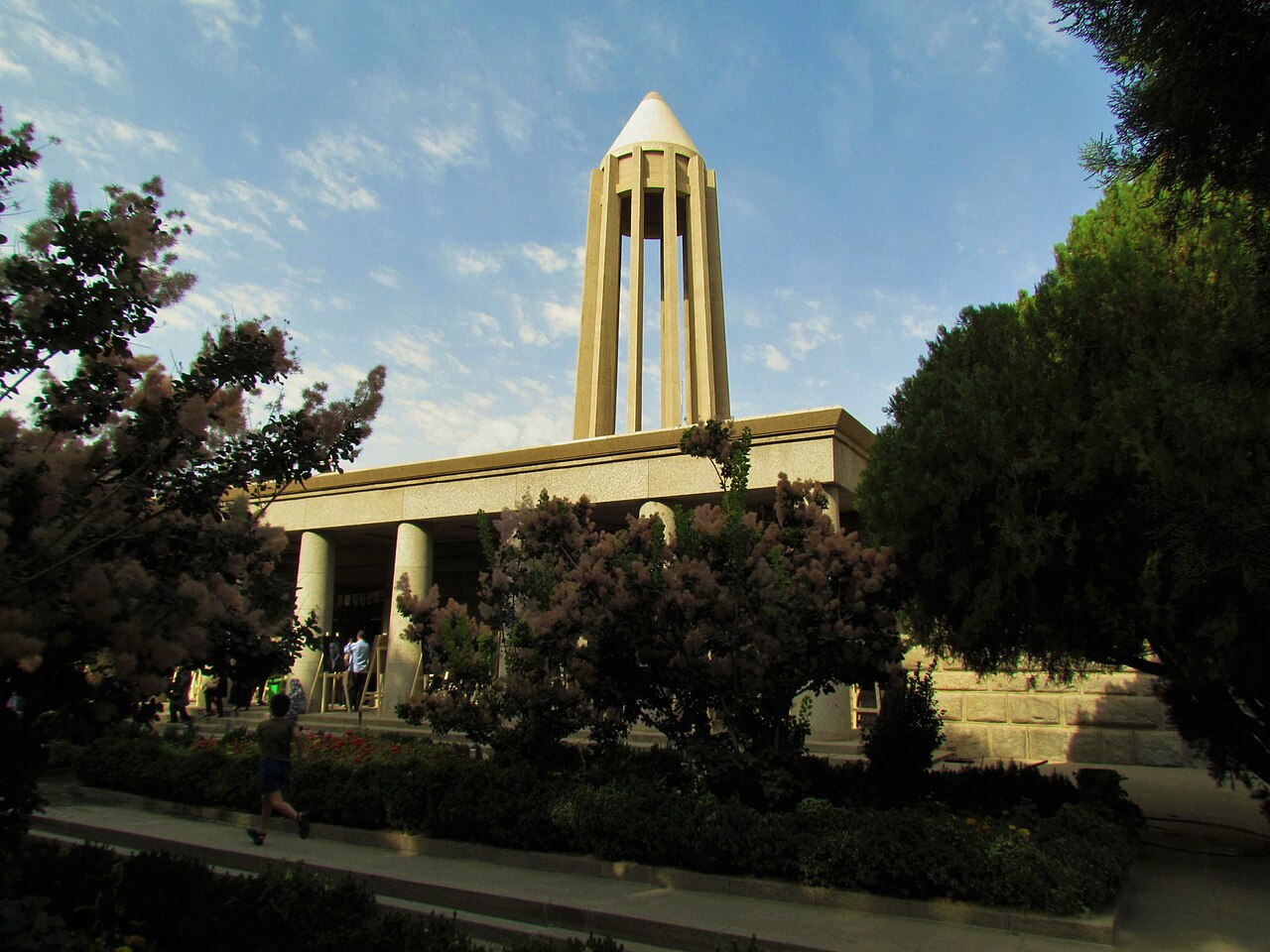
The Tomb of Avicenna (آرامگاه بوعلی سینا, Ârâmgâh-e Bu-Ali Sinâ) in Hamadan is the burial place of the philosopher and physician Ibn Sina, who died in the city in 1037. Its slender 28-metre stone tower, designed by Houshang Seyhoun and opened in 1954 for the thousandth anniversary of Avicenna’s birth, is modelled on the 11th-century tower of Gonbad-e Qabus, and the complex also holds a small museum and a library.
| Who is buried here | Abu Ali al-Husayn ibn Sina (Avicenna), c. 980–1037 |
|---|---|
| Location | Bu-Ali Sina Square, central Hamadan |
| Architect | Houshang Seyhoun |
| Opened | Spring 1954, for the millenary of Avicenna’s birth (by the lunar Islamic calendar) |
| Inside | Tomb chamber, museum of local archaeology, library |

Why Avicenna is buried in Hamadan
Avicenna was born near Bukhara, in Central Asia, and spent his life moving between the courts of Iranian rulers. His last decades were divided between Hamadan, where he served the Buyid emir Shams al-Dawla as physician and vizier, and Isfahan. He fell ill on campaign and died in Hamadan in 1037, aged about 57. His life, his Canon of Medicine and his philosophy are covered on our history page on Avicenna (Ibn Sina).
Local tradition holds that he was buried at the house of a friend, Abu Sa’id Dakhuk, whose own grave lies beside his. For centuries the place was marked by a modest tomb; in the Qajar period a small domed building was put up over it, said to have been paid for by a granddaughter of Fath-Ali Shah.
A modern tomb for a medieval scholar
In the 1940s the Society for National Heritage, which had already built the Tomb of Ferdowsi, decided to give Avicenna a monument for his millenary. Houshang Seyhoun, then a young architect, won the competition; he had developed the project as his diploma work at the École des Beaux-Arts in Paris. The Qajar building was taken down and the new tomb was opened in 1954 in the presence of Mohammad Reza Shah, with scholars from many countries in Hamadan for the celebrations.
Seyhoun chose a source from Avicenna’s own century. The tower copies the profile of Gonbad-e Qabus, the brick tomb tower built in 1006–1007 for the Ziyarid ruler Qabus, whom Avicenna had once hoped to serve. Instead of a solid shaft, Seyhoun’s tower is formed by twelve concrete fins faced in grey granite from nearby Mount Alvand, open to the sky.
Seyhoun gave the numbers a meaning. According to his own account, the twelve fins stand for the twelve branches of knowledge Avicenna mastered, and the ten columns of the entrance porch for the ten centuries between his life and the building of the tomb.
After 1979 several Pahlavi-era monuments were criticised for their royal associations, but Avicenna was admired across the political spectrum, and his tomb and the square around it kept their name.
What to see
- The tower and porch: walk around the outside first. The tower looks very different from the side and from below, where the fins open into a star-shaped crown.
- The tomb chamber: under the tower, plain stone markers cover the graves of Avicenna and Abu Sa’id Dakhuk. Verses and inscriptions in Persian and Arabic run around the walls.
- The museum: the southern hall holds coins, pottery, bronzes and other finds from the Hamadan region, from prehistoric times to the Islamic period. Hamadan is ancient Ecbatana, so the collection has real depth; see Ecbatana: Capital of the Medes.
- The library: the northern hall has a library of several thousand printed books and manuscripts, with a display on Avicenna’s works and on writers from Hamadan.
- The garden: the tomb sits on a broad granite platform in a garden with pools, a quiet place in a busy part of the city.
Practical notes
- Getting there: the tomb is in the centre of Hamadan and easy to reach on foot or by taxi. Combine it with the Ganjnameh inscriptions on Mount Alvand and the Hegmataneh hill.
- Time needed: an hour is enough for the tomb and museum.
- Dates: 23 August (1 Shahrivar) is marked in Iran as Avicenna Day and Physicians’ Day, and events are held at the tomb.
- Tickets and hours: check current official information.
- Safety: follow your own government’s travel advice for Iran.
For more about the city, see our guide to Hamadan.
Persian words from this page
| ابن سینا | Ebn-e Sinâ | Avicenna |
| بوعلی | Bu-Ali | Avicenna’s popular name in Iran |
| همدان | Hamedân | Hamadan |
| پزشک | pezeshk | physician |
| فیلسوف | filsuf | philosopher |
| برج | borj | tower |
Sources and further reading
- Encyclopaedia Iranica, “AVICENNA i. Introductory note” and the following sections on his life and works.
- Encyclopaedia Iranica, “HAMADĀN i. Geography“.
- Talinn Grigor, Building Iran: Modernism, Architecture, and National Heritage under the Pahlavi Monarchs (Periscope, 2009), on Seyhoun and the Avicenna millenary.
- William E. Gohlman (ed. and trans.), The Life of Ibn Sina (SUNY Press, 1974), the autobiography and the account of his death by his pupil Juzjani.
Want to learn Persian? Get the free Starter Pack
Get the 14-page printable Starter Pack (all 32 letters, a 7-day reading plan, 100 core words and 20 survival phrases) and a short 5-email course. Free.
More in Top Places to Visit in Iran
- Naqsh-e Jahan Square
- Shah (Imam) Mosque, Isfahan
- Sheikh Lotfollah Mosque
- Ali Qapu Palace
- Jameh Mosque of Isfahan
- Si-o-se Pol and Khaju Bridge
- Vank Cathedral
- Hasht Behesht Palace
- Naqsh-e Rostam
- Eram Garden, Shiraz
- Nasir al-Molk (Pink) Mosque
- Tomb of Hafez (Hafezieh)
- Tomb of Saadi (Saadieh)
- Shah Cheragh Shrine
- Arg of Karim Khan
- Fin Garden, Kashan
- Historic Houses of Kashan
- Jameh Mosque of Yazd
- Yazd Fire Temple and Towers of Silence
- Dowlatabad Garden and Windcatcher
- Amir Chakhmaq Complex
- Golestan Palace
- National Museum of Iran
- Treasury of National Jewels
- Tehran Grand Bazaar
- Milad Tower
- Imam Reza Shrine, Mashhad
- Tomb of Ferdowsi, Tus
- Tomb of Omar Khayyam, Neyshabur
- Tomb of Avicenna, Hamadan
- Ganjnameh Inscriptions, Hamadan
- Behistun (Bisotun): Visiting the Site
- Taq-e Bostan: Visiting the Site
- Tabriz Historic Bazaar
- Takht-e Soleyman
- Armenian Monastic Ensembles of Iran
- Sheikh Safi al-Din Shrine, Ardabil
- Dome of Soltaniyeh
- Alamut Castle
- Falak-ol-Aflak Castle
- Shushtar Historical Hydraulic System
- Chogha Zanbil: Visiting the Ziggurat
- Susa Archaeological Site
- Arg-e Bam
- Ganjali Khan Complex, Kerman
- Shazdeh Garden, Mahan
- Rayen Castle
- Dasht-e Lut (Lut Desert)
- Maranjab Desert and Caravanserai
- Varzaneh Desert
- Mount Damavand
- Hyrcanian Forests
- Lake Urmia
- Badab-e Surt Springs
- Ali Sadr Cave
- The Kaluts of Shahdad
- Qeshm Geopark
- Hormuz Island Colours
- Visiting Persepolis: A Day Trip from Shiraz
- Visiting Pasargadae
- Persian Caravanserais
- The Qanat of Gonabad
- Meymand Village
- Sasanian Sites of Fars: Firuzabad, Bishapur and Sarvestan
- Gonbad-e Qabus: Visiting the Tower
- Zayandeh Rud and Isfahan’s Bridges
- Tochal and Darband: Hiking Above Tehran
- Mount Sabalan
- Skiing in Iran: Dizin and Shemshak
- Golestan National Park