Persian poetry in its modern form began in the 9th and 10th centuries in eastern Iran, where poets such as Rudaki wrote for the Samanid court in the newly written New Persian language. Over the next five hundred years Ferdowsi, Khayyam, Nizami, Attar, Rumi, Saadi and Hafez made it one of the great literatures of the world, and it remains part of everyday life in Iran: quoted in conversation, written on tombs and consulted for fortunes.
This page gives the long history in outline, with links to pages on each poet. On a site for Persian learners, poetry is also a way into the language; our Hafez quotes, real Rumi quotes in Persian, Saadi quotes, Khayyam quotes and Ferdowsi quotes give original lines with translations.
Before New Persian
Iranians had poetry long before Islam, but little survives. Parthian minstrels, the gosans, sang tales of kings and heroes, and the love story of Vis and Ramin, retold in the 11th century, goes back to a Parthian original. From the Sasanian period a few Middle Persian poems survive, such as the debate between a goat and a palm tree, Draxt-i Asurig. Its verse rested on stress and syllable count, not the quantitative metres borrowed later from Arabic. See the history of the Persian language.
The Samanid beginnings (9th–10th centuries)
New Persian, written in Arabic script and full of Arabic loanwords, became a literary language at the courts of eastern Iran. The Samanids of Bukhara made it the language of their court, and Rudaki (d. c. 940), blind or blinded in later life, is remembered as the father of Persian poetry. Poets of this age fixed the forms that would last a thousand years: the qasida, a long ode of praise; the ghazal, a short lyric; the masnavi, a long poem in rhyming couplets for narrative; and the robâ’i, a quatrain. Rabe’a of Balkh, of the 10th century, is the first woman poet in Persian whose verses survive. The Samanid renaissance tells this story more fully.
Epic and court: Ferdowsi and the Ghaznavids
Around 1010 Ferdowsi finished the Shahnameh, about 50,000 couplets in the masnavi form, telling the history of Iran from the first king to the Arab conquest with remarkably few Arabic words. At the Ghaznavid court of Mahmud of Ghazni, panegyric poets such as Onsori, Farrokhi and Manuchehri wrote polished qasidas, with nature openings describing spring, wine and gardens before turning to praise of the sultan.
Philosophers, preachers and the Seljuk age (11th–12th centuries)
Poetry widened. Naser Khosrow, an Ismaili missionary, wrote moral and religious qasidas. Baba Taher of Hamadan composed folk-style quatrains in dialect. Omar Khayyam, the mathematician, is credited with robâ’is questioning fate and the afterlife, though how many of the hundreds attributed to him are genuine is a long-running scholarly question. Anvari brought the court qasida to its peak, and Khaqani of Shirvan wrote some of its most difficult masterpieces.
Two new streams began here. Sanai of Ghazni (d. c. 1131) used poetry for Sufi teaching, and his Hadiqat al-Haqiqa is the first of the great mystical masnavis. Nizami Ganjavi (d. c. 1209) perfected the romance; his Khamsa, five long poems including Khosrow and Shirin and Layla and Majnun, was imitated for centuries from Istanbul to Delhi.
The age of the mystics (13th century)
The Mongol invasions did not end Persian poetry; some of its greatest works came in their shadow. Attar of Nishapur wrote the Conference of the Birds, an allegory of the soul’s journey in which thirty birds seek the Simorgh and find themselves. Jalal al-Din Rumi (1207–1273), born in Balkh and settled in Konya, composed the six books of the Masnavi and thousands of ghazals in the Divan-e Shams. (Our article on Rumi’s life looks at why he is so widely read today.)
Saadi of Shiraz returned home after years of travel and in 1257–1258 wrote the Bustan, in verse, and the Golestan, in prose mixed with verse. The Golestan was for centuries the first book every learner of Persian read, and one of its lines is the most quoted in the language:
بنیآدم اعضای یکدیگرند / که در آفرینش ز یک گوهرند
“The children of Adam are limbs of one another, for in their creation they are of one essence.” (Saadi, Golestan, chapter 1)

Hafez and the ghazal (14th century)
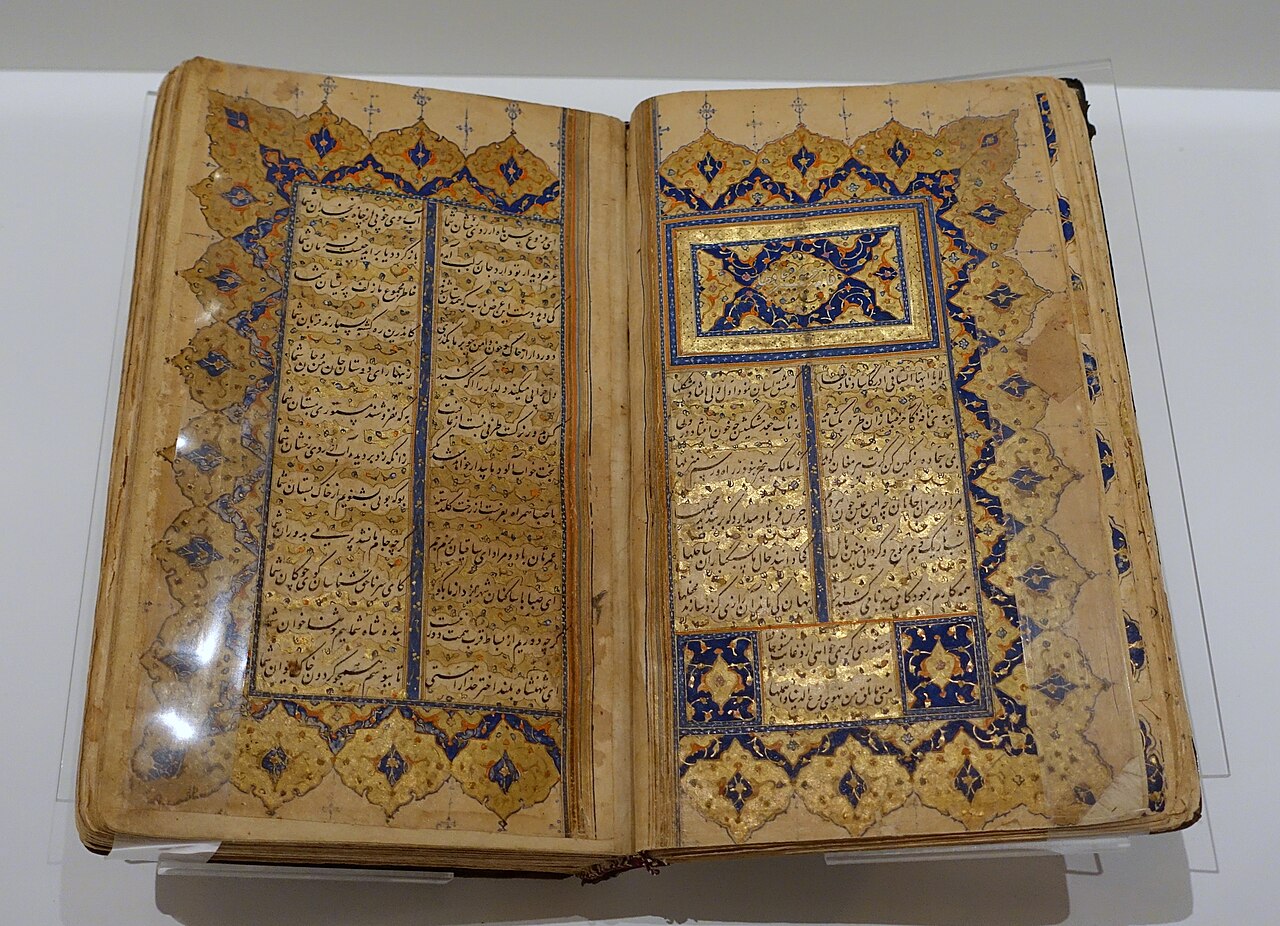
In 14th-century Shiraz, under the Injuids and Muzaffarids, Hafez (d. c. 1390) brought the ghazal to a perfection no one has matched. His roughly five hundred ghazals mix love, wine, mysticism and sharp criticism of religious hypocrisy so closely that readers still argue whether his wine is real or symbolic. His divan is the book Iranians open for an omen, the fal-e Hafez; you can try it with our Hafez fortune tool. His contemporaries included Khwaju of Kerman and the satirist Obeyd Zakani.
Jami, the Indian style and the return (15th–19th centuries)
Jami of Herat (1414–1492) is often called the last classical master. After him the centre of gravity moved east. In the Safavid and Mughal period poets wrote in the Indian style (sabk-e hendi), dense with paradox and complex imagery: Saeb of Tabriz in Isfahan, and Bidel of Delhi, still widely read in Afghanistan and Tajikistan. Persian was the language of culture at the Mughal court (see Iran and India). In 18th- and 19th-century Iran, a movement known as the literary return (bazgasht-e adabi) rejected the Indian style and imitated the older masters; the Qajar court poets Saba and Qa’ani belong to it.
Poetry and revolution (1890s–1920s)
The Constitutional Revolution brought poetry to newspapers and the street. Aref Qazvini wrote patriotic songs; Iraj Mirza mocked veiling and hypocrisy in plain, colloquial verse; Mirzadeh Eshghi wrote political satire and was assassinated in 1924; Mohammad Taqi Bahar, known as Malek al-Shoara, put classical forms to modern politics. Women’s voices grew stronger after Tahirih: Parvin E’tesami (1907–1941) wrote moral debate poems admired by the classical-minded.
New poetry: Nima and after
Nima Yushij (1895–1960) broke with the classical rules on line length and rhyme; his long poem Afsaneh (1922) is usually taken as the start of she’r-e now, “new poetry”. His successors took Persian verse in many directions:
- Ahmad Shamlu (1925–2000) wrote she’r-e sepid, free verse without metre.
- Mehdi Akhavan-Sales (1929–1990) used Nima’s forms for epic and elegy after the 1953 coup.
- Forough Farrokhzad (1934–1967) wrote frankly of a woman’s life and desire.
- Sohrab Sepehri (1928–1980), also a painter, wrote quiet, mystical poems of nature.
- Simin Behbahani (1927–2014) renewed the ghazal with new metres and modern subjects.
Poetry in daily life
Poetry is still lived in Iran. Children learn lines from Ferdowsi and Saadi at school; adults trade verses in a game called moshâ’ere, each answering with a line that begins with the last letter of the one before; on Shab-e Yalda families read Hafez. The tombs of Hafez and Saadi in Shiraz, of Ferdowsi at Tus and of Khayyam at Nishapur are places of pilgrimage. To test yourself, try our Persian poetry quiz.
Persian words from this page
| شعر | she’r | poetry, poem |
| شاعر | shâ’er | poet |
| غزل | ghazal | lyric poem |
| قصیده | qaside | ode |
| مثنوی | masnavi | poem in couplets |
| رباعی | robâ’i | quatrain |
| دیوان | divân | collected poems |
| شعر نو | she’r-e now | new poetry |
Sources and further reading
- Jan Rypka, History of Iranian Literature (1968).
- E. G. Browne, A Literary History of Persia, 4 vols (1902–1924).
- J. T. P. de Bruijn, ed., General Introduction to Persian Literature (A History of Persian Literature, vol. 1, 2009).
- Dick Davis, Faces of Love: Hafez and the Poets of Shiraz (2012).
- Ahmad Karimi-Hakkak, Recasting Persian Poetry: Scenarios of Poetic Modernity in Iran (1995).
- Encyclopaedia Iranica, articles “Ghazal”, “Hafez” and “Rudaki”.
Love Persian poetry? Learn to read it: free Starter Pack
Get the 14-page printable Starter Pack (all 32 letters, a 7-day reading plan, 100 core words and 20 survival phrases) and a short 5-email course. Free.
More in Themes Across Iranian History (3000 BCE–today)
- A History of the Persian Language
- Zoroastrianism through the Ages
- Shi’a Islam in Iranian History
- The Jews of Iran
- The Armenians of Iran
- Christians of Iran
- The Baha’i Faith in Iran
- The Kurds in Iranian History
- Azerbaijanis in Iranian History
- The History of the Iranian Calendar
- Nowruz through History
- The Persian Garden (Pardis) through History
- Qanats: Iran’s Ancient Water Tunnels
- A History of Persian Carpets
- A History of Persian Architecture
- A History of Persian Painting
- A History of Persian Music
- Science in Iranian History
- Women in Iranian History
- Iran and the Silk Road
- Iran and China through History
- Iran and India through History
- Iran and Greece: Perceptions and Exchanges
- Persia and Rome: Seven Centuries of Rivalry
- Iran and the Ottoman Empire
- Iran and Russia through History
- Iran and Britain through History
- Iran and the United States
- How Iran’s Borders Changed
- The Capitals of Iran through History
- Coins of Iran through History: From the Daric to the Rial
- Flags and Symbols of Iran through History
- Myth and History in the Shahnameh: The Epic’s Kings and the Real Past
- Timeline of Iranian History: Key Dates from Elam to Today
- A History of Persian Cuisine: From Royal Banquets to Chelow Kabab
- A History of Persian Poetry: From Rudaki to Forough
- Wine in Iranian History: From Hajji Firuz to Hafez and Prohibition
- Sports in Iranian History: Polo, the Zurkhaneh and Wrestling
- List of Iranian Dynasties and Rulers