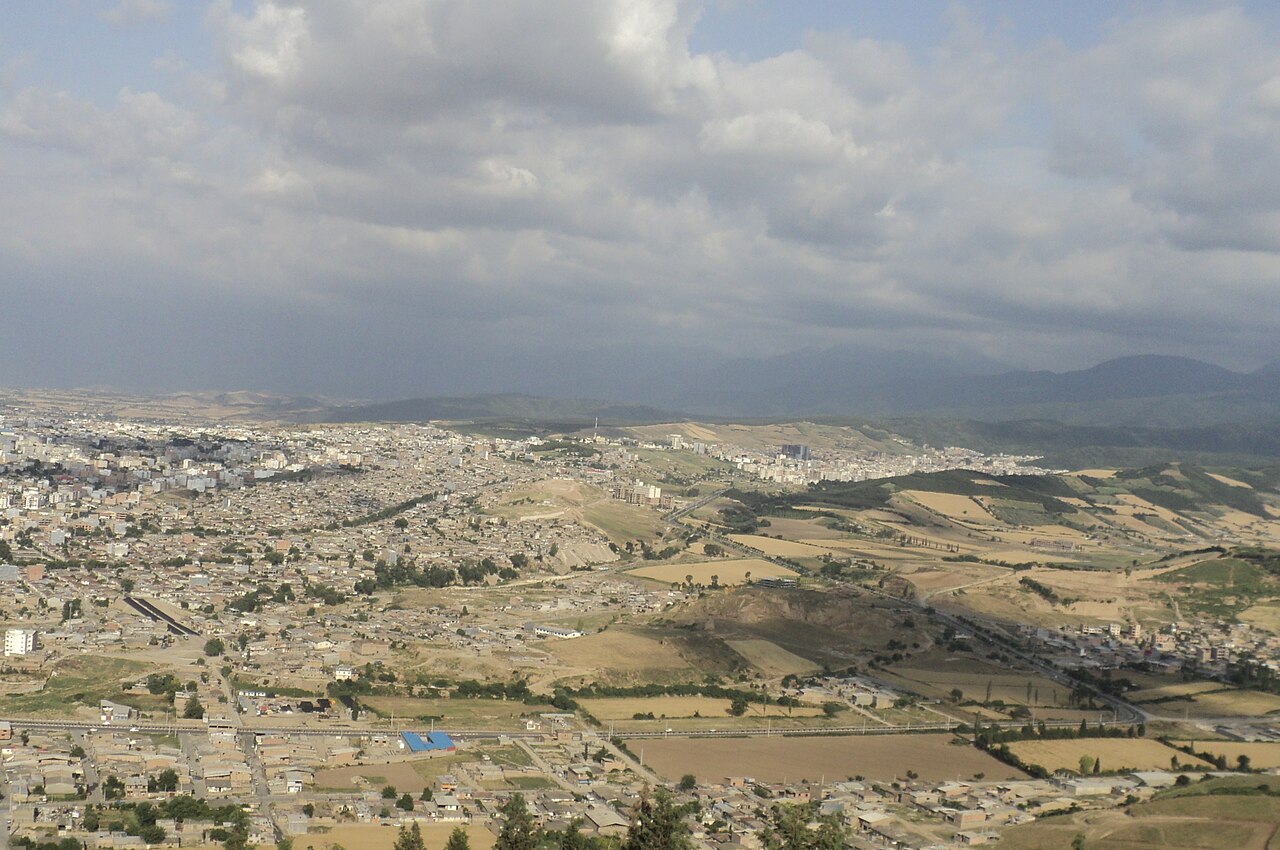
Gorgan is the capital of Golestan province in north-eastern Iran, a city of the Caspian plain lying between the forested Alborz mountains and the Turkmen steppe, about 30 km from the sea. Until 1937 it was called Astarabad, the home town of the Qajar tribe that ruled Iran from 1789 to 1925. The name Gorgan was borrowed from the medieval city of Jurjan, whose ruins lie further east near the famous brick tower of Gonbad-e Qabus.
| Persian name | گرگان (Gorgân) |
|---|---|
| Former name | Astarabad (استرآباد), until 1937 |
| Province | Golestan (capital since the province was formed in 1997) |
| Population | 350,676 (city, 2016 national census) |
| Elevation | about 155 m |

Hyrcania, the land of wolves
The name Gorgan goes back to the Old Persian Varkâna, “land of wolves”, known to the Greeks as Hyrcania. The Achaemenid kings counted it among their provinces, and Greek writers described it as a green, wooded country unlike the dry plateau to the south. Arrian, writing about Alexander’s march, names Zadracarta as the largest town of Hyrcania; where exactly it stood is not known, though some scholars place it near modern Gorgan.
In the Sasanian period the region was the empire’s north-eastern gate against peoples of the steppe. The Sasanians built a great defensive wall, often called the Great Wall of Gorgan or the “Red Snake” for its fired red bricks, running for about 195 km from the Caspian shore inland, with forts along its length. Excavations by Iranian and British archaeologists since the 2000s have dated it to the fifth or sixth century CE.
Medieval Jurjan and the Ziyarids
After the Arab conquest, Jurjan (the Arabic form of Gorgan) became a prosperous city on the Gorgan river. In the tenth and eleventh centuries it was the capital of the Ziyarids, whose most famous ruler, Qabus ibn Voshmgir, built himself a tomb tower in 1006 to 1007. That tower, Gonbad-e Qabus, still stands, 53 m of plain brick, in the town of Gonbad-e Kavus about 90 km north-east of modern Gorgan; it was inscribed by UNESCO in 2012. Visiting details are on our Gonbad-e Qabus site page.
Jurjan was a centre of learning. The poet Fakhr al-Din As’ad Gorgani wrote the romance Vis and Ramin in the eleventh century, and Avicenna spent part of his wandering life in the city. The Mongol invasion of the thirteenth century ruined it, and the regional centre moved west to Astarabad, the town that is now Gorgan.
Astarabad and the Qajars
Astarabad was a frontier town facing the Turkmen tribes of the steppe and the Russian presence on the Caspian. It was also the base of the Qajars, a Turkic tribe settled in the area by the Safavids. Agha Mohammad Khan, founder of the Qajar dynasty, was born in Astarabad in 1742, and his family’s struggle for power started from here and from Mazandaran; see our page on Agha Mohammad Khan Qajar. The Safavid philosopher Mir Damad, one of the founders of the School of Isfahan, was also born in Astarabad.
In 1937, under Reza Shah, the town was renamed Gorgan, reviving the name of the medieval city. When Golestan was split off from Mazandaran as a separate province in 1997, Gorgan became its capital.
The old quarter
Gorgan’s historic core, around the old bazaar and the Jameh Mosque, is different from the mud-brick cities of central Iran. Because the climate is wet, houses are built of brick and timber, with sloping roofs of clay tiles, wooden balconies and deep eaves. Old neighbourhoods such as Meydan and Nalbandan keep a number of these Qajar-era houses, some restored as guest houses and cafés. The mosque has a long history of rebuilding, and its brick minaret is one of the older structures in the city.
Forest, steppe and Turkmen markets
South of the city the land rises quickly into the Hyrcanian forest, the ancient broadleaf woodland of the Caspian slopes that UNESCO listed as a World Heritage site in 2019. Nahar Khoran (ناهارخوران), a forest park on the edge of town, is where local families go on weekends; roads continue up to viewpoints such as Hezarpich hill. The wider forests are described on our page on the Alborz and Caspian forests.
North of Gorgan the forest gives way to open steppe, the Turkmen Sahra, home to Iran’s Turkmen people. Towns such as Gonbad-e Kavus and Bandar-e Torkaman have weekly markets where Turkmen carpets, felt and horses are traded, and Turkmen horse breeding is a strong local tradition. Further east lies Golestan National Park, Iran’s oldest national park. For the wider Caspian region, our blog post on the north of Iran (Shomal) is a good companion read.
Persian words from this page
| گرگان | Gorgân | Gorgan |
| گرگ | gorg | wolf |
| استرآباد | Astarâbâd | Astarabad |
| گنبد | gonbad | dome, tower tomb |
| ترکمن | Torkaman | Turkmen |
| جنگل | jangal | forest |
| گلستان | Golestân | Golestan (“rose garden”) |
Sources and further reading
- Encyclopaedia Iranica, “Gorgan” (history and historical geography).
- Encyclopaedia Iranica, “Astarabad”.
- UNESCO World Heritage List, Gonbad-e Qābus (2012) and Hyrcanian Forests (2019).
- Eberhard Sauer, Hamid Omrani Rekavandi and others, Persia’s Imperial Power in Late Antiquity: The Great Wall of Gorgan and Frontier Landscapes of Sasanian Iran (Oxbow, 2013).
- Arrian, Anabasis of Alexander, Book 3.
Want to learn Persian? Get the free Starter Pack
Get the 14-page printable Starter Pack (all 32 letters, a 7-day reading plan, 100 core words and 20 survival phrases) and a short 5-email course. Free.
More in Cities of Iran
- Tehran: Iran’s Capital
- Mashhad
- Isfahan
- Shiraz
- Tabriz
- Yazd
- Kashan
- Kerman
- Hamadan
- Qom
- Ahvaz
- Rasht
- Kermanshah
- Urmia
- Ardabil
- Zanjan
- Qazvin
- Sanandaj
- Khorramabad
- Bandar Abbas
- Bushehr
- Zahedan
- Birjand
- Gorgan
- Sari
- Semnan
- Arak
- Ilam
- Yasuj
- Shahr-e Kord
- Bojnurd
- Karaj
- Abadan and Khorramshahr
- Kish Island
- Qeshm Island
- Hormuz Island
- Masuleh
- Abyaneh
- Kandovan
- Bam
- Neyshabur (Nishapur)
- Shush (Susa) Today