Gonbad-e Qabus (گنبد قابوس) is a 53-metre brick tomb tower built in 1006–07 for the Ziyarid prince Qabus ibn Voshmgir, and it stands today in a park in the middle of the town of Gonbad-e Kavus in Golestan province. A World Heritage Site since 2012, it is one of the most striking single buildings in Iran: no tilework, no carving beyond two inscription bands, just a plain fluted shaft of brick under a pointed roof.
| Built | 1006–07 CE, for Qabus ibn Voshmgir (ruled 977–981 and 997–1012) |
|---|---|
| Height | About 53 m (UNESCO), on top of an earth mound |
| Plan | Circular shaft with ten triangular flanges, conical brick roof |
| Town | Gonbad-e Kavus, Golestan province, about 90 km north-east of Gorgan |
| UNESCO | Inscribed 2012 |
The story of Qabus, the dating of the tower and its place in architectural history are covered in Gonbad-e Qabus Tower, with the dynasty in The Ziyarids and Qabus ibn Voshmgir. This page is about what you find when you go there.
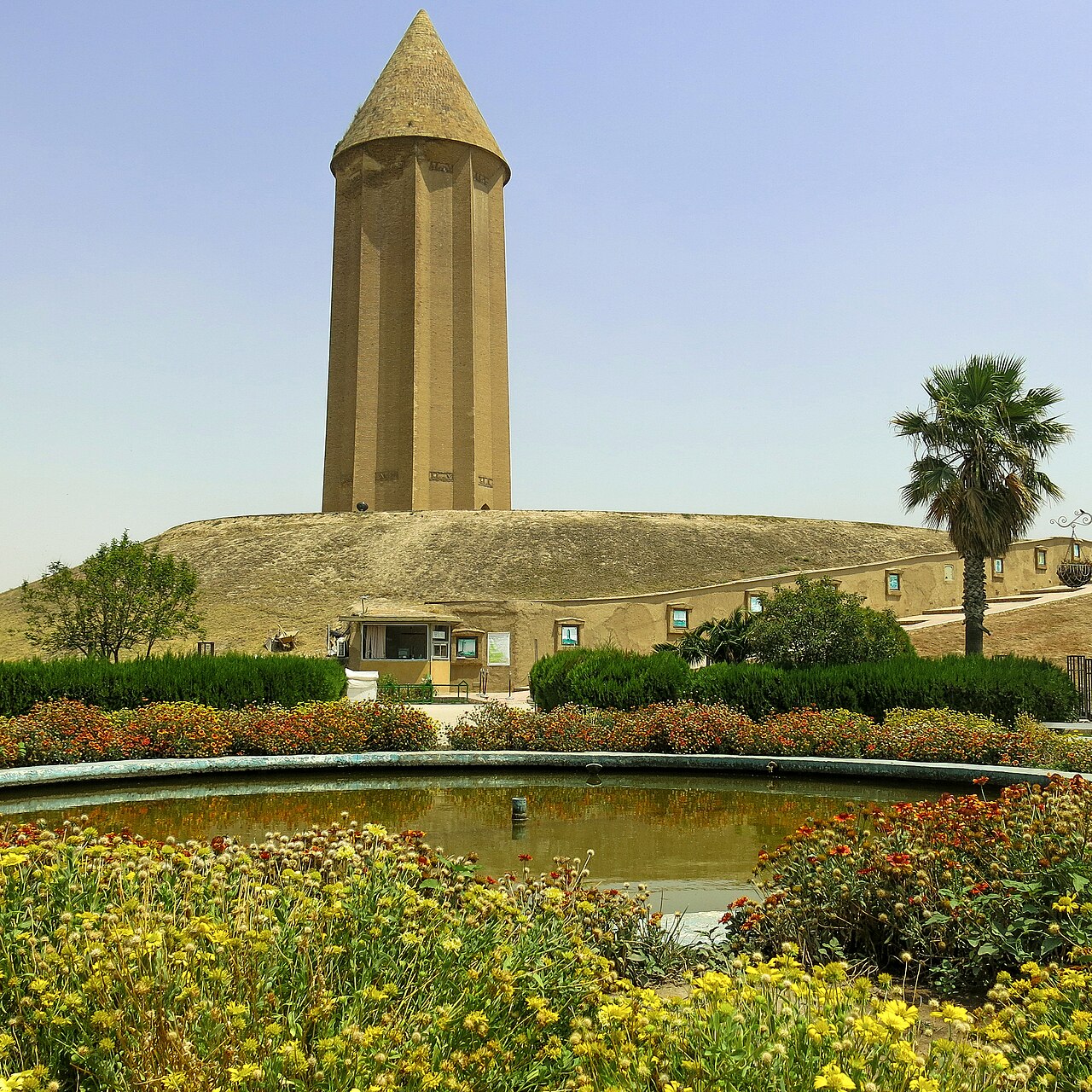

Approaching the tower
The tower stands on a grassy mound in a public park, and it is visible from much of the town; the flat Gorgan plain around it makes it seem taller still. Walk all the way round it first. The ten sharp brick flanges catch the light differently through the day, so the shaft looks almost smooth at noon and deeply ribbed in the early morning or late afternoon. There is a single low doorway, under a small pointed arch.
Near the top and just above the base, a band of Kufic lettering in raised brick runs round the tower between the flanges. It names Qabus as the builder and gives the date in both the Islamic lunar calendar and the Iranian solar calendar. Binoculars or a long lens help to see the letters.
Inside: the echo
The interior is a single empty shaft rising to the underside of the roof, with no floors or stairs. Visitors usually step inside to look up, and to try the famous echo: a word spoken or a clap made in the centre of the floor comes back clearly from the walls high above. There is no tomb to see. Old travellers’ stories said Qabus was laid in a glass coffin hung from the roof; that is a story that cannot be checked, and nothing of a burial is visible today.
The town of Gonbad-e Kavus
The town grew on the site of ancient Jorjan, the Ziyarid capital, which was ruined in the Mongol period. Gonbad-e Kavus is now a market town of the Turkmen steppe, and its streets show the mix of the region: Turkmen families, Persian-speaking settlers and others. The Turkmen are famous for their horses, and the town has a long tradition of horse racing on the plains outside it; races are held in the cooler seasons. Look in the bazaar for Turkmen carpets, felt, embroidered dresses and silver jewellery.
Nearby sites
- Jorjan: the low mounds of the old city lie close to the modern town; excavations have uncovered parts of the medieval city and its pottery.
- The Great Wall of Gorgan: a Sasanian brick frontier wall, about 200 km long, runs across the plain north of the town; little stands above ground, but traces can be seen with a local guide. See Sasanian Cities, Palaces and Bridges.
- Golestan National Park: the forests and grasslands of Golestan National Park lie to the east, on the road towards Mashhad.
- Gorgan: the provincial capital, with an old quarter of brick houses; see Gorgan.
Practical notes
- Gonbad-e Kavus is usually reached by road from Gorgan, which has an airport and rail links to Tehran.
- Opening times, any entry charges and access to the interior change; check current information locally.
- Summers on the Gorgan plain are hot and humid; spring and autumn are the most pleasant seasons.
- For safety, follow your own government’s current travel advice for Iran.
Persian words from this page
| گنبد | gonbad | dome; also a domed tomb tower |
| برج | borj | tower |
| آجر | âjor | fired brick |
| کتیبه | katibe | inscription |
| ترکمن | Torkaman | Turkmen |
| اسب | asb | horse |
Sources and further reading
- UNESCO World Heritage Centre, Gonbad-e Qābus (inscribed 2012).
- Encyclopaedia Iranica, “Gonbad-e Qābus”.
- Robert Hillenbrand, Islamic Architecture: Form, Function and Meaning (Edinburgh University Press, 1994), on tomb towers.
- Sheila Blair, The Monumental Inscriptions from Early Islamic Iran and Transoxiana (Brill, 1992), on the tower’s inscription.
Want to learn Persian? Get the free Starter Pack
Get the 14-page printable Starter Pack (all 32 letters, a 7-day reading plan, 100 core words and 20 survival phrases) and a short 5-email course. Free.
More in Top Places to Visit in Iran
- Naqsh-e Jahan Square
- Shah (Imam) Mosque, Isfahan
- Sheikh Lotfollah Mosque
- Ali Qapu Palace
- Jameh Mosque of Isfahan
- Si-o-se Pol and Khaju Bridge
- Vank Cathedral
- Hasht Behesht Palace
- Naqsh-e Rostam
- Eram Garden, Shiraz
- Nasir al-Molk (Pink) Mosque
- Tomb of Hafez (Hafezieh)
- Tomb of Saadi (Saadieh)
- Shah Cheragh Shrine
- Arg of Karim Khan
- Fin Garden, Kashan
- Historic Houses of Kashan
- Jameh Mosque of Yazd
- Yazd Fire Temple and Towers of Silence
- Dowlatabad Garden and Windcatcher
- Amir Chakhmaq Complex
- Golestan Palace
- National Museum of Iran
- Treasury of National Jewels
- Tehran Grand Bazaar
- Milad Tower
- Imam Reza Shrine, Mashhad
- Tomb of Ferdowsi, Tus
- Tomb of Omar Khayyam, Neyshabur
- Tomb of Avicenna, Hamadan
- Ganjnameh Inscriptions, Hamadan
- Behistun (Bisotun): Visiting the Site
- Taq-e Bostan: Visiting the Site
- Tabriz Historic Bazaar
- Takht-e Soleyman
- Armenian Monastic Ensembles of Iran
- Sheikh Safi al-Din Shrine, Ardabil
- Dome of Soltaniyeh
- Alamut Castle
- Falak-ol-Aflak Castle
- Shushtar Historical Hydraulic System
- Chogha Zanbil: Visiting the Ziggurat
- Susa Archaeological Site
- Arg-e Bam
- Ganjali Khan Complex, Kerman
- Shazdeh Garden, Mahan
- Rayen Castle
- Dasht-e Lut (Lut Desert)
- Maranjab Desert and Caravanserai
- Varzaneh Desert
- Mount Damavand
- Hyrcanian Forests
- Lake Urmia
- Badab-e Surt Springs
- Ali Sadr Cave
- The Kaluts of Shahdad
- Qeshm Geopark
- Hormuz Island Colours
- Visiting Persepolis: A Day Trip from Shiraz
- Visiting Pasargadae
- Persian Caravanserais
- The Qanat of Gonabad
- Meymand Village
- Sasanian Sites of Fars: Firuzabad, Bishapur and Sarvestan
- Gonbad-e Qabus: Visiting the Tower
- Zayandeh Rud and Isfahan’s Bridges
- Tochal and Darband: Hiking Above Tehran
- Mount Sabalan
- Skiing in Iran: Dizin and Shemshak
- Golestan National Park