Tabriz (تبریز, Tabriz) is the largest city of north-west Iran and the capital of East Azerbaijan province. It was the capital of the Mongol Ilkhanate and of the first Safavid shah, its covered bazaar is a UNESCO World Heritage Site, and its people, most of whom speak Azerbaijani Turkish, played a leading part in the Constitutional Revolution. It had 1,558,693 inhabitants at the 2016 census.

| Persian name | تبریز (Tabriz) |
|---|---|
| Province | East Azerbaijan (capital) |
| Population | 1,558,693 (city, 2016 census, Statistical Centre of Iran) |
| Elevation | About 1,350 m, below Mount Sahand |
| Main languages | Azerbaijani Turkish in daily life; Persian in schools and administration |
| Capital of | The Ilkhanate (13th–14th centuries), the Qara Qoyunlu and Aq Qoyunlu, the early Safavids |
| UNESCO site | Tabriz Historic Bazaar Complex (2010) |
Earthquakes and early history
Tabriz lies in a basin between the volcanic massif of Sahand to the south and the bare Eynali hills to the north, with Lake Urmia to the west. The region is seismically active, and the city has been flattened several times; Iranian and foreign records mention major earthquakes in 858, 1042, 1721 and 1780. That is one reason so little survives from before the Mongols, even though Tabriz was an important town in the early Islamic period and the seat of local dynasties in Azerbaijan.
Capital of the Ilkhans
Tabriz’s great age began in the 1260s, when the Mongol Ilkhan Abaqa made it his capital. Under Ghazan Khan (reigned 1295–1304) it became one of the largest cities of Asia, where merchants from Genoa, Venice, India and China met. Ghazan built a vast suburb around his tomb, and his vizier Rashid al-Din founded the Rab’-e Rashidi, a quarter of colleges, hospitals and workshops where his world history was copied. Marco Polo passed through and described the city’s trade in silk and precious stones. The period is covered on Tabriz under the Ilkhans.
The most striking survivor is the Arg-e Alishah, the massive brick walls of an early 14th-century mosque begun by the vizier Taj al-Din Alishah. Its prayer hall was so large that it cracked; later it was used as a citadel.
Turkmen sultans and the first Safavid capital
In the 15th century two Turkmen confederations, the Qara Qoyunlu (“Black Sheep”) and then the Aq Qoyunlu (“White Sheep”), ruled from Tabriz. The Qara Qoyunlu left the Blue Mosque (Masjed-e Kabud), completed in 1465 and famous for tilework so fine that it survived as fragments even after the 1780 earthquake brought down its domes.
In 1501 the young Ismail I entered Tabriz, was crowned shah and declared Twelver Shi’ism the religion of the state. Tabriz was close to the Ottoman frontier, and after the Ottoman victory at Chaldiran in 1514 Sultan Selim briefly occupied it. Ottoman armies returned several times in the 16th century, and the Safavids moved their capital to Qazvin and later Isfahan.
The crown prince’s city and the Constitutional Revolution
Under the Qajars, Tabriz was the seat of the crown prince (vali-ahd), who governed Azerbaijan. The best known was Abbas Mirza, who organised a European-style army here during the wars with Russia and sent students abroad. Close to the Russian and Ottoman borders, Tabriz received new ideas, newspapers and goods before most of Iran; one of the country’s first printing presses was set up here in the 1810s.
That openness shaped the city’s role in the Constitutional Revolution. When Mohammad Ali Shah shelled the Majlis in 1908, Tabriz held out. Its fighters, led by Sattar Khan and Baqer Khan, resisted a royalist siege for months until Russian troops entered in 1909. See The siege of Tabriz and Sattar Khan. The Constitution House, where the leaders met, is now a museum near the bazaar.
Tabriz was also at the centre of the 1945–1946 crisis, when a Soviet-backed autonomous government of Azerbaijan, led by Ja’far Pishevari, ruled from the city for about a year until Iranian forces returned in December 1946.
The bazaar and the old city
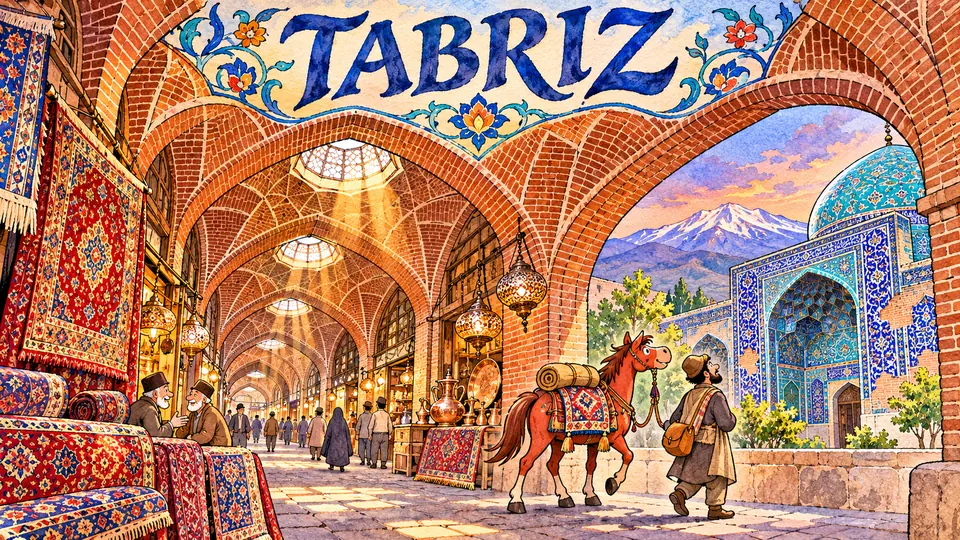
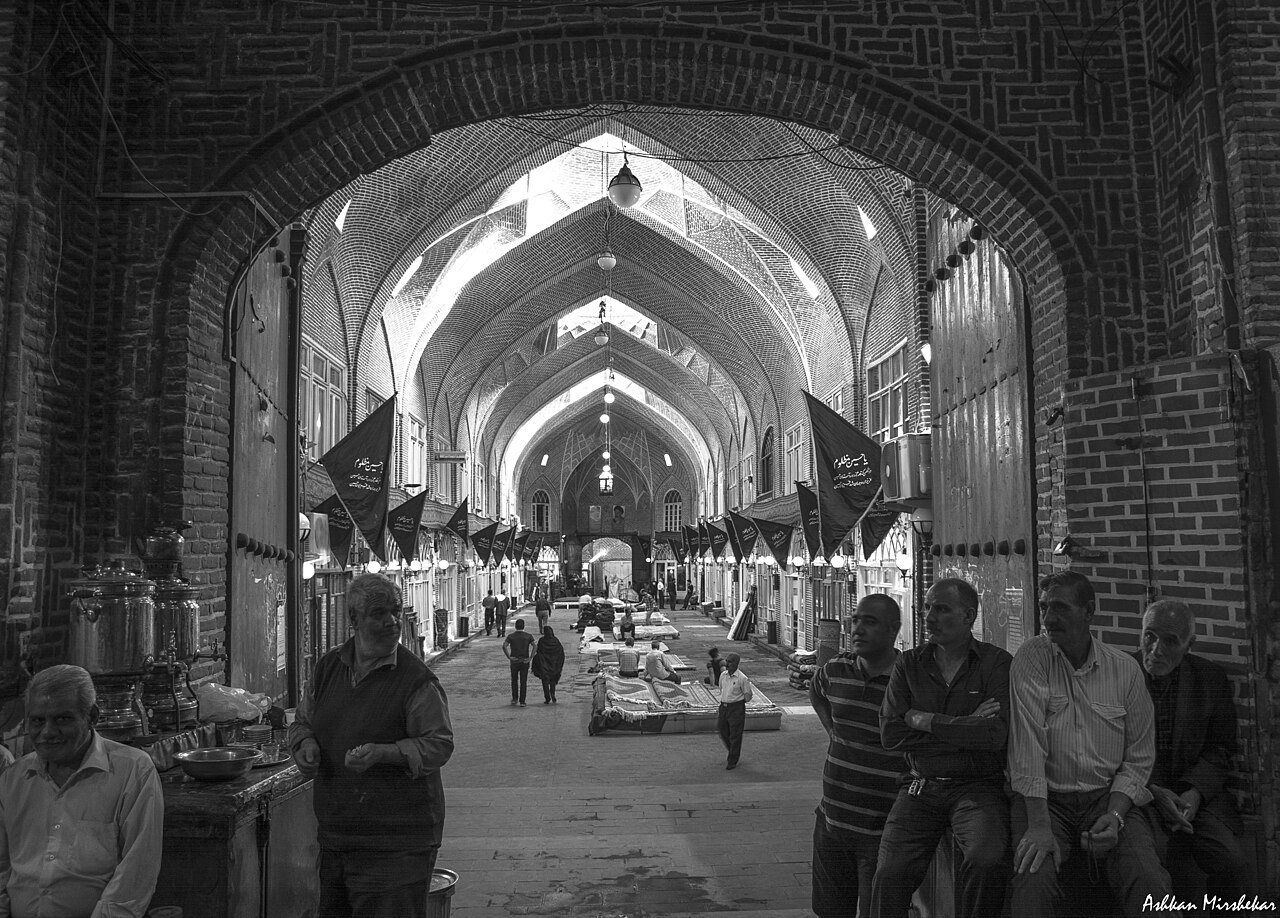
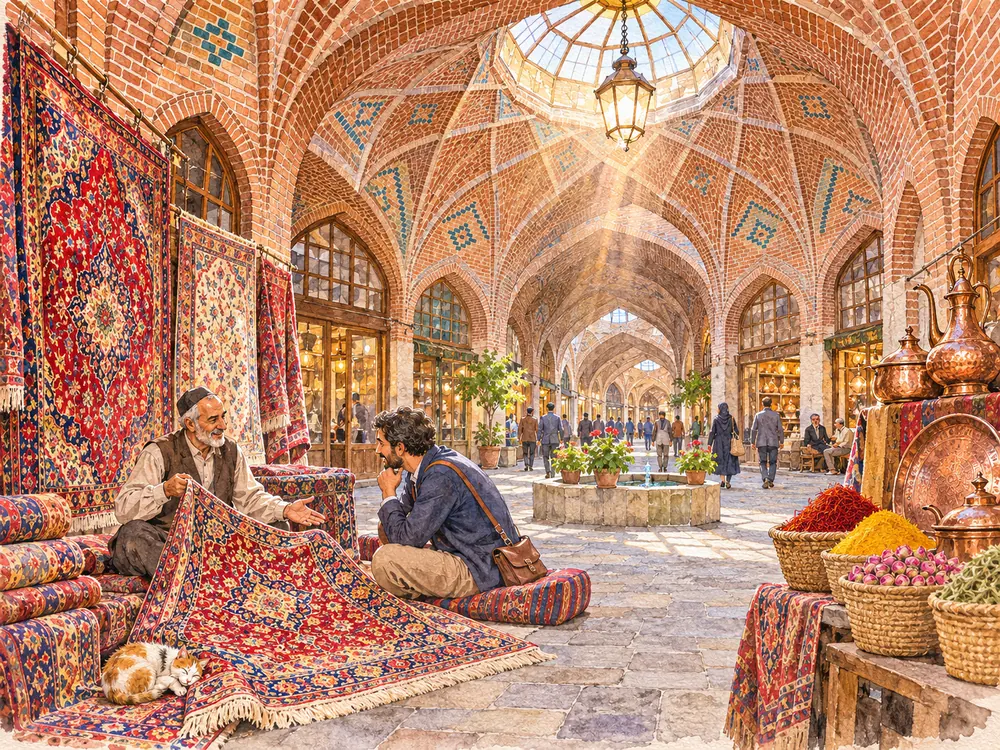
The Tabriz bazaar is a covered network of passages, domed halls (timche), caravanserais and mosques, mostly in its 18th- and 19th-century form after the earthquakes. UNESCO inscribed it in 2010 as one of the most complete traditional commercial complexes in the region. It is still a working market, with sections for carpets, gold, spices and dried fruit. See the Tabriz Historic Bazaar page.
Other sights within the city include the Blue Mosque, the Arg-e Alishah, the Azerbaijan Museum, the Qajar mansions of the Amir Nezam and Behnam houses, and the Maqbarat-o-Sho’ara, the “tomb of the poets”, where the modern poet Mohammad-Hossein Shahriar is buried. Shahriar wrote in both Persian and Azerbaijani; his Azerbaijani poem Heydar Babaya Salam is widely loved on both sides of the border. On the south-east edge of the city, El Goli is a park built around an old artificial lake, popular on summer evenings.
Language, food and daily life
Most Tabrizis speak Azerbaijani Turkish at home and in the bazaar, and Persian in school, at work and with visitors. You will hear both. Our page on Azerbaijanis in Iranian history gives the background.
Tabriz is known for its carpets, its sweets, above all the almond biscuits called qurâbiye, and for kufte tabrizi, a large meatball with rice, herbs and a hidden filling of egg, dried fruit and nuts. Lighvan cheese, made from sheep’s milk in the villages of Sahand, is sold all over Iran.
Getting there and around, and trips from Tabriz
Tabriz is about 630 km north-west of Tehran by road. The airport has domestic flights and some regional international routes, and overnight trains run from Tehran. In the city a metro line, opened in 2015, crosses from east to west, and taxis and buses fill the gaps. Winters are cold and snowy; late spring and early autumn are the best seasons.
Tabriz is the natural base for the north-west: the cliff village of Kandovan on the slopes of Sahand, Lake Urmia, the Armenian monasteries of St Stepanos and St Thaddeus, and Ardabil. Check current information with official sources and your own government’s travel advice before travelling to border areas.
Persian words from this page
| تبریز | Tabriz | Tabriz |
| آذربایجان | Âzarbâyjân | Azerbaijan (the Iranian region) |
| مسجد کبود | Masjed-e Kabud | the Blue Mosque |
| تیمچه | timche | domed hall in a bazaar |
| ولیعهد | vali-ahd | crown prince |
| مشروطه | mashrute | constitutional (the revolution) |
| کوفته تبریزی | kufte tabrizi | Tabriz meatball |
Sources and further reading
- Encyclopaedia Iranica, “Tabriz” (history and monuments).
- UNESCO World Heritage Centre, Tabriz Historic Bazaar Complex.
- Ervand Abrahamian, Iran Between Two Revolutions (Princeton University Press, 1982), on the Constitutional Revolution and the 1945–1946 Azerbaijan crisis.
- Rashid al-Din, Jami’ al-Tawarikh, trans. W.M. Thackston, Compendium of Chronicles (1998–1999).
- Statistical Centre of Iran, National Population and Housing Census 2016 (1395).
Want to learn Persian? Get the free Starter Pack
Get the 14-page printable Starter Pack (all 32 letters, a 7-day reading plan, 100 core words and 20 survival phrases) and a short 5-email course. Free.
More in Cities of Iran
- Tehran: Iran’s Capital
- Mashhad
- Isfahan
- Shiraz
- Tabriz
- Yazd
- Kashan
- Kerman
- Hamadan
- Qom
- Ahvaz
- Rasht
- Kermanshah
- Urmia
- Ardabil
- Zanjan
- Qazvin
- Sanandaj
- Khorramabad
- Bandar Abbas
- Bushehr
- Zahedan
- Birjand
- Gorgan
- Sari
- Semnan
- Arak
- Ilam
- Yasuj
- Shahr-e Kord
- Bojnurd
- Karaj
- Abadan and Khorramshahr
- Kish Island
- Qeshm Island
- Hormuz Island
- Masuleh
- Abyaneh
- Kandovan
- Bam
- Neyshabur (Nishapur)
- Shush (Susa) Today