Zoroastrianism is the religion founded on the teachings of the prophet Zoroaster (Zartosht), who lived on the eastern Iranian plateau at a date scholars still dispute, probably between about 1500 and 1000 BCE. It was the main religion of the Iranian empires for more than a thousand years, the official faith of the Sasanian state, and after the Islamic conquest it became the religion of a small minority that survives today in Yazd, Kerman, Tehran, India and a worldwide diaspora.
| Founder | Zoroaster (Avestan Zarathushtra, Persian Zartosht) |
|---|---|
| Scripture | The Avesta; its oldest part is the Gathas, hymns attributed to Zoroaster |
| God | Ahura Mazda, the “Wise Lord” |
| State religion | Sasanian empire, 224–651 CE |
| Iran today | 25,271 Zoroastrians in the 2011 census; community estimates are higher |
| Centres | Yazd, Kerman, Tehran; the Parsis of Mumbai and Gujarat in India |
The prophet and the problem of dates
Almost everything about Zoroaster’s life is uncertain. The Gathas, seventeen hymns in an archaic form of the Avestan language, are the only texts most scholars attribute to him. Their language is very close to that of the Indian Rigveda, and on that basis many specialists place him somewhere around 1500–1000 BCE, in eastern Iran or Central Asia. A later tradition, which put him “258 years before Alexander”, gives a date in the sixth century BCE, and some historians still prefer a date nearer that. Neither can be proven. The page on Zoroaster and the Avesta sets out the debate and his core teachings.
The heart of the religion is a choice. Ahura Mazda is the wise creator; opposed to him is the destructive spirit, later called Ahriman. Every person must choose between truth (asha) and the lie (druj), and the three-part ethic of “good thoughts, good words, good deeds” (pendâr-e nik, goftâr-e nik, kerdâr-e nik) is still the best-known summary. Fire, as the purest of the elements, is the focus of worship, which is why Zoroastrians have often been mistakenly called fire-worshippers.

Under the Medes and Achaemenids
How and when the religion reached western Iran is unclear. The Medes had a priestly tribe, the Magi, who later became the priests of Zoroastrianism (see Median society, Magi and religion). The Achaemenid kings from Darius I onward called on Ahura Mazda in their inscriptions, but they never mention Zoroaster, and historians still argue over whether they were Zoroastrians in a strict sense. The evidence and the arguments are on the religion of the Achaemenid kings. What is clear is that by the late Achaemenid period gods such as Mithra and the goddess Anahita were honoured alongside Ahura Mazda.
Parthians and Sasanians: from tradition to state church
Under the Parthians the religion seems to have been decentralised, with local fire temples and a mix of practices (see religion and culture in Parthian Iran). The Sasanians, who came from a priestly family attached to the Anahita temple at Istakhr, made it a pillar of their state. The high priest Kartir boasted in his third-century inscriptions of founding fire temples and of acting against Jews, Christians, Manichaeans and others. Great fires such as Adur Gushnasp in Azerbaijan were royal shrines, and the Avesta, until then handed down orally, was written in a specially invented alphabet, probably in the fifth or sixth century. Religious rivals and reformers, from Mani to Mazdak, met hard resistance from the priesthood. The fullest account is Zoroastrianism under the Sasanians.
After the Islamic conquest: a slow decline
The fall of the Sasanians in the 640s did not end Zoroastrianism overnight. Zoroastrians became a protected people paying the poll tax (jizya), and conversion to Islam took several centuries. In the ninth and tenth centuries priests compiled most of the Middle Persian religious books that survive, such as the Denkard and the Bundahishn, while the community was still sizeable. Pressure grew over time, and some Zoroastrians left for India. According to the Qissa-i Sanjan, a Parsi account written down in 1599, a group sailed to Gujarat; the date of their arrival is uncertain and estimates range from the eighth to the tenth century. Their descendants are the Parsis. The details are on Zoroastrians after the Arab conquest.
By the Safavid and Qajar periods the Iranian community had shrunk to villages and city quarters around Yazd and Kerman. European travellers and Zoroastrian sources describe poverty, special taxes and restrictions on dress and building. Communication with the wealthier Parsis was never fully broken: from the fifteenth century onward Iranian priests answered religious questions sent from India in letters known as the Rivayats.
Revival in the nineteenth and twentieth centuries
A turning point came with Maneckji Limji Hataria, an envoy sent by Parsi charities who arrived in Iran in 1854. He founded schools and lobbied the Qajar court, and in 1882 Naser al-Din Shah abolished the jizya on Zoroastrians. Many Iranian Zoroastrians moved to Tehran and Bombay; families such as the Jamshidians became prominent merchants. The Constitutional Revolution gave Zoroastrians a representative in the Majlis, and under the Pahlavis, who stressed Iran’s pre-Islamic past, Zoroastrian symbols such as the winged faravahar became national emblems. In Yazd the old practice of exposing the dead on towers of silence (dakhme) was given up in the twentieth century in favour of burial.
Zoroastrians in Iran today
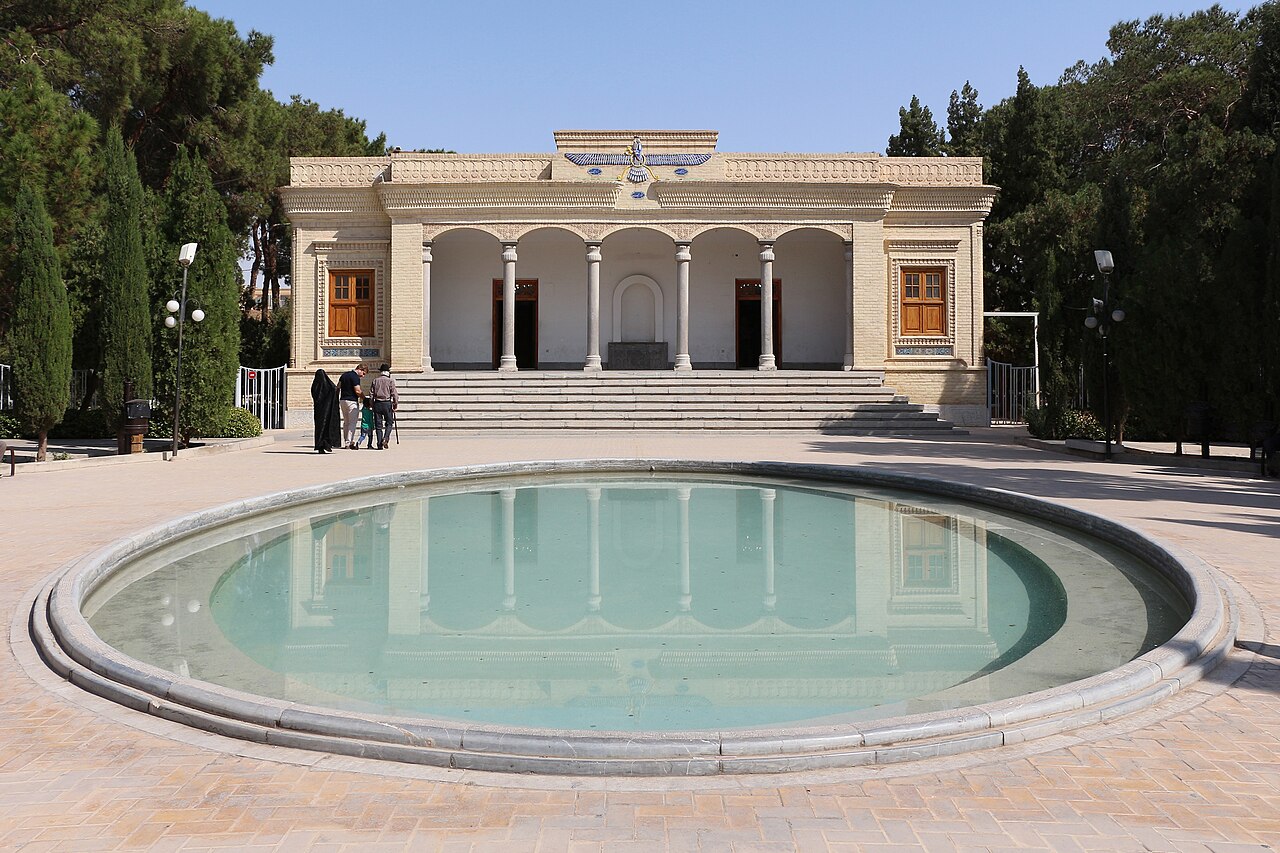
The constitution of the Islamic Republic recognises Zoroastrians as one of three non-Muslim religious minorities and reserves one seat for them in parliament. The 2011 census counted 25,271 Zoroastrians; community leaders have suggested higher figures, and emigration and low birth rates have reduced numbers. Fire temples in Yazd, Kerman and Tehran remain in use, and festivals such as Sadeh and the Gahanbars are still celebrated. Many customs that all Iranians share, from Nowruz to Shab-e Yalda and the month names of the calendar, have roots in the Zoroastrian world. For today’s religious landscape see religion in Iran; visitors can see the Yazd temple and towers described on Yazd fire temple and towers of silence.
Persian words from this page
| زرتشت | Zartosht | Zoroaster |
| زرتشتی | zartoshti | Zoroastrian |
| اوستا | Avestâ | the Avesta |
| آتشکده | âtashkade | fire temple |
| موبد | mobad | Zoroastrian priest |
| دخمه | dakhme | tower of silence |
| فروهر | forouhar | faravahar, the winged symbol |
Sources and further reading
- Mary Boyce, Zoroastrians: Their Religious Beliefs and Practices (1979, revised 2001).
- Jamsheed K. Choksy, Conflict and Cooperation: Zoroastrian Subalterns and Muslim Elites in Medieval Iranian Society (1997).
- Michael Stausberg and Yuhan Sohrab-Dinshaw Vevaina (eds.), The Wiley Blackwell Companion to Zoroastrianism (2015).
- Encyclopaedia Iranica, “Zoroastrianism” and “Hataria, Manekji Limji”.
- Jenny Rose, Zoroastrianism: An Introduction (2011).
Want to learn Persian? Get the free Starter Pack
Get the 14-page printable Starter Pack (all 32 letters, a 7-day reading plan, 100 core words and 20 survival phrases) and a short 5-email course. Free.
More in Themes Across Iranian History (3000 BCE–today)
- A History of the Persian Language
- Zoroastrianism through the Ages
- Shi’a Islam in Iranian History
- The Jews of Iran
- The Armenians of Iran
- Christians of Iran
- The Baha’i Faith in Iran
- The Kurds in Iranian History
- Azerbaijanis in Iranian History
- The History of the Iranian Calendar
- Nowruz through History
- The Persian Garden (Pardis) through History
- Qanats: Iran’s Ancient Water Tunnels
- A History of Persian Carpets
- A History of Persian Architecture
- A History of Persian Painting
- A History of Persian Music
- Science in Iranian History
- Women in Iranian History
- Iran and the Silk Road
- Iran and China through History
- Iran and India through History
- Iran and Greece: Perceptions and Exchanges
- Persia and Rome: Seven Centuries of Rivalry
- Iran and the Ottoman Empire
- Iran and Russia through History
- Iran and Britain through History
- Iran and the United States
- How Iran’s Borders Changed
- The Capitals of Iran through History
- Coins of Iran through History: From the Daric to the Rial
- Flags and Symbols of Iran through History
- Myth and History in the Shahnameh: The Epic’s Kings and the Real Past
- Timeline of Iranian History: Key Dates from Elam to Today
- A History of Persian Cuisine: From Royal Banquets to Chelow Kabab
- A History of Persian Poetry: From Rudaki to Forough
- Wine in Iranian History: From Hajji Firuz to Hafez and Prohibition
- Sports in Iranian History: Polo, the Zurkhaneh and Wrestling
- List of Iranian Dynasties and Rulers