Iran’s flags and emblems have changed with each regime, but a few images keep returning: the royal eagle of the Achaemenids, the jewelled banner of Kaveh the blacksmith, the winged figure of Persepolis and, for some seven centuries, the Lion and Sun. The green, white and red tricolour dates from the Constitutional Revolution of 1906–1907; the current emblem replaced the Lion and Sun in 1980.
This page follows the history of these symbols. For what the current flag, emblem and anthem look like and mean today, see national symbols of Iran.
The eagle standard of the Persian kings
No Achaemenid flag survives, but Greek writers saw one. Xenophon, who marched with Cyrus the Younger in 401 BCE, says the king’s standard was a golden eagle with outspread wings mounted on a spear, and that it was still the Persian royal standard in his day. Eagle and falcon images appear in Achaemenid art and, in the Shahnameh tradition, in the banner of Iranian heroes. Whether the bird was an eagle in the strict sense, or a falcon, is not something the evidence can settle.
The faravahar: a winged figure with many meanings
Above the royal figures at Persepolis, Naqsh-e Rostam and Behistun hovers a bearded man rising from a winged disc. Persians today call it the faravahar فروهر and treat it as the emblem of Zoroastrianism and of ancient Iran. What it meant to the Achaemenids is debated. Older scholarship read it as the god Ahura Mazda; others see the king’s guardian spirit (fravashi) or the royal glory (khvarenah), and the design itself was adapted from Assyrian and Egyptian winged discs. The modern meanings, with the three wings standing for good thoughts, good words and good deeds, are a 20th-century reading. See Achaemenid religion and Zoroastrianism through the ages.
Derafsh-e Kaviani: the banner of Kaveh
The Sasanian state standard, the Derafsh-e Kaviani درفش کاویانی, carried a legend of its own. In the Shahnameh, the blacksmith Kaveh raises his leather apron on a spear to lead a revolt against the tyrant Zahhak; the restored king Fereydun covers it with jewels, brocade and coloured tassels, and every later king adds more gems. Arabic historians report that the real banner, by then heavy with jewels, was captured by the Arab army after the Battle of Qadisiyyah and the death of the commander Rostam Farrokhzad, and that it was cut up and divided as booty. For later Iranians the banner of Kaveh stood for resistance to tyranny, which is why it appears in Ferdowsi’s poem (see Ferdowsi and the Shahnameh) and in modern nationalist art.
The Lion and Sun: from the zodiac to the state
The Lion and Sun شیر و خورشید began as an astrological image: the sun in its “house” of Leo, a popular motif across the Islamic world. It appears as a political symbol in the 13th century on the coins of Kaykhusraw II, Seljuk sultan of Rum (1237–1246). By Safavid times it was a familiar sign in Iran, on copper coins, banners and works of art.
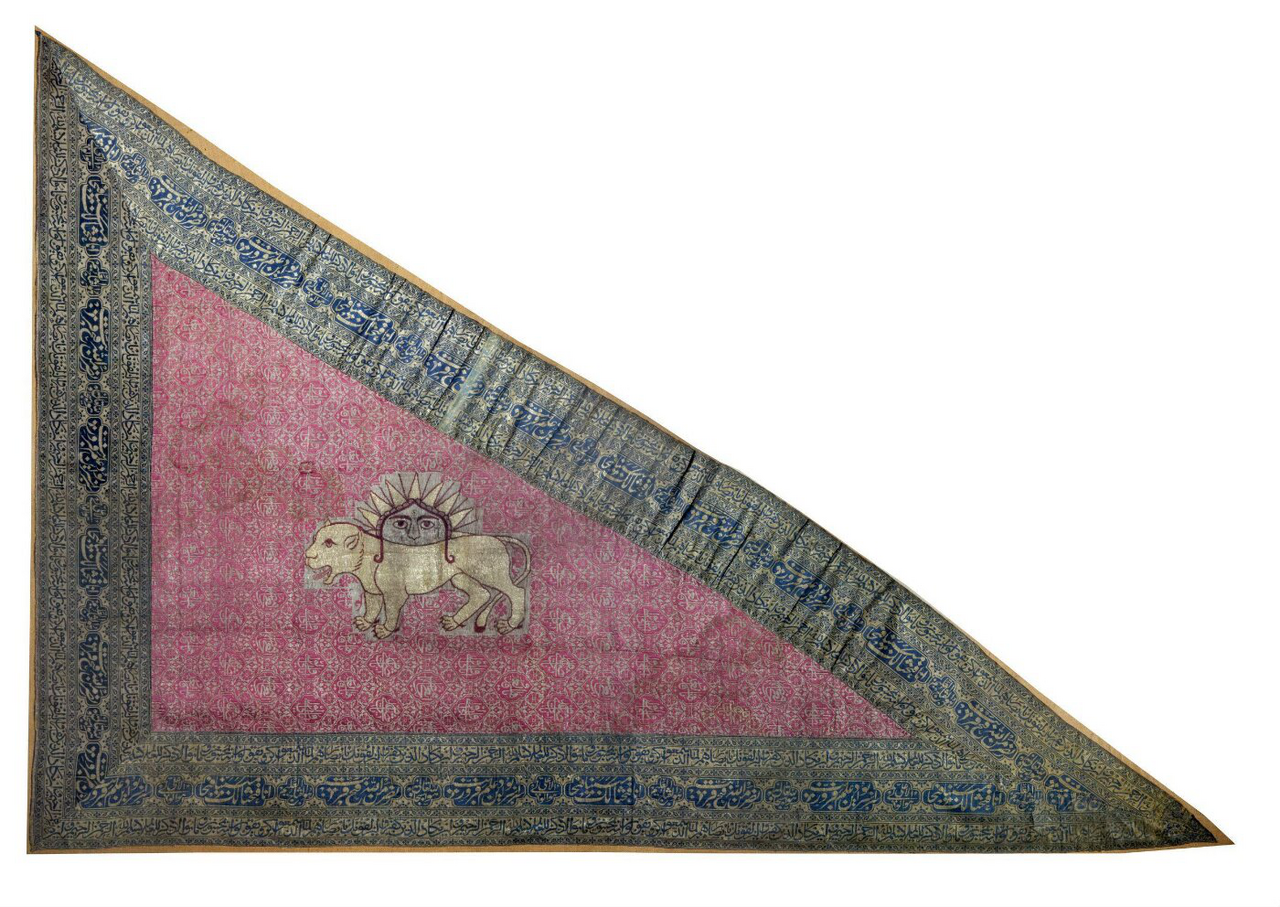
Its meaning shifted over time. In the Safavid period the lion was sometimes read as Ali, “the lion of God”, and the sun as the Shi’a faith or the shah. Under the Qajars it became firmly the emblem of the state. Fath-Ali Shah founded the Order of the Lion and Sun in 1808 to decorate foreign officers and envoys, and in 1846 a decree of Mohammad Shah gave the image a national reading, claiming it had been Persia’s emblem for some three thousand years. European visitors who believed it ancient helped spread this view. In Qajar flags the lion gained a raised sword and the sun a human face.

Green, white and red: the constitutional tricolour
The Constitutional Revolution gave Iran its first legally defined flag. The Supplementary Fundamental Laws of 7 October 1907 described a tricolour of green, white and red with the Lion and Sun in the centre, and a decree of 1910 fixed its proportions and details. Why these three colours is not documented in the law; later explanations link green with Islam or growth, white with peace and red with courage or martyrdom, and some point to older uses of the same colours in Qajar banners.
Under Reza Shah and his son the design stayed, with the Pahlavi crown placed above the lion on the state flag. The Lion and Sun also became the name of Iran’s humanitarian society. The Red Lion and Sun was recognised in the Geneva Convention of 1929 as a protective emblem alongside the red cross and the red crescent.
1980: a new emblem
After the revolution and the referendum of 1979, the Lion and Sun was dropped as a symbol of the monarchy. A new emblem designed by Hamid Nadimi was approved by Ayatollah Khomeini on 9 May 1980: four crescents and a sword forming a stylised form of the word Allah. The flag in its current form was adopted in July 1980, keeping the three colours and adding the phrase Allahu Akbar in stylised Kufic script, repeated 11 times along the edge of the green band and 11 times along the red, 22 in total, a reference to 22 Bahman, the date of the revolution’s victory in 1979. On 4 September 1980 the Red Lion and Sun Society became the Red Crescent Society.
The Lion and Sun did not disappear. Many Iranians abroad, monarchist and non-monarchist alike, use the old flag at rallies and in diaspora events, while the plain tricolour without an emblem is another common choice. Inside Iran the motif survives on old buildings, coins and carpets. The flag a person carries has become, for some Iranians, a way of stating a political position.
Other symbols with a long history
- The Simorgh سیمرغ: the mythical bird of the Shahnameh, which raises the hero Zal, and of Attar’s Conference of the Birds. Sasanian art shows a related creature, the senmurv, with a dog’s head and peacock’s tail (see Sasanian art).
- The cypress: the slender sarv, an image of the beloved in poetry and a common motif in carpets and tiles.
- Fire: the sacred fire of Zoroastrianism, shown on the reverse of every Sasanian coin and still kept burning in the fire temple of Yazd.
Persian words from this page
| پرچم | parcham | flag |
| درفش | derafsh | banner, standard |
| شیر | shir | lion |
| خورشید | khorshid | sun |
| کاوه | Kâve | Kaveh |
| فروهر | farvahar / faravahar | the winged figure |
| سیمرغ | simorgh | Simorgh |
Sources and further reading
- Xenophon, Anabasis 1.10 and Cyropaedia 7.1 (the royal eagle standard).
- Ferdowsi, Shahnameh, the story of Zahhak, Kaveh and Fereydun.
- Encyclopaedia Iranica, “Derafš-e Kāvīān”.
- A. Shapur Shahbazi, “Flags i. Of Persia”, Encyclopaedia Iranica.
- Afsaneh Najmabadi, Women with Mustaches and Men without Beards (2005), on the gendering of the Lion and Sun.
Want to learn Persian? Get the free Starter Pack
Get the 14-page printable Starter Pack (all 32 letters, a 7-day reading plan, 100 core words and 20 survival phrases) and a short 5-email course. Free.
More in Themes Across Iranian History (3000 BCE–today)
- A History of the Persian Language
- Zoroastrianism through the Ages
- Shi’a Islam in Iranian History
- The Jews of Iran
- The Armenians of Iran
- Christians of Iran
- The Baha’i Faith in Iran
- The Kurds in Iranian History
- Azerbaijanis in Iranian History
- The History of the Iranian Calendar
- Nowruz through History
- The Persian Garden (Pardis) through History
- Qanats: Iran’s Ancient Water Tunnels
- A History of Persian Carpets
- A History of Persian Architecture
- A History of Persian Painting
- A History of Persian Music
- Science in Iranian History
- Women in Iranian History
- Iran and the Silk Road
- Iran and China through History
- Iran and India through History
- Iran and Greece: Perceptions and Exchanges
- Persia and Rome: Seven Centuries of Rivalry
- Iran and the Ottoman Empire
- Iran and Russia through History
- Iran and Britain through History
- Iran and the United States
- How Iran’s Borders Changed
- The Capitals of Iran through History
- Coins of Iran through History: From the Daric to the Rial
- Flags and Symbols of Iran through History
- Myth and History in the Shahnameh: The Epic’s Kings and the Real Past
- Timeline of Iranian History: Key Dates from Elam to Today
- A History of Persian Cuisine: From Royal Banquets to Chelow Kabab
- A History of Persian Poetry: From Rudaki to Forough
- Wine in Iranian History: From Hajji Firuz to Hafez and Prohibition
- Sports in Iranian History: Polo, the Zurkhaneh and Wrestling
- List of Iranian Dynasties and Rulers