Borzuya (Burzoe) was a physician at the court of Khosrow I who, according to tradition, travelled to India in the 6th century CE and brought back a book of animal fables, which he translated into Middle Persian. Through its Arabic version, Kalila wa Dimna, it became one of the most widely read books of the Middle Ages. The same reign is remembered as the time when chess reached Iran from India, and when Iran answered with backgammon.
| Period | Reign of Khosrow I (531–579 CE) |
|---|---|
| Indian original | The Sanskrit Panchatantra, with material from the Mahabharata and other books |
| Middle Persian version | Kalilag ud Damanag, lost |
| Surviving descendants | Old Syriac version (c. 570); Arabic version by Ibn al-Muqaffa’ (c. 750) |
| Persian versions | Rudaki’s verse (10th century, lost); Nasrallah Monshi’s prose (12th century); Kashefi’s Anvar-e Soheyli (c. 1500) |
| Games | Chess (Middle Persian chatrang) from India; backgammon (new-ardakhshir, later nard) in reply |
Borzuya’s journey
The fullest account of Borzuya’s mission is found in the introductory chapters of the Arabic Kalila wa Dimna and in Ferdowsi’s Shahnameh. In Ferdowsi’s version, Borzuya reads that in the mountains of India grows a herb that can bring the dead back to life. Khosrow sends him to find it. In India he searches in vain until a sage explains the riddle: the “herb” is wisdom, the “mountains” are learned men and the “dead” are the ignorant, and the cure is a book kept in the king’s treasury, the Kalila. Borzuya obtains it, has it copied secretly or with the king’s permission, depending on the version, and brings it home.
The story is a legend built around a real event. A Middle Persian translation of Indian fables certainly existed in the 6th century, because an Old Syriac translation made from it, by a churchman named Bud, survives and is dated to around 570. Scholars such as François de Blois accept that a physician named Borzuya was responsible for it, while treating the details of the journey as literary embroidery.
From Panchatantra to Kalila wa Dimna
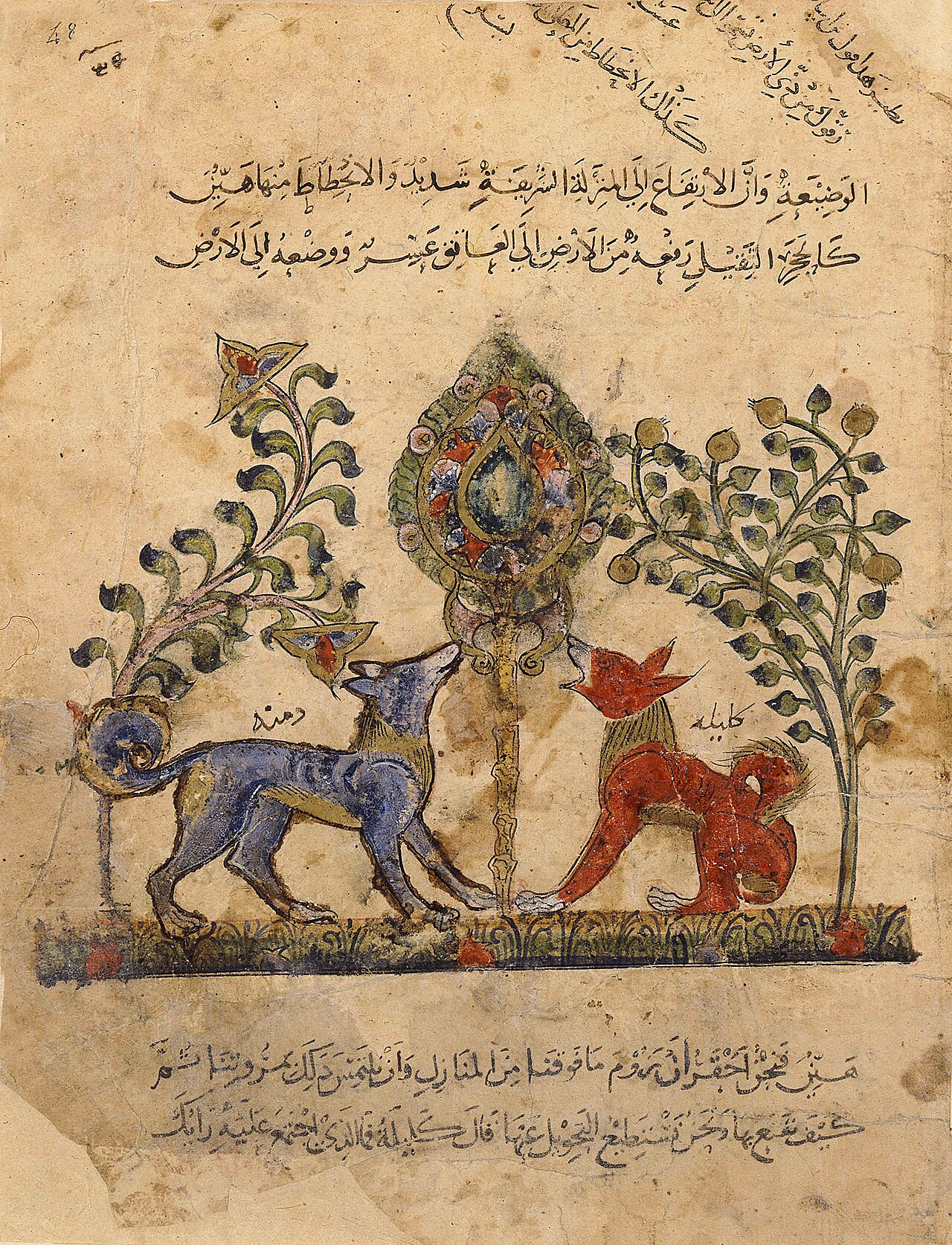
The core of the book is the Sanskrit Panchatantra, “Five Books”, a collection of fables told to teach princes the art of statecraft. Its first story tells of two jackals, Karataka and Damanaka, at the court of a lion king; their names became Kalilag and Damanag in Middle Persian and Kalila and Dimna in Arabic. The cunning Dimna sets the lion against his friend the bull, and is punished for it. Inside this frame are stories within stories: animals who argue, deceive and advise one another about friendship, trust and power.
Borzuya’s version added material from other Indian works, and the Arabic translator added more. The Middle Persian text itself is lost. What we read today descends mostly from the Arabic version made around 750 by Ibn al-Muqaffa’, a Persian convert to Islam and a master of Arabic prose, who was executed a few years later.

Borzuya’s own chapter
The Arabic book opens with a chapter in which Borzuya tells his own life: his training as a physician, his wish to heal without seeking reward, and his growing doubt about the competing religions of his day, each claiming to be the only truth. He decides to live by the moral teaching that all of them share. This frank passage has fascinated readers for centuries. Some scholars think it is a genuine Sasanian text; others suspect that Ibn al-Muqaffa’, himself accused of religious unorthodoxy, wrote or shaped it.
A book that travelled the world
From Arabic, Kalila wa Dimna was translated into almost every literary language of the medieval world: Greek in the 11th century, Hebrew, Latin, Old Spanish in 1251, and from those into Italian, German and English. In Persian it was put into verse by Rudaki in the 10th century for the Samanid court (only fragments survive) and into elegant prose by Nasrallah Monshi in the 12th century, a text that is still studied in Iranian schools. Around 1500 Hosayn Va’ez Kashefi produced a new, ornate version called Anvar-e Soheyli, “The Lights of Canopus”. A French translation of that version reached Jean de La Fontaine, who drew on these “fables of Pilpay” for some of his own fables.
The illustrated manuscripts are a world of their own. Painters in Baghdad, Syria, Iran and India filled the book with lions, jackals, crows and tortoises, and many of the finest early Arabic paintings to survive come from copies of Kalila wa Dimna.
Chess comes to Iran
Chess, too, came from India, and Iranian tradition placed its arrival in the reign of Khosrow I. A short Middle Persian text, the Explanation of Chess and the Invention of Backgammon, tells how an Indian king sent Khosrow a chess set with a challenge: if the Persians could work out the rules, India would pay tribute; if not, Iran would pay. The king’s wise minister Wuzurgmihr (Bozorgmehr) solved the game in a day and beat the Indian envoy three times. In return he invented a new game, new-ardakhshir, played with dice on a board, which the Indians could not solve. The text explains the board as the world, the thirty pieces as the days of the month and the throw of the dice as the turning of the heavens. Ferdowsi tells a similar story in the Shahnameh, where the Persian game is called nard, the ancestor of backgammon.
The story is a piece of court propaganda, but its basic claim, that chess reached Iran from India in the Sasanian period, is accepted by historians of the game. The vocabulary shows the route. Sanskrit chaturanga, the “four branches” of an army, became Middle Persian chatrang and Arabic shatranj. The Persian shah, “king”, gave the game its name in many European languages, and “checkmate” comes from shah mat, usually explained as “the king is helpless”. The rook descends from Persian rokh. For chess, backgammon and polo as pastimes of the Sasanian court, see Polo, Hunting and Games at the Sasanian Court.
Iran as a bridge
Taken together, the stories of Borzuya and of chess show how later Iranians remembered the age of Khosrow I: as a time when the court gathered the wisdom of India, Greece and Iran. The reality was more modest than the legends, as the page on Gondishapur shows, but in these two cases the legend points to something real. Iran did pass Indian fables and an Indian game to the Islamic world and, through it, to Europe. For the longer history of these links, see Iran and India through History and, on the language of the lost original, Middle Persian (Pahlavi) Language and Literature.
Persian words from this page
| کلیله و دمنه | Kelileh o Demneh | Kalila and Dimna |
| برزویه | Borzuyeh | Borzuya |
| بزرگمهر | Bozorgmehr | Bozorgmehr, the wise minister |
| شطرنج | shatranj | chess |
| نرد | nard | backgammon |
| شاه مات | shâh mât | checkmate |
| هند | Hend | India |
Sources and further reading
- Ibn al-Muqaffa’, Kalila wa Dimna, including the chapter of Burzoe; English version in Kalīlah and Dimnah: Fables of Virtue and Vice, trans. Michael Fishbein and James E. Montgomery (Library of Arabic Literature, NYU Press, 2021).
- Ferdowsi, Shahnameh, reign of Nushin-ravan (Borzuya’s journey, chess and nard); English translation by Dick Davis (Penguin, 2006).
- François de Blois, Burzōy’s Voyage to India and the Origin of the Book of Kalīlah wa Dimnah (Royal Asiatic Society, 1990).
- François de Blois, “Borzūya”, Encyclopaedia Iranica.
- H. J. R. Murray, A History of Chess (Oxford, 1913).
Want to learn Persian? Get the free Starter Pack
Get the 14-page printable Starter Pack (all 32 letters, a 7-day reading plan, 100 core words and 20 survival phrases) and a short 5-email course. Free.
More in The Sasanian Empire (224–651 CE)
- The Origins of the Sasanian Family
- Ardashir I, Founder of the Sasanian Empire
- Firuzabad: Ardashir’s Round City
- Shapur I, King of Kings of Iran and Non-Iran
- Bishapur: Shapur’s City
- The Battle of Edessa and the Capture of Valerian
- The Ka’ba-ye Zartosht Inscription of Shapur I
- Mani and Manichaeism
- Hormizd I and Bahram I
- Kartir and the Zoroastrian Church
- Bahram II
- Narseh and the Peace of Nisibis
- Shapur II the Great
- Julian’s Invasion of Persia (363)
- Christians in the Sasanian Empire
- Shapur III and the Partition of Armenia
- Yazdegerd I
- Bahram V Gur
- Yazdegerd II
- The Battle of Avarayr (451)
- The Hephthalites and Iran’s Eastern Frontier
- Peroz I and the Hephthalite Disaster
- Kavad I
- Zamasp and Kavad’s Return
- Mazdak and the Mazdakite Movement
- Khosrow I Anushirvan the Just
- The Sasanian–Byzantine Wars of the 6th Century
- The Battle of Dara (530)
- Khosrow I Sacks Antioch (540)
- The Lazic War (541–562)
- The Reforms of Khosrow I
- The Academy of Gondishapur: History and Legend
- Borzuya, Chess and Kalila wa Dimna
- Taq Kasra: The Arch of Ctesiphon
- The Sasanian Conquest of Yemen
- The Sasanians and the Western Turks
- Hormizd IV
- Bahram Chobin’s Rebellion
- Khosrow II Parviz
- The Last Great War: Byzantium and Persia, 602–628
- The Siege of Constantinople (626)
- Heraclius Strikes Back
- Shirin: Queen and Legend
- Shahrbaraz, the General Who Became King
- Civil War and the Queens Boran and Azarmidokht
- Yazdegerd III, the Last Sasanian King
- The Sasanian Army
- Sasanian Society and the Class System
- Zoroastrianism under the Sasanians
- Sasanian Art: Silver, Reliefs and Silk
- The Sasanian Reliefs of Naqsh-e Rostam
- Taq-e Bostan
- Sasanian Cities, Palaces and Bridges
- Middle Persian (Pahlavi) Language and Literature
- Sasanian Coins and Silverwork
- Women in the Sasanian Empire
- Polo, Hunting and Games at the Sasanian Court
- The Sasanian Legacy