Iran sat at the centre of the Silk Road, the network of caravan routes that linked China with the Mediterranean from the 2nd century BCE to the 17th century CE. Parthian and Sasanian kings controlled and taxed the trade between Rome and China, Iranian-speaking Sogdians carried it across Central Asia, and Persian became a common language of merchants from Tabriz to the ports of China. The roads are still marked across Iran by hundreds of caravanserais.

| Main route through Iran | Merv – Nishapur – Rey – Hamadan – Kermanshah – Ctesiphon/Baghdad; branches via Tabriz to Anatolia and via Yazd and Kerman to the Persian Gulf |
|---|---|
| Period | c. 2nd century BCE to 17th century CE |
| Goods | Chinese silk and porcelain; Iranian silver, textiles, carpets, horses, dates and later raw silk from Gilan |
| Name | “Silk Road” coined by Ferdinand von Richthofen in 1877 |
| UNESCO | “The Persian Caravanserai”, 54 caravanserais, inscribed 2023 |
Before the Silk Road: the Royal Road
Long-distance trade crossed Iran long before silk. Lapis lazuli from Afghanistan reached Mesopotamia and Egypt through the plateau in the 3rd millennium BCE. The Achaemenids built the first great road system of the region, the Royal Road from Sardis to Susa, with way stations and relay riders. Its roads, more than any single route, laid the pattern later caravans followed.
The Parthians open the way to China
The Silk Road proper began when Han China pushed west. The envoy Zhang Qian returned from Central Asia around 126 BCE with reports of a great country called Anxi, the Chinese name for the Arsacids of Parthia. Chinese embassies soon followed, and in the reign of Mithridates II regular exchanges began. Parthia now stood between two empires that wanted each other’s goods, and it profited as middleman. In 97 CE the Chinese envoy Gan Ying reached the Persian Gulf on his way to Rome; Chinese records say the Parthians discouraged him from going further by describing a long and dangerous sea voyage. Our page on the Parthians and the Silk Road covers this in detail.
Sasanian control and the silkworm
The Sasanians kept a firm hold on the trade and on the Persian Gulf sea route to India. Byzantium, which had to buy its silk through Persia, tried to find alternatives. Around 552, according to Byzantine historians, monks smuggled silkworm eggs to Constantinople in hollow canes, and Byzantium began to produce its own silk. Sasanian textiles with roundels of animals and birds, along with silver vessels and coins, travelled east as far as China and Japan (see Sasanian art). When the Arabs overthrew the empire, the last king’s son, Peroz, fled east along the same roads to the Tang court (see Peroz III and the Sasanian exiles in China).
In Central Asia the main merchants were the Sogdians, an Iranian people of Samarkand and Bukhara whose language was related to Persian. Sogdian merchant communities lived in towns all the way to the Chinese capital, and Sogdian was the commercial language of the eastern routes until about the 8th century.
The Islamic centuries: Persian as the language of trade
The Abbasid caliphate joined the old Sasanian and Central Asian lands into one market. Under the Samanids, Bukhara and Samarkand prospered, and Nishapur, Merv and Rey were among the largest cities of the world. Persian slowly replaced Sogdian as the shared language of trade in the east. Seljuk rulers built fortified roadside caravanserais, such as Robat-e Sharaf in Khorasan (see Seljuk tomb towers and caravanserais).
Under the Mongols: Tabriz at the crossroads
The Mongol conquests were devastating, but once the empire was in place, merchants could travel from China to the Black Sea under one authority. The Ilkhanid capital Tabriz became one of the great markets of Asia, where Venetian and Genoese traders met merchants from India and China. Marco Polo passed through Iran in the 1270s, describing Tabriz, Yazd, Kerman and the port of Hormuz, and returned through it in the 1290s escorting a Mongol princess to the Ilkhan’s court. Persian was used by the Mongol administration in China as well, and Persian-speaking officials and merchants lived in Chinese cities. Contacts with the West are followed on our page on the Ilkhanate and Europe.
Safavid silk and the turn to the sea
In the Safavid era Iran itself became a major silk producer. Raw silk from Gilan and Mazandaran was the country’s most valuable export, and Shah Abbas I made its sale a royal monopoly in 1619. He gave the trade to the Armenian merchants he had resettled at New Julfa in Isfahan, who carried it overland to Aleppo, Smyrna and Russia and by sea to India and Europe (see the Safavid silk trade and New Julfa and the Armenian merchants). Shah Abbas also built roads and caravanserais; legend credits him with 999 of them. But the world was changing. Portuguese, then Dutch and English ships carried Asian goods round Africa, and when Abbas took Hormuz from the Portuguese in 1622 with English help, the future of trade already lay on the sea. After the fall of the Safavids in 1722 the overland routes declined.
What remains
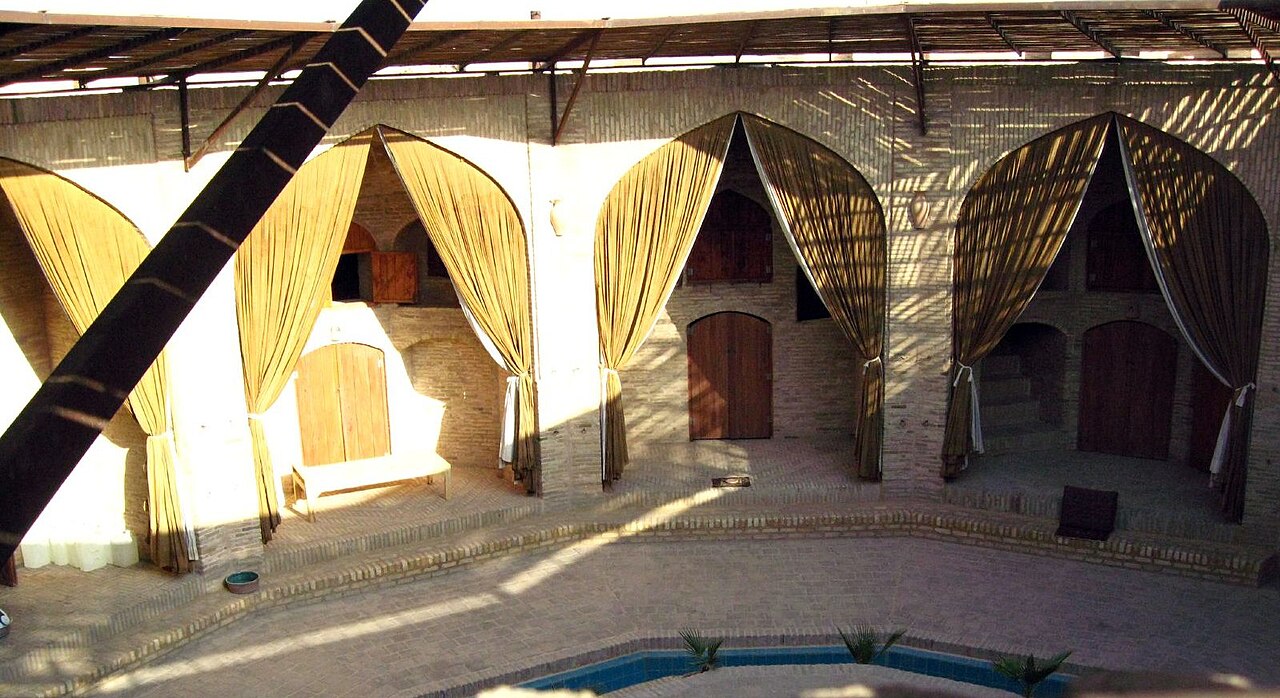
The Silk Road left Iran a legacy of bazaars, such as the Tabriz historic bazaar, and of caravanserais spaced about a day’s journey apart along the old roads. In 2023 UNESCO listed 54 of them together as “The Persian Caravanserai”; our page on Persian caravanserais describes them, and you can still stay at some, such as the one at Maranjab near Kashan. Trade with China itself is explored further on our page on Iran and China through history, and the goods Iran sent west on our page on the history of Persian carpets.
- c. 500 BCE Achaemenid Royal Road from Sardis to Susa
- c. 126 BCE Zhang Qian reports on Parthia (Anxi)
- 97 CE Gan Ying reaches the Persian Gulf
- c. 552 Silkworms smuggled to Byzantium
- 7th–8th c. Sasanian exiles at the Tang court; Sogdian trade at its height
- 1270s–1290s Marco Polo travels through Iran
- 1619 Shah Abbas makes silk a royal monopoly
- 1622 Hormuz taken from the Portuguese
- 2023 54 Persian caravanserais inscribed by UNESCO
Persian words from this page
| جاده ابریشم | jâdde-ye abrisham | Silk Road |
| ابریشم | abrisham | silk |
| کاروان | kârvân | caravan |
| کاروانسرا | kârvânsarâ | caravanserai |
| رباط | robât | fortified roadside inn |
| بازرگان | bâzargân | merchant |
| بازار | bâzâr | bazaar |
Sources and further reading
- Valerie Hansen, The Silk Road: A New History, Oxford, 2012.
- Peter Frankopan, The Silk Roads: A New History of the World, 2015.
- Étienne de la Vaissière, Sogdian Traders: A History, Brill, 2005.
- Rudolph P. Matthee, The Politics of Trade in Safavid Iran: Silk for Silver, 1600–1730, Cambridge, 1999.
- UNESCO World Heritage Centre, “The Persian Caravanserai” (2023).
Want to learn Persian? Get the free Starter Pack
Get the 14-page printable Starter Pack (all 32 letters, a 7-day reading plan, 100 core words and 20 survival phrases) and a short 5-email course. Free.
More in Themes Across Iranian History (3000 BCE–today)
- A History of the Persian Language
- Zoroastrianism through the Ages
- Shi’a Islam in Iranian History
- The Jews of Iran
- The Armenians of Iran
- Christians of Iran
- The Baha’i Faith in Iran
- The Kurds in Iranian History
- Azerbaijanis in Iranian History
- The History of the Iranian Calendar
- Nowruz through History
- The Persian Garden (Pardis) through History
- Qanats: Iran’s Ancient Water Tunnels
- A History of Persian Carpets
- A History of Persian Architecture
- A History of Persian Painting
- A History of Persian Music
- Science in Iranian History
- Women in Iranian History
- Iran and the Silk Road
- Iran and China through History
- Iran and India through History
- Iran and Greece: Perceptions and Exchanges
- Persia and Rome: Seven Centuries of Rivalry
- Iran and the Ottoman Empire
- Iran and Russia through History
- Iran and Britain through History
- Iran and the United States
- How Iran’s Borders Changed
- The Capitals of Iran through History
- Coins of Iran through History: From the Daric to the Rial
- Flags and Symbols of Iran through History
- Myth and History in the Shahnameh: The Epic’s Kings and the Real Past
- Timeline of Iranian History: Key Dates from Elam to Today
- A History of Persian Cuisine: From Royal Banquets to Chelow Kabab
- A History of Persian Poetry: From Rudaki to Forough
- Wine in Iranian History: From Hajji Firuz to Hafez and Prohibition
- Sports in Iranian History: Polo, the Zurkhaneh and Wrestling
- List of Iranian Dynasties and Rulers