Farid al-Din Attar (c. 1145 – c. 1221) was a Persian poet and pharmacist of Nishapur and one of the three great masters of Sufi poetry in Persian, between Sana’i before him and Rumi after him. He is best known for The Conference of the Birds, an allegory of the soul’s journey to God, but he also wrote several other long poems and a prose book of Sufi saints’ lives, and tradition says he was killed when the Mongols sacked Nishapur in 1221.
| Full name | Abu Hamid Muhammad ibn Ibrahim, called Farid al-Din; pen name Attar |
|---|---|
| Lived | c. 1145 – c. 1221, Nishapur, Khorasan (both dates approximate) |
| Profession | Druggist and perfumer (عطار, attâr) |
| Main works | Mantiq al-Tayr (The Conference of the Birds), Ilahi-nama, Musibat-nama, Asrar-nama, Mukhtar-nama, Tadhkirat al-Awliya, a Divan |
| Tomb | Nishapur, in a garden near the tomb of Omar Khayyam |
A poet in the pharmacy
Almost nothing about Attar’s life is certain. He did not write for princes, so he appears in no court history, and the biographies written in later centuries mix memory with legend. What his own poems tell us is that he kept a pharmacy in Nishapur, where he made up remedies and saw large numbers of patients every day, and that he wrote much of his poetry there. The pen name Attar means a seller of drugs and perfumes, and he plays on it often.
His Nishapur was a city in trouble. It was sacked by the Oghuz in 1153, when Attar was a boy, rebuilt around the suburb of Shadyakh, and then fought over by Seljuk commanders, Ghurids and Khwarazmshahs. It remained a great centre of Sufism, with lodges, preachers and a long tradition of mystics going back to the ninth century.
The long poems
Attar’s reputation rests on a group of masnavis, long poems in rhyming couplets, built as frame stories that hold dozens of shorter tales.
The Conference of the Birds
In Mantiq al-Tayr (منطقالطیر), usually dated to the late twelfth century, the birds of the world gather to find their king, the Simorgh. The hoopoe leads them, and answers each bird’s excuse with a story. They cross seven valleys, from the quest to the annihilation of the self, and only thirty birds arrive, to discover that the Simorgh is themselves: in Persian si morgh means “thirty birds”. The plot, the seven valleys and the famous stories inside it, such as Shaykh San’an and the Christian girl, are told in our article on The Conference of the Birds.
The Ilahi-nama and the Musibat-nama
The Ilahi-nama, “Book of God”, has a king who asks his six sons what they most desire. They name worldly things, such as a fairy princess, magic and the elixir of alchemy, and the father answers each with stories that show the desire to be a disguised longing for something higher. The Musibat-nama, “Book of Affliction”, follows a seeker who visits forty beings, from angels and prophets to the sun, the sea and the animals, asking each for help, until he is sent back into his own soul. The Asrar-nama, “Book of Secrets”, is a shorter collection of teaching tales.

Quatrains, lyrics and a book of saints
Attar also left a Divan of lyric poems and the Mukhtar-nama, a collection of more than two thousand quatrains that he arranged himself by theme. His only prose work, the Tadhkirat al-Awliya, “Memorial of the Saints”, tells the lives and sayings of the early Sufis, from the woman mystic Rabi’a of Basra to al-Hallaj, executed in Baghdad in 922 for his words “I am the Truth”. Written in simple, vivid Persian, it became one of the main sources for how later Muslims imagined the early saints.
What is genuine
For centuries Attar was credited with dozens of books, some said to number as many as the chapters of the Quran. Modern scholarship, especially the work of the German orientalist Hellmut Ritter and the Iranian scholar Mohammad-Reza Shafiei-Kadkani, has shown that several of these, such as the Mazhar al-Aja’ib and the Jawhar al-Dhat, were written later by another poet using the same name. The list given above is the core most scholars accept.
A death and its legends
In April 1221 the Mongols took Nishapur and, in revenge for the death of Genghis Khan’s son-in-law in the siege, killed most of its inhabitants. The tradition that Attar died in this massacre, as an old man in his seventies, is old and widely repeated, though not all scholars accept it. Later storytellers added a famous anecdote of a Mongol soldier who captured him and was offered a high ransom for him; the anecdote is a teaching story about the worth of a human soul, not a record. The invasion itself is described on the page on Genghis Khan’s invasion of Iran.
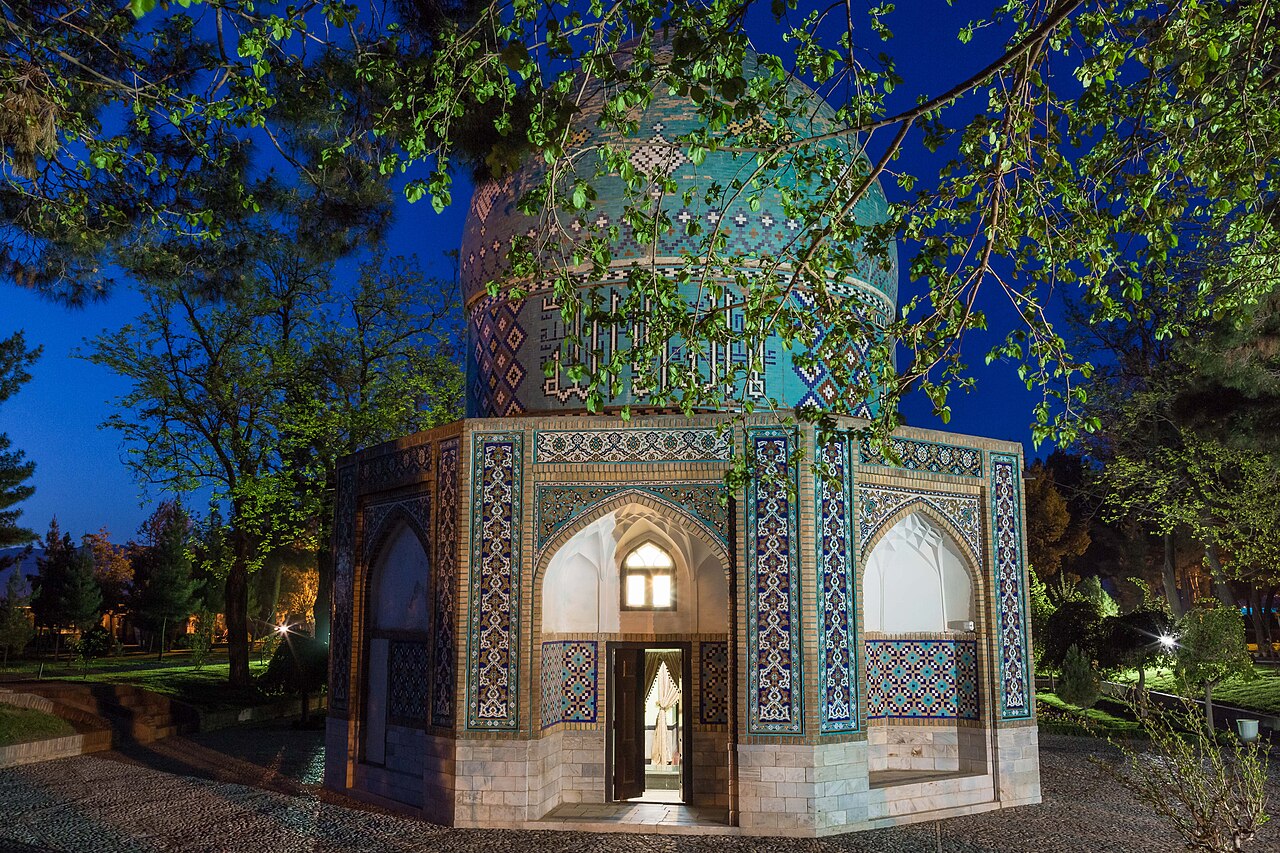
His tomb in Nishapur was rebuilt in the late fifteenth century, traditionally under the patronage of the Timurid statesman and poet Ali-Shir Navai, and restored in modern times. It stands not far from the tomb of Omar Khayyam and the grave of the painter Kamal-ol-Molk; see the page on Neyshabur.
Attar and Rumi
A story told in fifteenth-century biographies says that when the family of the young Jalal al-Din Rumi passed through Nishapur on their way west, Attar met the boy, foresaw his greatness and gave him a copy of the Asrar-nama. The dates make the meeting possible, but the story cannot be confirmed. What is certain is that Rumi admired him. A line attributed to him calls Attar the spirit and Sana’i its two eyes, and says that Rumi came after them both. Rumi’s Masnavi retells several of Attar’s stories; one of his comments on a saying of Attar is discussed in our article on Attar on poison as an antidote.
Why he matters
Attar made the long Sufi masnavi into a work of storytelling. Where Sana’i’s Hadiqat al-Haqiqa was mainly a work of instruction, Attar’s poems move through dramatic scenes, dialogues and short, often humorous tales of fools, kings and saints, held together by a single journey. That model passed to Rumi and to later poets such as Jami. In translation, The Conference of the Birds has become one of the best-known Persian poems in the world, staged by Peter Brook in the 1970s and translated many times. More on the tradition he belongs to is on the page on the history of Persian poetry.
Persian words from this page
| عطار | attâr | druggist, perfumer; the poet Attar |
| منطقالطیر | Manteq ot-teyr | The Conference (literally “Speech”) of the Birds |
| سیمرغ | Simorgh | the Simorgh, king of the birds |
| سی مرغ | si morgh | thirty birds |
| هدهد | hodhod | hoopoe |
| مثنوی | masnavi | long poem in rhyming couplets |
| نیشابور | Neyshâbur | Nishapur |
Sources and further reading
- Hellmut Ritter, The Ocean of the Soul: Man, the World and God in the Stories of Farid al-Din Attar, trans. John O’Kane (Leiden, 2003).
- Attar, The Conference of the Birds, trans. Afkham Darbandi and Dick Davis (Penguin Classics, 1984).
- Attar, Muslim Saints and Mystics: Episodes from the Tadhkirat al-Auliya, trans. A. J. Arberry (London, 1966).
- Encyclopaedia Iranica, “Attar, Farid-al-Din”.
- Attar, The Ilahi-nama or Book of God, trans. John Andrew Boyle (Manchester, 1976).
Want to learn Persian? Get the free Starter Pack
Get the 14-page printable Starter Pack (all 32 letters, a 7-day reading plan, 100 core words and 20 survival phrases) and a short 5-email course. Free.
More in Ghaznavids, Seljuks and Khwarazmshahs (977–1231)
- The Ghaznavid Empire
- Mahmud of Ghazni
- The Rise of the Seljuks
- The Battle of Dandanaqan (1040)
- Tughril Beg Enters Baghdad
- Alp Arslan
- Seljuk Architecture: Tomb Towers and Caravanserais
- The Battle of Manzikert (1071)
- Malik Shah I
- The Seljuks of Kerman
- Nizam al-Mulk and the Siyasatnama
- The Seljuk Domes of Isfahan’s Jameh Mosque
- Omar Khayyam: Poet and Scientist
- Al-Ghazali
- Sana’i of Ghazni
- Hassan-i Sabbah and the Fortress of Alamut
- The Nizari Ismailis and the “Assassins” Legend
- Sultan Sanjar and the Qara Khitai
- The Battle of Qatwan (1141)
- Anvari and Seljuk Court Poetry
- Seljuk Decline and the Atabegs
- The Ghurids
- Attar of Nishapur
- Nizami Ganjavi
- The Khwarazmian Empire
- Ala al-Din Muhammad II
- The Otrar Incident (1218): How Khwarazm Provoked Genghis Khan
- Jalal al-Din Mingburnu